
speech
COTTON TEXTILE INDUSTRY — PROBLEMS & SOLUTION
Published by M. R. Pai for the Forum of Free Enterprise, "Sohrab House", 235, Dr. Dadabhai Naoroji Road, Bombay-1, and printed by H. Narayan Rao at H. R. Mohan & Co. (Press), 9-B, Cawasjee Patel Street, Bombay-1. · Bombay · 1967
13 pages
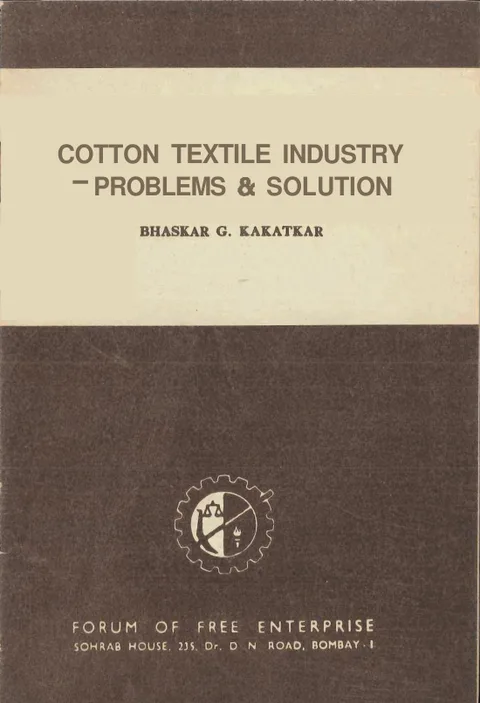
Summary
Delivered as a lecture by Bhaskar G. Kakatkar, Secretary-General of the Indian Cotton Mills Federation, under the auspices of the Forum of Free Enterprise in Bombay on 11 February 1967, and published as a pamphlet with a foreword by R. G. Saraiya dated 16 December 1966, this address surveys the structural crises confronting the Indian cotton textile industry in the mid-1960s. The foreword establishes the context starkly: cotton production reached only 55–56 lakh bales in 1965–66 against a Third Plan target of 70 lakh bales, while India simultaneously held the world’s largest acreage under cotton — 20 million acres — yet achieved the lowest yield per acre, at 110–120 lbs against a world average of over 300 lbs.
Kakatkar organises his argument around the industry’s dependence on three interlocking failures: the cotton supply crisis, destructive price-control policy, and unequal competitive treatment across mill, powerloom, and handloom sectors. On cotton supply, he quantifies the gap precisely: the industry requires 70 lakh bales to maintain per capita cloth availability of 15–16 yards, but 1966–67 production was expected to reach only 55 lakh bales. Rather than directing resources toward raising per-acre yields — which Federation-run trials showed could be improved by 50–100 per cent on irrigated land, with 32 lakh irrigated acres capable of yielding 16 lakh additional bales at an input cost of Rs. 200 per acre — the Government had instead abolished the Indian Central Cotton Committee (on the advice of two unnamed American consultants whose report was never published) and was planning new spinning mills to share an already scarce raw material. On price controls, Kakatkar demonstrates their futility through a simple price series: the ceiling for Moglai Jarilla Fine cotton rose from Rs. 820 in 1961–62 to Rs. 947, Rs. 1,022, and Rs. 1,070 by 1966–67, each ceiling breached in turn. Mills were openly paying 14–50 per cent above official ceilings. He calls for abolition of ceiling prices, arguing they serve only to formalise black-market premiums.
On the three-sector imbalance, Kakatkar presents detailed excise duty figures that illustrate the structural unfairness: a mill pays Rs. 3,300–11,000 per loom per year depending on cloth category, while a comparable powerloom pays only Rs. 25–150. The powerloom sector had grown from one-fifth of total production in 1951 to 40 per cent by 1965 without providing better employment conditions or export capacity. On rehabilitation, the American textile industry, 1.5 times India’s size, was investing Rs. 500 crores per year in capital equipment; Japan, of comparable size, Rs. 200 crores; India’s mills were spending only Rs. 50 crores annually, largely through borrowing. The address ends with a vision of India becoming the world’s leading cotton textile exporter if cotton yields are prioritised — a prospect made plausible by India’s unique position as one of the few major textile exporters with home-grown cotton.
Key points
-
India held the world’s largest cotton acreage (20 million acres) in 1965–66 but the lowest yield per acre (110–120 lbs versus a world average of over 300 lbs), making yield improvement — not new capacity — the correct policy priority.
-
The Third Plan cotton target of 70 lakh bales went unmet; actual production was 55–56 lakh bales, leaving a shortfall of 15 lakh bales against the industry’s minimum requirement.
-
Federation-run trials showed that irrigated cotton yields could be raised 50–100 per cent with an input of Rs. 200 per acre, sufficient to close the entire shortfall from the 32 lakh acres already under irrigation.
-
Ceiling price controls were demonstrably ineffective: the ceiling for Moglai Jarilla Fine cotton rose from Rs. 820 (1961–62) to Rs. 1,070 (1966–67), with mills openly paying 14–50 per cent above ceilings throughout — Kakatkar calls for their complete abolition.
-
The Government abolished the Indian Central Cotton Committee — responsible for the varietal improvements that had doubled cotton quality — on the advice of two American experts whose report was never released, replacing it with a body that had not met even once nine months after formation.
-
Mill excise duties ranged from Rs. 3,300 to Rs. 11,000 per loom per year; powerloom duties ranged from Rs. 25 to Rs. 150 — a ratio of up to one-hundredth — creating structural unfair competition that drove the decentralised sector from 20 per cent to 40 per cent of output between 1951 and 1965.
-
Indian mill workers had the highest textile wage relative to average industrial wage in the world (105 per cent) yet the lowest labour productivity — 2,864 kg yarn per worker per year versus 23,490 kg in the USA — due to outdated machinery and insufficient rationalisation.
-
India spent only Rs. 50 crores per year on mill rehabilitation against Rs. 500 crores by the American industry (1.5 times India’s size) and Rs. 200 crores by Japan (roughly equal size), a disparity Kakatkar argues will prove fatal to export competitiveness.
Metadata and summary are AI-extracted from the source PDF and reviewed for editorial accuracy. The original work is available via the Read PDF tab above (where present); paragraph-level citation inside the PDF is deferred to a future engagement.
People in this work
Related across the archive
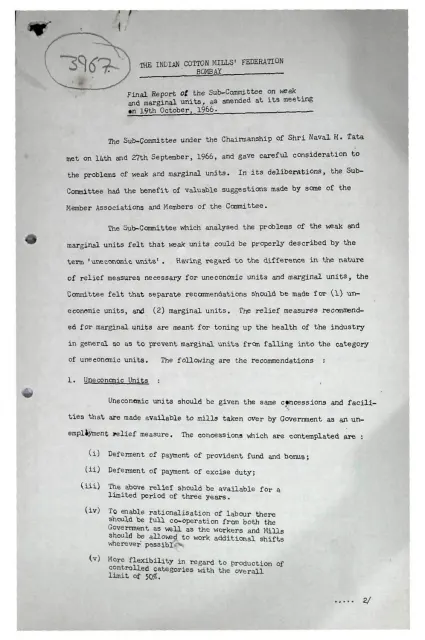 Primary workFinal Report of the Sub-Committee on weak and marginal units, as amended at its meeting on 19th October, 1966.
 Primary workTHE ECONOMIC IMPLICATIONS OF THE UNION BUDGET FOR 1966-67
 Primary workImpact of Taxation on Small & Medium Scale Industries
 ExcerptHas Private Enterprise Failed?
 ExcerptThe Missed Opportunity