occasional paper · statement of principles
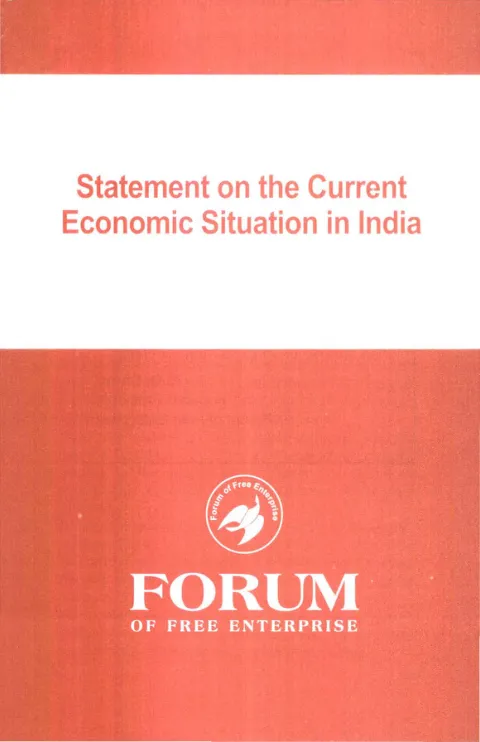
Statement on the Current Economic Situation in India
Published by S. S. Bhandare for Forum of Free Enterprise, Peninsula House, 2nd Floor, 235, Dr. D. N. Road, Mumbai 400001, and printed by S. V. Limaye at India Printing Works, India Printing House, 42 G. D. Ambekar Marg, Wadala, Mumbai 400 031. · Mumbai · 2019
20 pages
Statement on the Current Economic Situation in India
Summary
Published in September 2019 by the Forum of Free Enterprise, this short booklet is an institutional position paper addressed to Parliament and the wider public on India’s then-slowing economy. The Forum frames the moment — a six-year-low GDP growth rate of 5%, the stated ambition of a $5 trillion economy by 2024, and a million young people entering the workforce each month — as a 1991-style opportunity to push through structural reform. It calls for a special session of Parliament that listens to industry and agriculture and commits to a higher growth trajectory of 8–9% sustained over seven years, arguing that with an unstable external environment the answers must be found internally.
The core of the statement is a numbered list of eight critical issues on the relationship between government and the private sector: (1) the role of government should be confined to rules of the game and law and order, with major spending channelled through the private sector and the release of an estimated Rs 12 lakh crore of undisputed government dues; (2) loss-making public sector units such as Air India, BSNL and MTNL must be disinvested, banks and insurance companies privatised, with divestment proceeds used to retire public debt; (3) vacant public land — including parcels held by the Mumbai Port Trust — should be auctioned in a sequential, transparent manner; (4) punitive language by officials, including talk of creating “fear” around traffic penalties, must be replaced by progressive penalties and a collaborative tone protective of personal liberties and free expression; (5) the National Skill Development Corporation’s target of 500 million workers must be reinstated and monitored, given that only about 12% of trainees have found steady jobs; (6) ease of doing business needs ground-truth assessment alongside the World Bank index, with a clear roadmap for foreign direct investment and lower overall tax costs; (7) state and central governments must offer long-term policy clarity rather than overturning predecessors’ contracts; and (8) entrepreneurs should be supported as the Prime Minister’s “Growth Ambassadors.”
A closing section on industry-specific measures presses for revival of real estate and construction through lower GST and stamp duty, stability in telecom, textile, auto and power, recognition of India’s poor R&D base (a single Chinese university, Tsinghua, is said to produce more IP than all of India), and urgent labour reforms — including measures to lift female labour-force participation from 22% (against 43% in China). The booklet concludes that with bold reform a virtuous cycle of growth can lift India to a level “which could not have been foreseen a decade ago,” and is sponsored by the Shailesh Kapadia Memorial Trust in memory of the late chartered accountant Shailesh Kapadia (1949–1988). It opens with a Shroff epigraph on the perennity of free enterprise and closes with Eugene Black’s line that private enterprise must be accepted “not as a necessary evil, but as an affirmative good.”
Key points
-
Forum of Free Enterprise treats the 2019 slow-down (GDP at a six-year low of 5%) as a 1991-style window for structural reform, and urges a special session of Parliament dedicated to it.
-
Argues that government should confine itself to rules of the game and law and order, channelling major spending through the private sector and releasing an estimated Rs 12 lakh crore of undisputed government dues.
-
Calls for clear disinvestment and privatisation of Air India, BSNL, MTNL, nationalised banks and insurance companies, with proceeds used to retire public debt rather than fund recurring bailouts (Rs 300,000 crore injected into PSU banks over five years against NPAs of over Rs 800,000 crore).
-
Demands transparent, time-bound auction of vacant public land (e.g. Mumbai Port Trust parcels) to private development as a tool to lower real-estate prices and stimulate construction.
-
Pushes back on the rhetoric of “fear” in penalty regimes, insisting that personal liberties and freedom of expression are preconditions of a sustainable economy.
-
Identifies skilling, ease of doing business, foreign direct investment clarity, lower tax burden, predictable policy across states, and a stronger R&D base as preconditions for an 8–9% growth trajectory sustained over seven years.
-
Highlights female labour-force participation (~22% vs China’s 43%) as both a source of depressed incomes and a moral issue requiring labour reform.
-
Booklet is published in memory of chartered accountant Shailesh Kapadia (1949–1988) by his memorial trust, and is bookended by epigraphs from A. D. Shroff and former World Bank president Eugene Black.
Generated by the v1.5 extraction pipeline. Awaiting editorial review.
Metadata and summary are AI-extracted from the source PDF and reviewed for editorial accuracy. The original work is available via the Read PDF tab above (where present); paragraph-level citation inside the PDF is deferred to a future engagement.