speech · memorial lecture
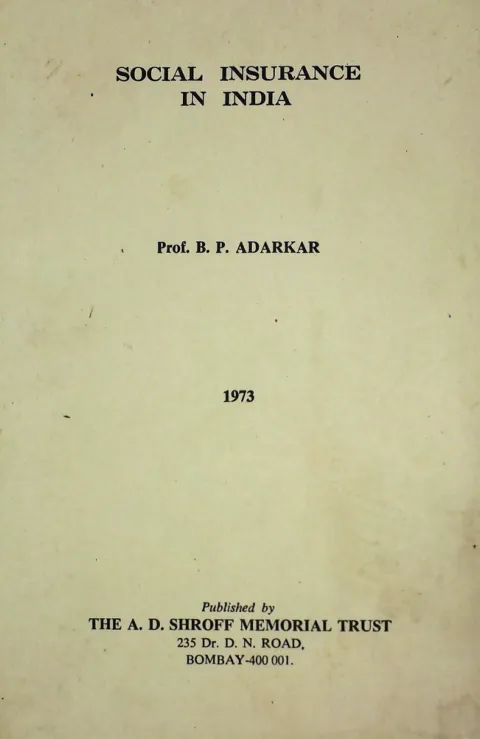
SOCIAL INSURANCE IN INDIA
Published by THE A. D. SHROFF MEMORIAL TRUST, 235 Dr. D. N. ROAD, BOMBAY-400 001. Published by M. R. Pai on behalf of The A. D. Shroff Memorial Trust, 235, Dr. Dadabhai Naoroji Road, Bombay 1, and Printed by Michael Andrades at The Bombay Chronicle Press, Sayed Abdulla Brelvi Road, Fort, Bombay-400 001. · Bombay · 1973
37 pages
Part of A. D. Shroff Memorial Lecture
SOCIAL INSURANCE IN INDIA
By Prof. B. P. ADARKAR
Summary
Delivered on 22 June 1973 as the A. D. Shroff Memorial Lecture on Insurance, this is Prof. B. P. Adarkar’s retrospective on the social insurance system whose foundations he himself laid in 1944 with his Report on Health Insurance — the document Sardar Patel famously dubbed the work of the ‘chhota Beveridge.’ Adarkar opens with a striking personal grievance: that the Indian ‘Steel Frame’ bureaucracy effectively ejected him from his own scheme, terminated his contract in 1946, and similarly drove out his successor Dr. C. L. Katial in 1953 — a pattern he generalises into his ‘favourite dictum that In India, it is not Science but Nescience that rules.’
The rendered chapters define the scope of social insurance (drawing on Beveridge’s ‘Five Giants’ and ILO doctrine), distinguish it from social assistance, and chart the progress of Indian schemes since 1952. Adarkar walks through the Employees’ State Insurance Scheme (ESIS), the Employees’ Provident Fund (EPF), the Coal Mines and Assam Tea Plantations Provident Fund Schemes, and lay-off/retrenchment compensation, with detailed statistics on coverage growth — ESIS alone now serving 16.7 million beneficiaries. He then frames the progress as three phases (Initial Planning 1942–48, Structural Foundation 1948–52, Expansion since 1952) and reviews three major investigations: the V. K. R. Menon Study Group (1957–58), the C. R. Pattabhi Raman ESI Review Committee (1963–66), and the P. B. Gajendragadkar National Commission on Labour (1969).
The rendered pages end inside Chapter IV’s appraisal of ESIS, where Adarkar levels sharp criticisms: the ESI Corporation is ‘over-administered and underfinanced by the Central Government,’ the board is bloated by State-wise representation, employees and employers are under-represented despite paying for most of the scheme, and — most galling to him — the Centre, after 1953, makes no contribution of any kind to the ESI Fund, even as it preaches socialism and a ‘socialistic pattern of society.’ The chunk closes mid-argument as he turns to the contribution structure.
Key points
-
Adarkar designed the original 1944 Indian health insurance scheme and was nicknamed the ‘chhota Beveridge’ by Sardar Patel; he treats this lecture as both a memorial and a settling of accounts.
-
He argues social insurance is not a luxury India cannot afford — quoting Beveridge that ‘the poorer you are, the more you need it’ — and that piecewise schemes can later be welded into a Beveridge-style comprehensive plan.
-
Detailed statistics document the growth of ESIS (from 120,000 employees in Delhi and Kanpur in 1952 to 4.59 million covered and 16.7 million beneficiaries by 31.3.1972) and the EPF (from 1.2 million to 5.7 million subscribers).
-
He periodises Indian social insurance into three phases — Initial Planning (1942–48), Structural Foundation (1948–52), Expansion (1952 onward) — anchored to specific Acts and committees.
-
He summarises three major investigative committees: the V. K. R. Menon Study Group (1957–58) recommending unification of ESI and EPF, the C. R. Pattabhi Raman ESI Review Committee (1963–66) with 176 recommendations, and the P. B. Gajendragadkar National Commission on Labour (1969).
-
The appraisal of ESIS faults the Corporation as ‘over-administered and underfinanced’ by the Centre, bloated by State-wise representation, and dominated by officials while employees and employers underwrite the scheme.
-
Adarkar reserves his sharpest criticism for the Central Government’s withdrawal of all contributions to ESI after 1953, contrasting this with its rhetoric of socialism and a ‘socialistic pattern of society.’
-
A recurring polemical thread is the failure to give the expert his ‘rightful place,’ replaced by ‘instant government’ from dilettante officials advising ‘half-educated Ministers’ — a planning-state critique grounded in personal experience.
Generated by the v1.5 extraction pipeline. Awaiting editorial review.
Metadata and summary are AI-extracted from the source PDF and reviewed for editorial accuracy. The original work is available via the Read PDF tab above (where present); paragraph-level citation inside the PDF is deferred to a future engagement.