speech
RISING PRICES, BLACK MONEY AND DEMONETISATION
Published by M. R. PAI for the Forum of Free Enterprise, 3rd Floor, 235, Dr D N Road, Bombay-400 001, and printed by H. NARAYAN RAO at H. R. MOHAN & CO., (Press), 9-B, Cowasji Patel Street. Bombay-400 001. · Bombay · 1973
12 pages
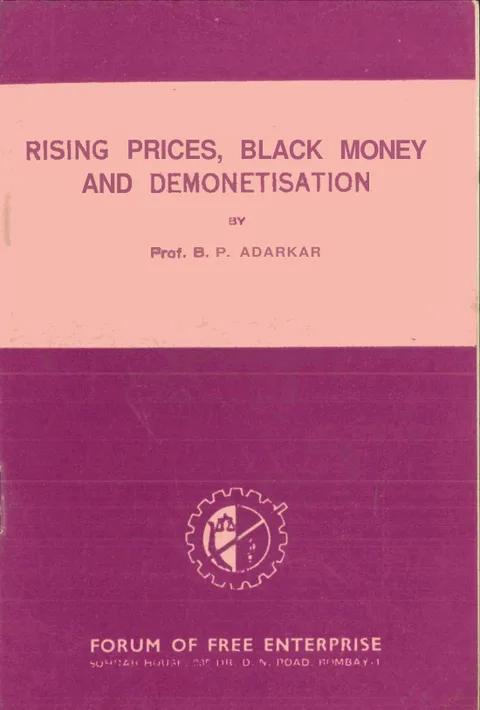
RISING PRICES, BLACK MONEY AND DEMONETISATION
By Prof. B. P. ADARKAR
Summary
Prof. B. P. Adarkar — formerly Economic Adviser in the Ministries of Labour, Finance and External Affairs and later Minister at the Indian Embassy in Bonn — opens this 1973 pamphlet with a deliberately provocative summary of his conclusion: rising prices have not caused black money, black money has not caused rising prices, and demonetisation is no remedy for either. The address, delivered to the Forum of Free Enterprise on 3 September 1973, is structured around three sections that take up each phenomenon in turn. Drawing on the Wanchoo Committee report on Direct Taxes and Black Money, he reads the Government’s habit of blaming hoarders, smugglers, tax-evaders and droughts as a way of dodging its own responsibility for deficit financing, profligate Plan expenditure, the wheat and rice takeover misadventure, the Permit Raj of licences and controls, and a tax structure whose 97.75 per cent marginal rate makes evasion almost rational.
The second section turns to black money itself. Adarkar carefully distinguishes black money — currency held outside the banking system to finance the parallel economy — from black wealth, the land, gold, jewellery, benami deposits and housing into which concealed income has already been converted. He argues that this distinction is fatal to the demonetisation case: by the time a freeze on 100-rupee notes takes effect, the real holders have long since switched into assets, and middle-class people holding rupee notes for ordinary purposes end up bearing the cost. Citing the Wanchoo Committee’s estimates of black income at Rs. 2,350–3,080 crores and noting that the Committee’s confidential demonetisation recommendation in its Interim Report was deliberately not pursued in its Final Report, he warns that a sudden withdrawal of nearly half the rupee currency would damage confidence in the Indian currency abroad and shake the banking system at home.
The third section lays out Adarkar’s positive programme. Stop deficit financing absolutely. Drastically reduce income tax to a maximum of 75 per cent, with no adjustment at the lower end, and raise the exemption limit to Rs. 7,500 or Rs. 10,600 — citing France’s post-war decision to cut its income tax below 33⅓ per cent, after which evasion and black money ‘almost disappeared.’ Abolish the Wealth Tax. Dismantle the licensing and controls regime. Demand surrender of 90 per cent of black money for white money by 1 April 1974, after which undeclared assets would be confiscated, citing President Marcos’s anti-corruption drive in the Philippines as a precedent. Wind up the entire Five-Year-Plan apparatus, restricting the State to ‘main nation-building functions’ such as transport, technical education, population control and aerial navigation, and let private enterprise and the public sector alike grow freely. The pamphlet is bracketed by two marginalia: Eugene Black on accepting private enterprise as ‘an affirmative good,’ and the late A. D. Shroff’s aphorism that ‘Free Enterprise was born with man and shall survive as long as man survives.‘
Key points
-
Thesis: rising prices, black money and demonetisation are three distinct problems with distinct causes and remedies — collapsing them produces bad policy.
-
Deficit financing — Rs. 1,278 crores in 1972–73 alone — is named the ‘most potent cause’ of Indian inflation, with the wheat and rice takeovers, the Permit Raj and high punitive taxation as compounding factors.
-
The Wanchoo Committee on Direct Taxes and Black Money diagnosed four arms of policy (prevention, recovery, tax assessment, evasion) but had its central demonetisation recommendation, confidential to the Interim Report, dropped from the Final Report.
-
A 97.75% top marginal income-tax rate, Adarkar argues, makes the net profit on concealment ‘as much as 4,300 per cent of the after-tax income’ — France’s post-war cut to below 33⅓% made evasion and black money ‘almost disappear’ without revenue loss.
-
The wheat takeover collected only 4.3 of 8.5 million tonnes — Adarkar warns the Government not to ‘rush into another bungle over the Rice trade.’
-
Black money (currency funding the parallel economy) is conceptually separate from black wealth (assets purchased with concealed income); demonetisation only attacks the former, while the latter has already been moved into land, gold, jewellery and benami deposits.
-
Demonetising 100-rupee notes would be ‘a wild hit at the bull’s eye’ that mostly catches middle-class holders, since serious black-money holders have already converted into smaller-denomination notes and assets; sudden withdrawal of nearly half the rupee currency risks a confidence and banking crisis.
-
Adarkar’s positive programme: stop deficit financing; cap income tax at 75% with a higher exemption limit; abolish the Wealth Tax; dismantle licensing and controls; demand a 90% black-money surrender by 1 April 1974; phase out Five-Year Plans; restrict the State to nation-building infrastructure functions.
Generated by the v1.5 extraction pipeline. Awaiting editorial review.
Metadata and summary are AI-extracted from the source PDF and reviewed for editorial accuracy. The original work is available via the Read PDF tab above (where present); paragraph-level citation inside the PDF is deferred to a future engagement.