essay
ROLE OF PRIVATE ENTERPRISE
Some Unjustified Charges
THE FORUM OF FREE ENTERPRISE, "Sohrab House", 235, Dr. Dadabhai Naoroji Road, BOMBAY 1. · Bombay · 1956
4 pages
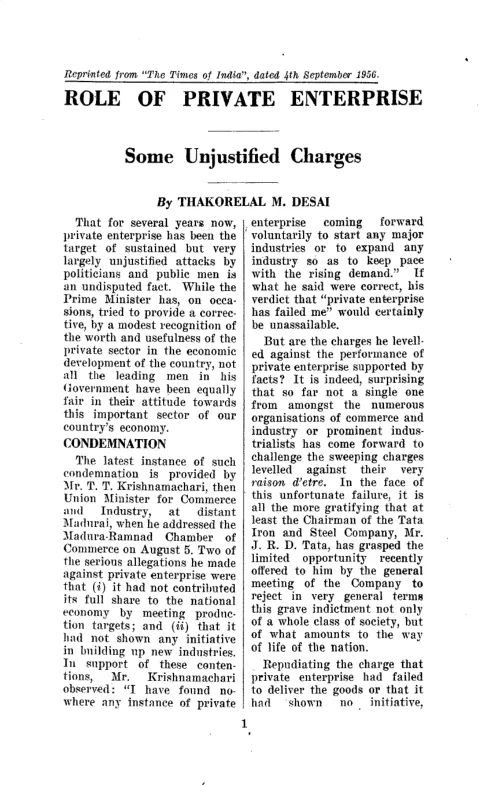
ROLE OF PRIVATE ENTERPRISE
By THAKORELAL M. DESAI
Summary
Thakorelal M. Desai’s article, reprinted from The Times of India of 4 September 1956 and circulated as a pamphlet by the Forum of Free Enterprise, mounts a point-by-point defence of Indian private enterprise against what Desai describes as a sustained but largely unjustified campaign by politicians and public men. The immediate provocation is a speech delivered by T. T. Krishnamachari, then Union Minister for Commerce and Industry, at the Madura-Ramnad Chamber of Commerce on 5 August 1956. Krishnamachari had levelled two allegations: that private enterprise had failed to meet the production targets set under the First Plan, and that it had shown no initiative in building new industries. Desai notes that J. R. D. Tata, as Chairman of the Tata Iron and Steel Company, had already rejected the charge in general terms, but argues that a documented rejoinder grounded in fact has become indispensable.
The core of the article is an inventory of the actual record. Desai lists sectors — bicycles, grinding wheels, non-ferrous alloys, ship-building, automobiles, machine tools, chemicals, belting, abrasives, ball-bearings and piston rings — and argues that almost every new line of industrial development absorbed by the First Plan grew out of schemes private enterprise had itself formulated; the Government’s role was to approve and accept what industry had already conceived. He invokes the Planning Commission’s own admission that investment in the public sector fell short by nearly 40 per cent of its target, with only Rs. 47 crores invested against an expected Rs. 94 crores, while a substantial number of industries — bicycles, caustic soda, paper, vegetable oils, electric transformers — either fulfilled or over-fulfilled their targets in the private sector. He cites the World Bank Mission’s finding that Indian business is “definitely expansion minded”, and walks through the long history in which the Tariff Commission and Government repeatedly rejected Tata Iron and Steel Company’s proposals to expand capacity between 1949 and 1953, and ultimately turned down its offer to build the Durgapur plant.
The pamphlet’s closing argument shifts from defence to indictment of the policy environment. Desai insists that the apparent under-performance of private enterprise cannot be separated from a regime of taxation, restrictions on returns to investors, and discretionary controls that he says deter risk capital. He calls upon the Forum of Free Enterprise to prepare and publish a detailed, documented rejoinder educating public opinion on the fundamentals of free enterprise, and ends with a rhetorical flourish that captures the whole essay’s frame: that blaming industry for failing to deliver while binding it in restrictions is “like tying up a man in knots and blaming him for not sprinting”.
Key points
-
Article reprinted from The Times of India, 4 September 1956, and circulated as a Forum of Free Enterprise pamphlet from Sohrab House, Bombay.
-
Direct rebuttal to T. T. Krishnamachari’s 5 August 1956 speech at the Madura-Ramnad Chamber of Commerce, which alleged that private enterprise had not met First Plan production targets and had shown no initiative in starting new industries.
-
Cites J. R. D. Tata’s recent TISCO chairman’s address as a first, generalised rejection of the indictment, and laments that no other industry body had yet stepped forward to defend its raison d’etre.
-
Lists specific industrial sectors — bicycles, grinding wheels, non-ferrous alloys, ship-building, automobiles, machine tools, chemicals, belting, abrasives, ball-bearings, piston rings — to argue that First Plan industrial development originated in schemes private enterprise had already formulated.
-
Invokes the Planning Commission’s own report showing public-sector investment fell nearly 40 per cent short of target (Rs. 47 crores against Rs. 94 crores expected), while private-sector targets in many industries were fulfilled or over-fulfilled.
-
Quotes the World Bank Mission’s finding that Indian private business is “definitely expansion minded” and that a substantial increase in investment is currently taking place.
-
Traces the Tariff Commission’s repeated rejection of Tata Iron and Steel Company expansion proposals from 1949 through 1953, and the Government’s later refusal to permit private enterprise to establish the Durgapur steel plant.
-
Calls on the Forum of Free Enterprise to issue a documented rejoinder educating public opinion on the fundamentals of free enterprise, and frames the underlying complaint as one of regulatory and fiscal constraint rather than entrepreneurial failure.
Generated by the v1.5 extraction pipeline. Awaiting editorial review.
Metadata and summary are AI-extracted from the source PDF and reviewed for editorial accuracy. The original work is available via the Read PDF tab above (where present); paragraph-level citation inside the PDF is deferred to a future engagement.