speech
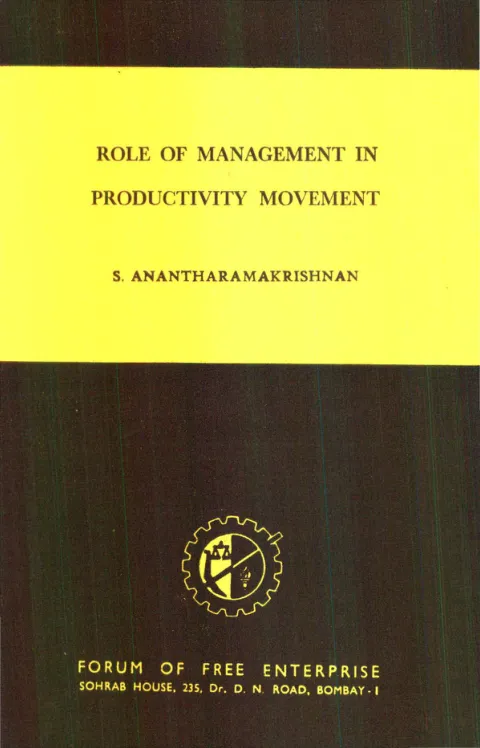
ROLE OF MANAGEMENT IN PRODUCTIVITY MOVEMENT
Published by M. R. Pai, for Forum of Free Enterprise, "Sohrab House," 235, Dr. Dadabhai Naoroji Road, Bombay 1, and printed by S. Krishnamoorthy at Western Printers & Publishers (Prop. K. S. Mistry), 15/23, Hamam Street, Bombay 1. · Bombay · 1960
15 pages
ROLE OF MANAGEMENT IN PRODUCTIVITY MOVEMENT
By S. ANANTHARAMAKRISHNAN
Summary
S. Anantharamakrishnan’s pamphlet reproduces the text of a speech delivered in Madras under the auspices of the Madras Productivity Council on June 28, 1960, and reissued by the Forum of Free Enterprise. He frames productivity as a national-development imperative: with capital, foreign exchange, plant, and trained manpower all in acutely short supply, and the country’s population projected at 527 million by 1971, India cannot afford to multiply plants before extracting the maximum output from those already running. Productivity, he insists, is no longer ‘ivory-tower speculation’ but a ‘new way of life’ in industry.
The core argument is that responsibility for the productivity drive sits with three parties — Government, employers, and workers — but the operative burden falls on management. Anantharamakrishnan rejects the common reflex of equating productivity with labour productivity alone, calling it ‘basically wrong’. He lays out seven cardinal requirements of modern industrial management — scientific methods, productivity techniques, good industrial relations, sound personnel policy, effective communication, fair sharing of productivity gains, and industrial research — and devotes successive sections to each. Management, he argues, is no longer an inherited family interest but a profession that must be taught and learnt; supervisory and middle-management training are the structural backbone of any productivity drive.
On industrial relations he leans heavily on documents from the International Confederation of Free Trade Unions and ILO expert committees: workers must be assured a share of productivity gains — through higher wages, lower prices, shorter hours or better conditions — and the precise form is a matter for collective bargaining. He acknowledges that India’s ‘multiplicity of trade unions in one industry’ is a ‘bane’ to joint consultation, and points to the United Kingdom’s last decade as a hopeful counter-example. The booklet closes with the formulation that productivity becomes ‘a measure of managerial efficiency’, and the publication is bookended by epigraphs from Eugene Black of the World Bank (‘People must come to accept private enterprise not as a necessary evil, but as an affirmative good’) and A. D. Shroff (‘Free Enterprise was born with man and shall survive as long as man survives’) — Forum of Free Enterprise framing that locates the speech within its broader liberal-economic agenda.
Key points
-
Productivity Movement in India is only two years old (1960) and is positioned as an instrument of national development at a moment of capital, foreign-exchange and manpower scarcity.
-
Cites Planning Commission estimate of 1.91% annual population growth and a projected 527 million Indians by 1971 to argue against expanding plant before fully utilising existing capacity.
-
Rejects the equation of productivity with labour productivity alone — calls focusing ‘all attention on the worker’ basically wrong and shifts the spotlight onto managerial competence.
-
Enumerates seven cardinal requirements of modern industrial management: scientific methods, productivity techniques, industrial relations, personnel policy, communication, sharing of gains, and research.
-
Argues that management has shifted from an inherited family interest to a learned profession requiring formal training, with middle-management and supervisors as ‘the backbone of the industry’.
-
On sharing of productivity gains, defers to ILO expert-committee reasoning that the share can take the form of higher wages, lower prices, shorter hours or better working conditions — to be settled by collective bargaining.
-
Diagnoses India’s ‘multiplicity of trade unions in one industry’ as the principal bane of joint consultation, while invoking the United Kingdom’s last ten years as evidence that co-operation can work.
-
Closes by reframing productivity as ‘a measure of managerial efficiency’, and the Forum of Free Enterprise brackets the speech with Eugene Black and A. D. Shroff epigraphs defending private enterprise.
Generated by the v1.5 extraction pipeline. Awaiting editorial review.
Metadata and summary are AI-extracted from the source PDF and reviewed for editorial accuracy. The original work is available via the Read PDF tab above (where present); paragraph-level citation inside the PDF is deferred to a future engagement.