
speech
PRODUCTIVITY AND QUALITY OF WORK LIFE
Forum of Free Enterprise, Piramal Mansion, 235 Dr. D. N. Road, Bombay 400 001. Published by M. R. Pai for the Forum of Free Enterprise, 235 Dr. Dadabhai Naoroji Road, Bombay-400 001, and Printed by H. Narayan Rao at H. R. Mohan & Co., 9-B Cawasji Patel Street, Bombay-400 001. · Bombay · 1979
16 pages
PRODUCTIVITY AND QUALITY OF WORK LIFE
By A. N. HAKSAR
Summary
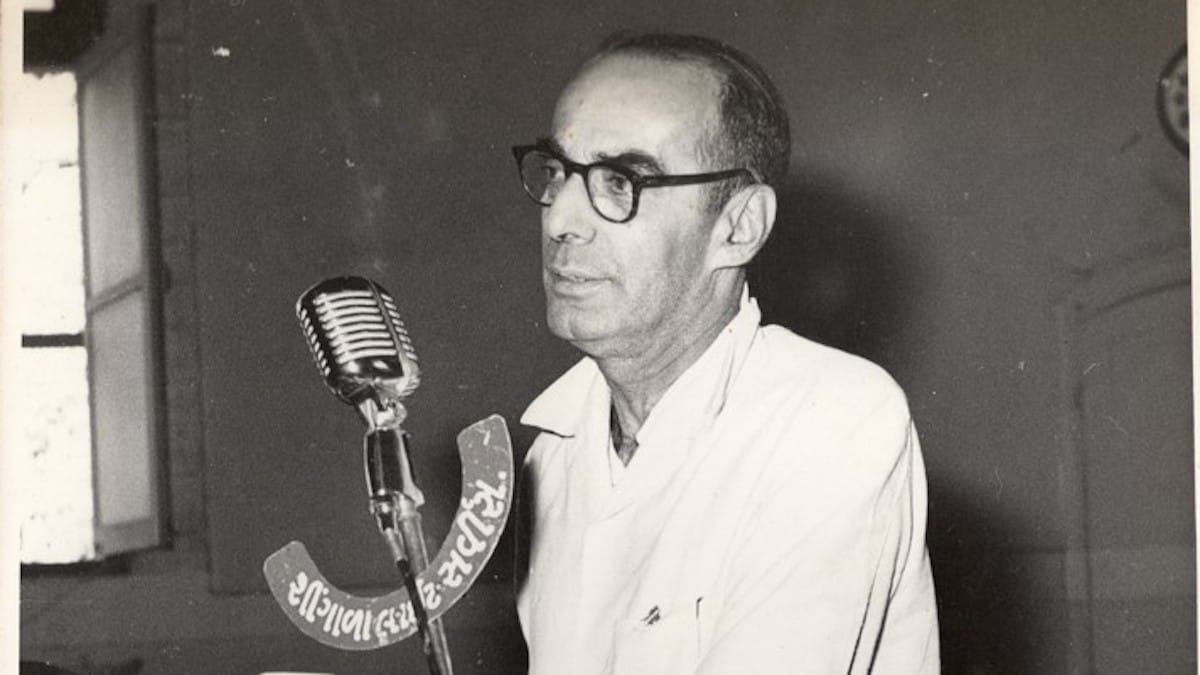
Delivered on 12 January 1979 as the Murarji Vaidya Memorial Lecture under the joint auspices of the Bombay Productivity Council and the Murarji J. Vaidya Memorial Trust, A. N. Haksar’s address — published in April 1979 as a Forum of Free Enterprise booklet — sets out to rescue the word “Productivity” from its many competing meanings and to weld it to a humane management philosophy. Haksar, then Chairman of India Tobacco Company, complains that productivity has “as many different meanings and interpretations as the word Socialism” and that departmentalised accountants, engineers, purchase managers and personnel officers each mutilate the term to suit their own discipline; the predictable result, he says, is the cost-cutting drive that “starts with a bang” and “dies with a whimper.”
At the heart of the lecture is a conceptual substitution: in place of “Productivity” Haksar proposes “Internal Profit” — the quality, quantity and cost of goods and services entirely under the company’s control — paired with “external profit” from the marketplace. To operationalise this he offers two memorable mnemonics: the seven basic resources (Real Estate, Time, Ideas, Men, Money, Machines, Materials, anagrammed as REMMITEMM) and the organisational “4 Ps” (People, Practices, Profits, Policies). Adapting Kipling’s six honest serving men, he urges that the central question of business be reframed as “WHO’S PRODUCTIVITY” — directing managerial attention to scientifically assessable and numerate measures rather than to inter-departmental blame.
From this base Haksar turns to Quality of Work Life. Drawing on Theodore W. Schultz’s “Human Wealth and Economic Growth” he argues that the unexplained residual in growth and output comes from “invisible” investment in human capital, and that humans are an organisation’s “most valuable asset.” Lincoln’s formula “of the people, by the people, for the people” is invoked to describe what organised economic activity must finally serve, and a “WORK LIFE CULTURE” of creativity, involvement, co-operation, self-growth, excellence, planning, training, meritocracy and fair reward is laid out as the pre-requisite for sustained internal profit.
The booklet is framed editorially by the Forum of Free Enterprise’s wider capitalism-defence agenda: a front-matter epigraph from Eugene Black on accepting private enterprise “as an affirmative good” and a closing epigraph from FFE founder-president A. D. Shroff that “Free Enterprise was born with man and shall survive as long as man survives.” Within those brackets Haksar’s text reads less as political polemic than as an industrialist’s attempt to give Indian management a vocabulary in which human dignity and the profit motive are not adversaries.
Key points
-
Haksar opens by arguing that the word “Productivity” is as semantically promiscuous as “Socialism” — interpreted by each manager according to where the shoe pinches.
-
He proposes replacing “Productivity” with “Internal Profit” (within-business cost/quantity/quality) as a single cohesive dimension, paired with “external profit” from the marketplace.
-
Seven basic resources are anagrammed as REMMITEMM (Real Estate, Time, Ideas, Men, Money, Machines, Materials) and coupled to an organisational “4 Ps”: People, Practices, Profits, Policies.
-
Departmentalisation, the “we/they” management-labour syndrome and isolated economy drives are identified as the chief enemies of real productivity.
-
Kipling’s six honest serving men are repurposed: only “how” survives, and the dominant question becomes “WHO’S PRODUCTIVITY” with numerate, scientifically assessable targets.
-
Quality of Work Life requires an enabling, open, meritocratic culture in which directors, managers, supervisors and labour pull in the same direction toward Profit-Growth-Survival.
-
Drawing on Theodore W. Schultz’s notion of investment in human capital, Haksar argues that humans are “an organisation’s most valuable asset” and that Indian organisations must study Indian people rather than import foreign assumptions.
-
The booklet is bookended by Forum of Free Enterprise epigraphs — Eugene Black at the front, A. D. Shroff at the back — that frame the lecture within a classical-liberal defence of private enterprise.
Generated by the v1.5 extraction pipeline. Awaiting editorial review.
Metadata and summary are AI-extracted from the source PDF and reviewed for editorial accuracy. The original work is available via the Read PDF tab above (where present); paragraph-level citation inside the PDF is deferred to a future engagement.
People in this work
Related across the archive
 Primary workROLE OF MANAGEMENT IN PRODUCTIVITY MOVEMENT
 Primary workPRINCIPLES OF A SOUND PERSONNEL POLICY
 Primary workTowards Self-Reliance and Greater Productivity
 ThePrintLiberal methods reach social justice faster than socialism: Minoo Masani
 ExcerptTHE APPLICATION OF SCIENCE AND TECHNOLOGY TO SOCIO-ECONOMIC DEVELOPMENT