edited volume · anthology
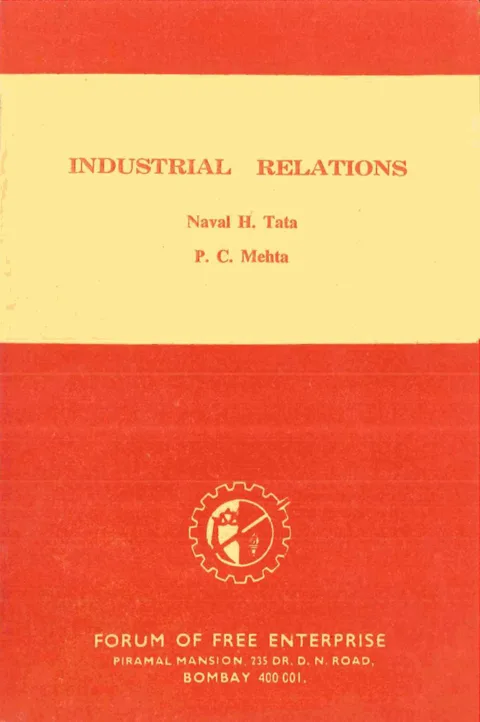
Industrial Relations
Published by M. R. PAI for the Forum of Free Enterprise, "Piramal Mansion", 235 Dr. Dadabhai Naoroji Road, Bombay-1. and printed by B. D. Nadirshaw at Bombay Chronicle Press, Sayed Abdulla Brelvi Road, Fort, Bombay-1. · Bombay · 1979
11 pages
Summary
This Forum of Free Enterprise booklet, issued in Bombay on 13 August 1979, gathers two industry-side interventions in the late-Janata-era debate on labour law and union power, plus an appendix reproducing a Financial Express report on the simultaneous bonus controversy. The opening essay is an extract from Naval H. Tata’s inaugural talk of 29 January 1979 at an ASSOCHAM workshop on the Industrial Relations Bill, framing labour-law reform as a human-rights issue and defending the Janata Government’s Bill against trade-union opposition. The second essay reproduces P. C. Mehta’s 16 April 1979 Forum lecture, ‘Democracy and Labour Movement’, arguing that industrial peace in a democracy must rest on law rather than trials of strength. The closing appendix carries the Finance Minister Charan Singh’s June 1979 case against extending bonus to railwaymen and Government departmental employees. Together the three pieces present a coordinated employer-side and free-enterprise critique of trade-union militancy, wage-productivity drift, and bonus-as-statutory-right.
Key points
-
Naval H. Tata, then President of the Employers’ Federation of India, frames the Industrial Relations Bill as a human-rights measure that protects citizens from union-led disruption of essential services such as Railways, Airlines, Dockyards and Banks.
-
Tata cites a daily wage of Rs. 25.65 for an unskilled metropolitan worker and Rs. 100 for a white-collar employee, arguing organised labour in Bombay and Calcutta is not underpaid and that absentee privileges inflate costs.
-
He invokes the Bhoothalingam Committee’s findings on wage-productivity disparity and points to Switzerland’s referendum-based union restraint and the Callaghan-Thatcher consensus in Britain as models for curbing union bargaining power.
-
P. C. Mehta, a member of the Janata Government’s Ravindra Varma Committee, defines industrial relations through two questions: the conditions under which work is done and how its proceeds are divided.
-
Mehta argues democracy is the middle position between totalitarianism and anarchy, requiring separation of legislative, judicial and executive functions and self-imposed restraint by every party involved.
-
He warns that the right to organise and bargain collectively, while fundamental, is being abused to substitute ‘trial of strength’ for ‘trial of issues’, risking a drift of democracy toward feudalism.
-
Mehta contends the organised industrial worker is already an elite compared with the unorganised landless poor, so economic growth rather than coercive redistribution is the true route to social change.
-
An appendix reproduces Finance Minister Charan Singh’s June 1979 case against extending statutory bonus to railwaymen and Government departmental employees.
Essays
Industrial Relations
By Naval H. Tata
Naval H. Tata, then President of the Employers’ Federation of India, argues that the Industrial Relations Bill before Parliament is a human-rights measure rather than an anti-labour one. He contends that unchecked direct action by trade unions in vital services — Railways, Airlines, Dockyards and Banks — inflicts social injustice on millions of uninvolved citizens, and welcomes the Bill’s attempt to identify bargaining agents and curb the proliferation of unions that has followed the ‘multiplicity of trade unions’ lacuna in existing law. Drawing on West Bengal Chief Minister Jyoti Basu’s call to employers to ‘explore all possible ways to avoid strike’ and on Dr. V. M. Dandekar’s critique of the bankmen’s strike invoking Karl Marx and social justice, Tata maintains that employers’ protest cannot be dismissed as sectional interest and that escalation of wages unlinked to productivity is counter-productive.
Tata supports his case with a quantitative survey of organised-labour costs in Bombay and Calcutta — a Rs.25.65 wage per day of an unskilled metropolitan worker, 253 working days a year after 112 days of leave and holidays, and Rs.100/- per day cost for a white-collar employee enjoying 30 days of annual leave plus festival holidays and five days a week — and asks for a hard look at wage-productivity disparities pin-pointed by the Bhoothalingam Committee. He praises Swiss trade unions for voluntarily refusing wage demands and additional management seats, points to the UK consensus emerging between Mr. Callaghan and Mrs. Thatcher that reducing union bargaining power is central to anti-inflation policy, and ends by appealing for industrial peace as a product of goodwill and meaningful mediation, not of unilateral State intervention at the behest of either side.
- Frames the Industrial Relations Bill as a human-rights issue that protects citizens, not just workers, from union-led dislocation of essential services.
- Rejects the union charge of anti-labour bias and argues the Bill plugs loopholes that employers could otherwise misuse, while curbing the multiplicity of unions.
- Cites wage figures — Rs.25.65 per unskilled day in metropolitan Bombay/Calcutta, Rs.100/- per white-collar day — to argue organised labour is not ‘sweated’ and absentee privileges raise costs by Rs.10.5 lakhs in a 1,000-worker plant.
- Endorses the Bhoothalingam Committee’s diagnosis of wage-productivity disparity and rejects the Boothalingam Report’s dismissal by trade unions.
- Holds up Switzerland’s referendum-based union restraint and the Callaghan-Thatcher convergence in the UK as comparative models that reduction of union bargaining power is central to anti-inflation policy.
- Defends the Janata Government against the union charge of betrayal, arguing a few restraints on ‘outsiders in the trade Union hierarchy’ are legitimate.
Democracy and Labour Movement
By P. C. Mehta
P. C. Mehta, a senior personnel executive and member of the Janata Government’s Ravindra Varma Committee on comprehensive industrial-relations law, argues that democracy and a robust labour movement must be tethered to the rule of law. India’s independent project — rapid economic development with social justice and a socialistic pattern of society — requires that industrial relations answer two questions: under what conditions shall work be done, and how shall its proceeds be divided. Democracy, he argues, is the middle position between totalitarian rule and anarchy; preserving it requires self-imposed restraint and the separation of legislative, judicial and executive functions. The right of organisation and collective bargaining is a fundamental right, but it is being used negatively — to substitute trial of strength for trial of issues — and risks pushing democracy itself toward feudalism by allowing one section to dominate others.
Mehta closes by warning that in an agrarian country where the unorganised landless masses live below the poverty line, the organised industrial worker is the elite of the working class, and economic growth — not coercive redistribution of poverty — is the route to social revolution. Constant vigilance, he concludes, is the price of liberty: only an awake public can prevent the nation from drifting either into totalitarianism or anarchy.
- Defines industrial relations through two questions: the conditions of work and the division of its proceeds.
- Treats democracy as the middle position between totalitarianism and anarchy, requiring separation of legislative, judicial and executive functions.
- Argues the right to organise and collectively bargain is fundamental but is being abused into ‘trial of strength’ that drifts democracy toward feudalism.
- Holds that disputes must be settled by law, adjudication or third-party arbitration — not lynch law — to avoid anarchy in modern industrial relations.
- Contends the organised industrial worker is already the elite, so privileging that section at the cost of the unorganised landless rural majority is a privileged status, not social justice.
- Closes on the Jeffersonian formula that ‘constant vigilance is the price of liberty’, warning against drift to totalitarianism or anarchy.
Appendix: The Bonus Issue
The appendix reproduces a 14 June 1979 Financial Express dispatch summarising a note from the then Finance Minister and Deputy Prime Minister Mr. Charan Singh, addressed to Prime Minister Morarji Desai, opposing the grant of bonus to railwaymen and other employees of Government departmental undertakings. Charan Singh argues that extending bonus to railwaymen would obligate it for all Central Government employees at an annual cost of about Rs.600 crores against a deficit budget of Rs.1,345 crores for 1979-80, generate inflationary deficit financing harming the poor, and unjustly reward a small organised section: of India’s 180-million working population (1971 census), only 30 million are in the wage and salary sector and only 7 million are eligible for bonus. The note also flags lower productivity of Indian Government employees (1,839 hours per year against 2,632-2,696 in Egypt and 2,156-2,192 in the U.K.), railwaymen’s existing concessions (free travel, 70 paid holidays vs. 40-45 elsewhere), and the Bhoothalingam Committee’s recommendation against bonus to railwaymen and Government departmental staff. A standard Forum disclaimer notes the views are reproduced because they have provoked country-wide discussion and are not necessarily those of the Forum of Free Enterprise.
- Reproduces Charan Singh’s June 1979 case against extending bonus to railwaymen and Government departmental employees.
- Pegs additional cost at Rs.600 crores annually against a Rs.1,345-crore 1979-80 deficit budget.
- Argues only ~7 million of India’s 180 million workers are bonus-eligible — so bonus reinforces privilege over equity.
- Cites lower Indian Government productivity (1,839 hours/year vs. UK 2,156-2,192, Egypt 2,632-2,696, USSR 2,248).
- Invokes the Bhoothalingam Committee’s standing recommendation against bonus to railwaymen and departmental employees.
Metadata and summary are AI-extracted from the source PDF and reviewed for editorial accuracy. The original work is available via the Read PDF tab above (where present); paragraph-level citation inside the PDF is deferred to a future engagement.