pamphlet
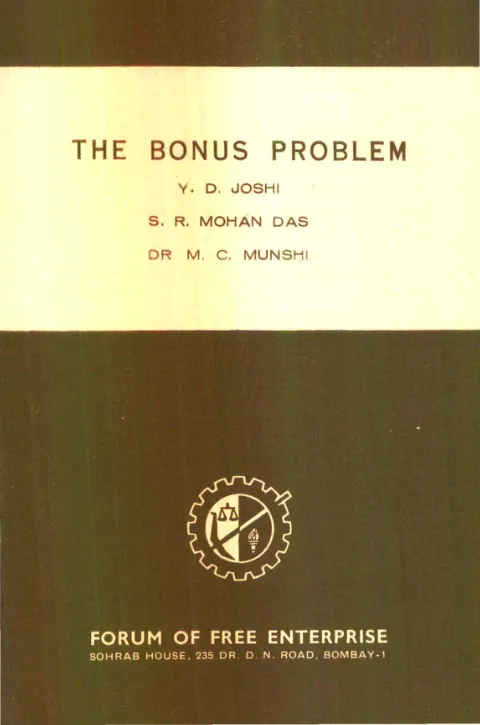
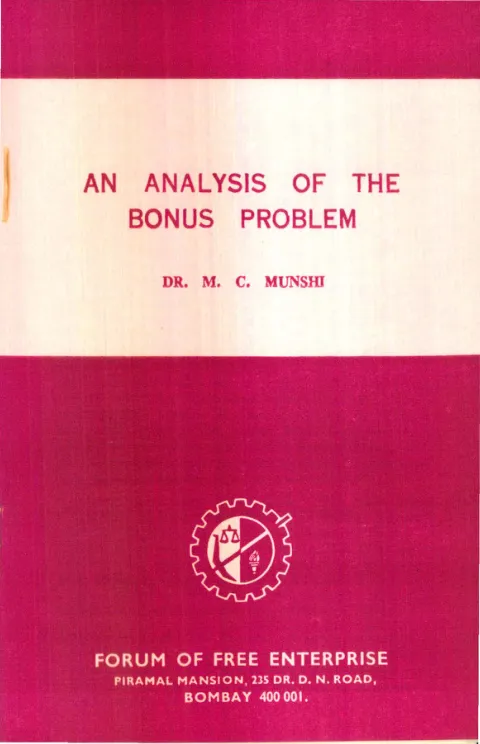
An Analysis of the Bonus Problem
Forum of Free Enterprise, Piramal Mansion, 235 Dr. D. N. Road, Bombay 400 001. · Bombay · 1977
20 pages
Summary
This Forum of Free Enterprise booklet, written by Dr. M. C. Munshi a few days before the Janata government’s September 1977 decision on bonus, traces the legal and administrative history of bonus payments in India and indicts the policy edifice that has grown around them. What began as an ex-gratia festival payment around the First World War drifted by stages into a compulsory statutory entitlement: through wartime industrial bargains, the Bombay High Court’s 1944 General Motors decision, the 1950 Labour Appellate Tribunal’s “available surplus” formula, Supreme Court obiter dicta in the 1955 Kanpur mills case, the 1962 Meher Commission, and the Payment of Bonus Act, 1965 with its 4% minimum and 20% maximum.
Munshi argues that each successive concession — raising the floor to 8.33%, jettisoning the ceiling under Section 34(3) collective bargaining, repeated tax-rebate amendments — has further unmoored bonus from any coherent economic rationale. The 1972 Bonus Review Committee under Dr. B. K. Madan ended in divided counsel and its report was never officially published; the Emergency produced a 1975 Ordinance re-pegging bonus to profits and a 1976 Amending Act allowing production-linked payments, but no universal principle was laid down. He treats the “deferred wage” thesis — popularised by labour leaders and conceded in the Janata Party’s election manifesto — as a slogan with no scientific basis, marshalling the Supreme Court, the National Commission on Labour, and the ILO’s 1948 Payment of Wages convention to argue that bonus is surplus-based, not cost-based, and that the Marxian Labour Theory of Value which underwrites alternative claims was “exploded nearly a century ago” in economic doctrine.
The polemical centre of the booklet is the consumer’s missing seat at the bargaining table. Munshi contends that available surpluses in an era of inflation and protected markets are not “adventitious gains” from the risks of enterprise but extractions from higher prices paid by consumers, who are unorganised and routinely forgotten while employers and unions divide the spoils. He warns that the organised sector covered by bonus is only about 1½ to 2 per cent of the labour force and that compulsory bonus has therefore created a “privileged class” inside a country where 40 per cent live below subsistence and another 30 per cent just above. The booklet closes with prescriptions: government should declare bonus a form of profit-sharing, lighten the consumer’s burden, work out coherent wages and prices policies, and consider an industry-by-industry Wage-Incentive Scheme — while cautioning that profit-sharing schemes elsewhere in the world have not been uniformly successful.
Key points
-
Traces bonus from a WWI ex-gratia festival payment to a compulsory statutory entitlement under the 1965 Payment of Bonus Act, via M. C. Chagla’s 1944 General Motors ruling, the 1950 Labour Appellate Tribunal “available surplus” formula, and the 1962 Bonus (Meher) Commission.
-
Documents how successive concessions — raising the floor from 4% to 8.33% (and ad hoc 8¼% and 4%+4% “advance” formulas), suspending the 20% ceiling under Section 34(3) collective bargaining, and the 1969 Section 5 tax-rebate amendment — progressively detached bonus from the surplus formula.
-
Recounts the 1972 Bonus Review Committee under Dr. B. K. Madan: divided counsel, never officially published, with one member (Mahesh Desai) breaking with the majority to demand uncapped bargained bonus.
-
Argues that despite being primarily an economic issue, no economist was consulted in the formative judicial decisions, and that the “deferred wage” theory has been rejected by the Supreme Court (Greaves Cotton, 1954) and the National Commission on Labour as surplus-based not cost-based.
-
Charges that compulsory bonus has manufactured a “privileged class” of workers — 1½ to 2 per cent of the labour force, organised — who impose costs on the unorganised 98 per cent as consumers, in a country where 40 per cent live below subsistence and 30 per cent just above.
-
Insists that the consumer is “conspicuous by its absence at the bargaining table”: in an era of inflation and controlled markets, the available surplus is extracted from higher prices, so part of it should flow back to consumers as lower prices.
-
Dismisses the Marxian Labour Theory of Value underwriting labour-union claims to the whole surplus as long discredited, citing S. R. Mohan Das’s June 1977 Economic Times column on “deferred wages” as a “parrot cry”.
-
Recommends: declare bonus a form of profit-sharing; lighten the consumer’s burden; develop wages and prices policies; introduce industry-specific Wage-Incentive Schemes — while noting that profit-sharing schemes worldwide have not been uniformly successful.
Metadata and summary are AI-extracted from the source PDF and reviewed for editorial accuracy. The original work is available via the Read PDF tab above (where present); paragraph-level citation inside the PDF is deferred to a future engagement.