speech
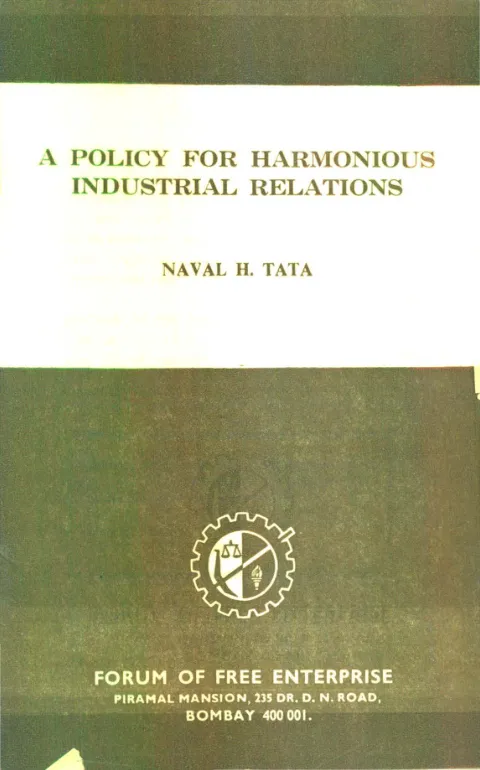
A Policy for Harmonious Industrial Relations
FORUM OF FREE ENTERPRISE, PIRAMAL MANSION, 235 DR. D. N. ROAD, BOMBAY 400 001. · Bombay · 1980
23 pages
Summary
Naval H. Tata, President of the Employers’ Federation of India, delivers a Forum of Free Enterprise address (14 April 1980) diagnosing what he calls a labour scene of chaos, confusion and despair. He frames the brief in starkly practical terms: 32 million man-days lost to strikes in 1979 alone, illegal lock-outs and gheraos becoming routine, and State Governments amending labour law unilaterally outside the tripartite Labour Conference. The new Government, he argues, cannot revive growth without first restoring cordial industrial relations, and he sets out four areas demanding immediate attention — orderly collective bargaining through truly representative unions, speedy dispute settlement through independent labour courts and voluntary arbitration, prevention of violence with strict enforcement of law and order, and an equitable wage policy with indexing for cost-of-living fluctuations and a clear bonus law.
The first half of the pamphlet works through each of these heads. Tata urges statutory recognition of a sole bargaining agent under a Central law applicable to undertakings employing more than one hundred workers, with the secret ballot preferred over verification of membership for selecting that agent on democratic principles. He calls for reviving and activating the tripartite National Commission on Labour’s recommendation to set up independent Industrial Relations Commissions at the State and Centre, freed from executive influence, with concurrent rights to refer disputes to adjudication. Voluntary arbitration on the American model — where the arbitrator is named in the agreement itself — is offered as a way out of the cumbersome compulsory adjudication regime. On violence, he insists that gheraos and physical assault forfeit the immunity that trade unions otherwise enjoy under the Constitution: unions guilty of violence should face derecognition for three years, and office-bearers disqualification for five to seven. The wage-policy section is illustrated by a ‘Wage Map of Bombay’ tabulating basic plus dearness allowance for sixteen occupational categories as of June 1977.
The second part of the pamphlet, ‘The Bonus Tangle: A Way Out’, argues that the Payment of Bonus Act of 1965 — far from securing industrial peace — has become a recurring trigger for agitation every June through November. Tata defends the original Bonus Commission view (chaired by the late M. R. Meher, I.C.S.) that bonus is a share in profits, not a deferred wage, and warns that treating it as a deferred wage would require disbursements running to Rs. 1,500 crores per annum for Government employees alone. He proposes deleting the existing minimum bonus by abolition or, as a compromise, merging it into wages over three years; restoring the productivity-linked bonus provision the Janata Party abandoned; scrapping Section 34(1) of the Act, which has been exploited by militant unions to extract awards of 35 to 40 per cent through coercive bargaining; and, more radically, financing an annual national dividend to labour through a four-per-cent excise surcharge on industrial production to displace plant-level bonus disputes altogether.
Key points
-
Diagnoses the 1979–80 labour climate as one of chaos: 32 million man-days lost to strikes in 1979, illegal lock-outs, and unilateral State amendments to central labour law bypassing the tripartite Labour Conference.
-
Proposes four reform heads: orderly collective bargaining through truly representative unions, speedy dispute settlement, prevention of violence, and an equitable indexed wage policy with a clear bonus law.
-
Argues for statutory recognition of a sole bargaining agent under a Central law for undertakings of 100+ workers, with the secret ballot preferred over membership verification on democratic grounds.
-
Calls for reviving the National Commission on Labour’s proposal for tripartite Industrial Relations Commissions at State and Central levels, independent of the executive and capable of adjudicating disputes referred by either party.
-
Endorses voluntary arbitration on the American model — where the arbitrator is named in the collective agreement itself — to escape the cumbersome compulsory-adjudication regime.
-
Holds that violence, gheraos, and intimidation are not legitimate parts of collective bargaining and should forfeit union immunity, with derecognition of offending unions for three years and disqualification of office-bearers for five to seven years.
-
Treats the Payment of Bonus Act, 1965 as a recurring trigger of industrial strife (notoriously between June and November each year), and defends the M. R. Meher Bonus Commission’s reading of bonus as a share in profits, not a deferred wage.
-
Proposes deleting the minimum bonus, restoring productivity-linked bonus, scrapping Section 34(1) of the Bonus Act, and exploring a national bonus fund financed by a 4-per-cent excise surcharge as an alternative to plant-level bonus disputes.
Metadata and summary are AI-extracted from the source PDF and reviewed for editorial accuracy. The original work is available via the Read PDF tab above (where present); paragraph-level citation inside the PDF is deferred to a future engagement.