
speech
Rights, Duties & Obligations of Company Directors
Published by M. R. Pai for the Forum of Free Enterprise, 235, Dr. Dadabhai Naoroji Road, Bombay 1, and Printed by Michael Andrades at the Bombay Chronicle Press, Horniman Circle, Bombay-1. · Bombay · 1964
17 pages
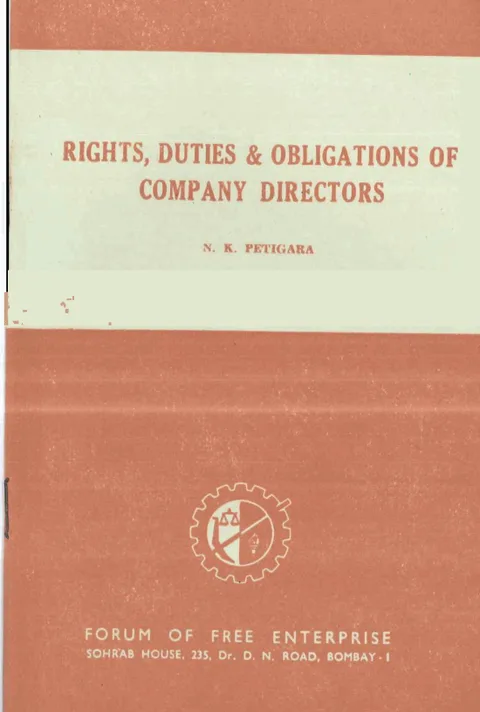
Rights, Duties & Obligations of Company Directors
By N. K. PETIGARA
Summary
N. K. Petigara, a Bombay solicitor and authority on company law, delivers a careful exposition of how the legal position of company directors in India had been transformed by the Companies Act 1956, the Companies (Amendment) Act 1963, and the Banking Laws (Miscellaneous Provisions) Act 1963. He argues that while the duties and obligations of directors have remained substantively unchanged, the rights of directors — particularly the right of management — have been steadily cut down. The recommendations of the Vivian Bose Commission, covering misuse of objects clauses, underwriting commissions, fictitious shareholdings, dummy directors, and inter-company loans, frame much of the new legislation and the booklet’s first half catalogues each item the Commission flagged.
The central polemical concern of the talk is the displacement of shareholder oversight by Government regulation under the elastic banner of “public interest.” Petigara accepts that mismanagement exists and that legislative intervention is sometimes warranted, but he insists that India’s institution of corporate enterprise is “extremely limited” relative to the country’s industrialisation needs and that an undesirable element exists in every system. He surveys the modern doctrine of directors’ fiduciary duties through House of Lords authority (Regal (Hastings) v. Gulliver) and the Allahabad High Court’s expansive use of Sections 397 and 398 of the Act in the Haridas Mundhra holding-company litigation, where the court pierced the corporate veil to treat parent and subsidiary as a single business reality.
In its closing sections Petigara turns to the new Tribunal and Board of Company Law Administration created by the 1963 amendments, the enhanced supervisory powers granted to the Reserve Bank over bank directors under the Banking Laws (Miscellaneous Provisions) Act, and the introduction of Section 388B permitting Government removal of directors. He is sharply critical of the transfer of jurisdiction from the High Courts to administrative tribunals, arguing — as a matter of constitutional principle and despatch — that judicial redress “capable of being corrected” remains preferable to administrative finality. The booklet records a talk delivered under the auspices of the Forum of Free Enterprise in Bombay on January 10, 1964, and is published in their characteristic format as a contribution to public debate on the regulatory direction of Indian company law.
Key points
-
Duties and obligations of directors are substantively unchanged by recent legislation; what has been cut down is the right of management.
-
The Vivian Bose Commission’s catalogue of abuses (misuse of objects clauses, underwriting commissions, fictitious or nominee holdings, dummy directors, inter-company loans, asset-stripping in liquidation) drives the recent statutory changes embodied in the Companies (Amendment) Act 1963.
-
Petigara’s central worry is the elastic concept of “public interest,” under which regulatory power is handed to Government agencies rather than left with shareholders — a notion “definitely something much wider than the interest of the shareholders.”
-
He defends the existence and growth of large limited companies as the only mechanism capable of mobilising the finance and resources required for industrialising India.
-
The fiduciary standard summarised through Lord Russell’s dictum in Regal (Hastings) Ltd. v. Gulliver and the treatise of Baker and Cury frames the discussion of directors as agents, trustees and officers held to “the extreme measure of candour, unselfishness and goodwill.”
-
The Allahabad High Court’s decision in the Life Insurance Corporation v. Haridas Mundhra litigation is treated as a major doctrinal development: courts may treat parent and subsidiary as a single enterprise and hold a holding company’s directors liable for subsidiary losses caused by misfeasance.
-
Petigara is openly critical of the new Tribunal and the Board of Company Law Administration replacing the Company Law Department; he sees the ouster of High Court jurisdiction in favour of administrative tribunals as constitutionally regressive.
-
Enhanced Reserve Bank powers over banking-company directors under the Banking Laws (Miscellaneous Provisions) Act 1963 — including appointment, removal, and the new Section 388B Central Government removal power — are presented as further restrictions on directors’ rights.
Generated by the v1.5 extraction pipeline. Awaiting editorial review.
Metadata and summary are AI-extracted from the source PDF and reviewed for editorial accuracy. The original work is available via the Read PDF tab above (where present); paragraph-level citation inside the PDF is deferred to a future engagement.
Related across the archive
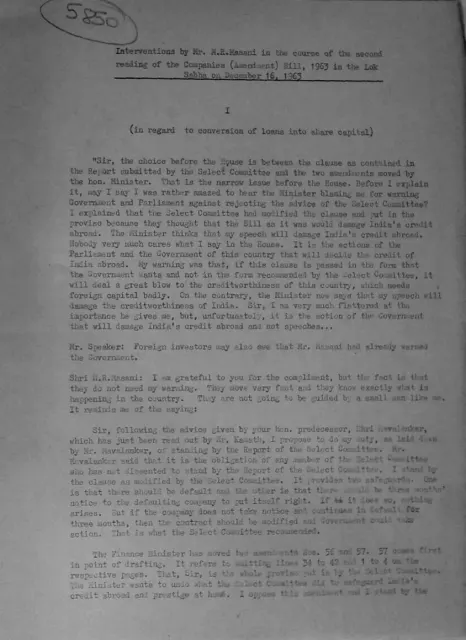 Primary workInterventions by Mr. K.R.Masani in the course of the second reading of the Companies (Amendment) Bill, 1963 in the Lok Sabha on December 16, 1963
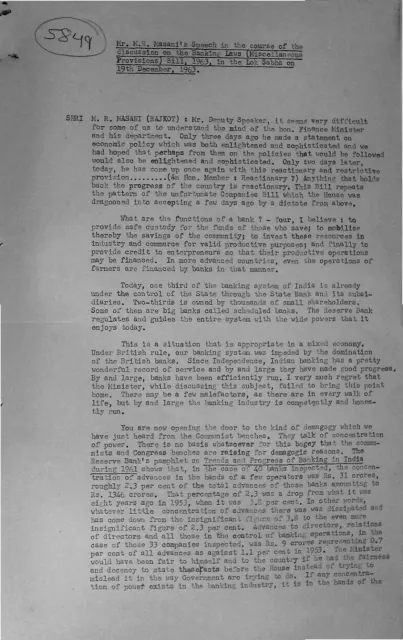 Primary workMr. M.R. Masani's Speech in the course of the discussion on the Banking Laws (Miscellaneous Provisions) Bill, 1963, in the Lok Sabha on 19th December, 1963.
 Primary workThe Position of Directors Under the Companies Act
 ExcerptSTATE MONOPOLIES AND THE CITIZEN IN A DEMOCRACY
 ExcerptDemocracy in India