pamphlet
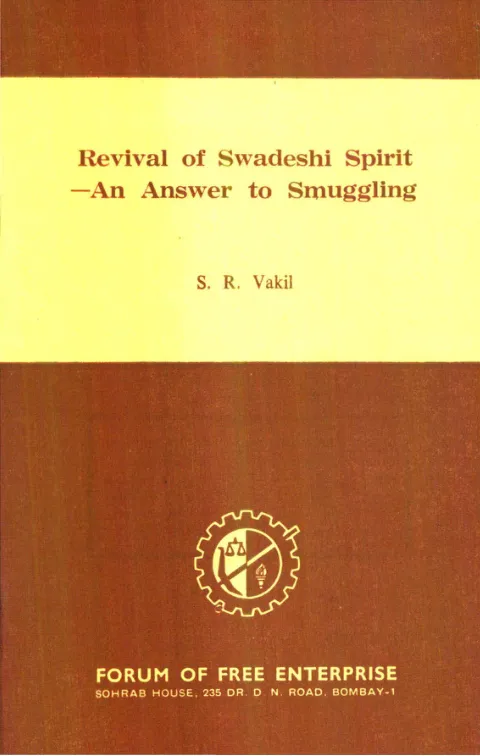
Revival of Swadeshi Spirit —An Answer to Smuggling
By S. R. Vakil
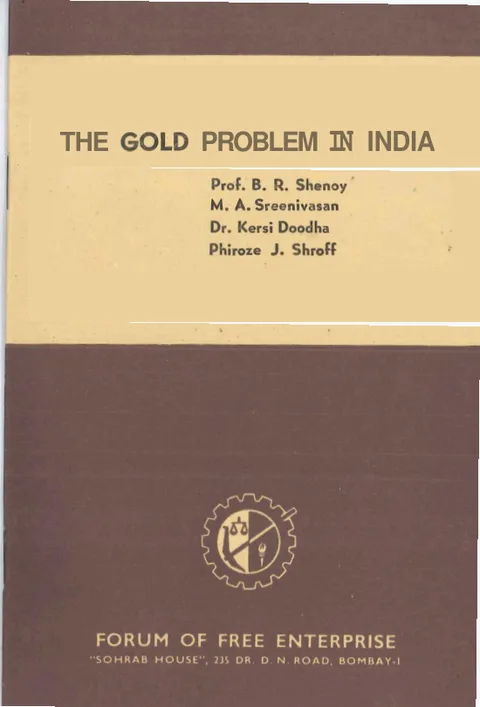
FORUM OF FREE ENTERPRISE, SOHRAB HOUSE, 235 DR. D. N. ROAD, BOMBAY-1 · Bombay · 1974
30 pages
Revival of Swadeshi Spirit —An Answer to Smuggling
By S. R. Vakil
Summary
S. R. Vakil’s 1974 pamphlet, published by the Forum of Free Enterprise (Bombay) and based on public lectures he had been delivering as a Bombay solicitor and authority on foreign exchange laws, frames smuggling as the urgent moral and economic crisis of post-independence India. Vakil opens with an autobiographical recollection of the Salt Satyagraha during his school days in Surat and offers a twin thesis: that the ‘Parallel Government’ run by smugglers can only be uprooted by reviving the Swadeshi spirit and boycotting foreign luxury goods, and that ‘Religion and Economics are obverse and reverse of the same coin’.
The body of the pamphlet marshals striking trade statistics — Dubai’s role as a free-port clearing house for gold, silver, watches, transistors, textiles and consumer luxuries; sterling-denominated import figures for 1962–1969; British estimates of Indian silver hoards at five thousand million ounces (£4.8 billion / Rs. 9,000 crores) in 1968; and the 39,925,100 ounces of Indian silver officially exported from Dubai to Britain in eleven months of 1968. Vakil ties the gold-and-silver haemorrhage to a ‘crisis of national confidence’, criticises India’s Gold Control as having produced unemployed goldsmiths, black-market property booms, capital flight and a new bureaucracy of corruption, and includes the recurring smuggling of women, idols and consumer kitsch among the moral costs.
The argumentative spine is a classical-liberal one within a Gandhian register: Vakil indicts the Government’s ‘unreasoning aversion’ to trusting the private sector with foreign-exchange-saving projects, the ‘neurotic zeal’ of experimental legislation, and Exchange Control laws whose ‘known uncertainty’ he likens to a Frankenstein monster, while welcoming the deterrent effect of the amended MISA on smugglers and arguing that the public must take a five-year vow against foreign goods. He invokes Mahatma Gandhi, J. N. Tata and A. B. Godrej as exemplars of Swadeshi, draws on extracts from Tendolkar’s ‘Life of Mahatma Gandhi’, and announces an Epilogue of sayings from Malcolm Muggeridge.
In the rendered pages, the front matter carries dedicatory quotes from A. D. Shroff (Forum founder-president) and Eugene Black; the main address runs printed pages 1–7; Appendix I reprints Vakil’s May 1969 ‘Note on gold Smuggling’; Appendix II reproduces extracts from MISA 1971, the MISA Amending Ordinance 1974, and the Presidential Order on MISA detenus; and Appendix III begins reprinting Section 111 of the Customs Act 1962. The closing pages of Appendix III and the Muggeridge Epilogue announced in the Introduction fall outside this rendered chunk.
Key points
-
Vakil’s central thesis: the ‘Parallel Government’ of smugglers can only be eradicated by reviving the Swadeshi spirit and boycotting foreign luxury goods, paired with a moral claim that religion and economics are inseparable.
-
Dubai is profiled as the seven-Trucial-States free port acting as smuggling clearing house: 4.625% duty on sea cargo, 2% on air, 1.25% on wrist watches, zero duty on gold, with 1964 gold imports of $75 million.
-
Sterling-denominated trade figures show Dubai imports rising from £8.15 million in 1962 to £80 million by 1969, with Indian silver exports from Dubai to Britain at 39,925,100 ounces in eleven months of 1968.
-
Vakil estimates Indian silver hoards at 5,000 million ounces (£4.8 billion / Rs. 9,000 crores by 1968 prices) and reports gold imports of 160 metric tonnes (Rs. 280 crores) into Dubai in 1968 alone, largely re-exported to India and Pakistan.
-
The pamphlet catalogues seven net effects of Gold Control — surreptitious smuggling, goldsmith unemployment, diversion of black money into property, rupee depreciation, capital flight, destruction of rural credit, and new corruption — and laments smuggled idols of Shankar and Vishnu plus the smuggling of girls under false marriage declarations.
-
MISA is welcomed as a ‘salutary’ deterrent that has lowered prices of iron, steel, cement and drugs by 40%, halted Singapore compensatory payments, and stilled share bazaars; Vakil casts MISA as ‘for smugglers and not for strugglers’.
-
Government policy is condemned for its ‘unreasoning aversion’ to entrusting the private sector with foreign-exchange-saving projects, its ‘neurotic zeal’ for experimental legislation, and its Exchange Control laws whose ‘known uncertainty’ Vakil compares to a Frankenstein monster.
-
Appendix II reproduces sections 3–9 of the Maintenance of Internal Security Act 1971 (No. 26 of 1971) as amended by the Defence of India Act 1971, the MISA Amending Ordinance 1974, and the Presidential Order on MISA detenus’ right to move the court suspending Articles 14, 21 and 22 during the Emergency proclaimed 3 December 1971.
-
Appendix III begins extracts from Section 111 of the Customs Act 1962 enumerating goods liable to confiscation as improperly imported.
Generated by the v1.5 extraction pipeline. Awaiting editorial review.
Metadata and summary are AI-extracted from the source PDF and reviewed for editorial accuracy. The original work is available via the Read PDF tab above (where present); paragraph-level citation inside the PDF is deferred to a future engagement.