essay
RE-THINKING ON GOLD CONTROL
Published by M. R. PAI for the Forum of Free Enterprise, "Sohrab House", 235, Dr. Dadabhai Naoroji Road, Bombay 1, and printed by H. NARAYAN RAO at H. R. MOHAN & CO., (PRESS), 9-B, Cawasjee Patel Street, Bombay 1. · Bombay · 1965
4 pages
Summary
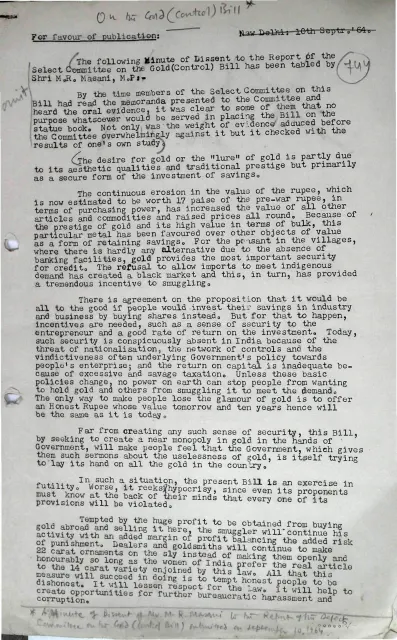
Writing in September 1965 for the Forum of Free Enterprise, B. S. Mahajan — identified in a footnote as Secretary of the All-India Sarafa Association and an authority on the gold problem — argues that the Gold Control Rules are fundamentally misconceived and have comprehensively failed on their own stated terms. His central contention is that gold-hoarding is not a pathology to be regulated away but a rational response to currency depreciation: with the rupee now worth roughly 17 paise in terms of its pre-war purchasing power, and postal savings yielding compound interest of only 4.4 per cent against gold investment’s implied 6.02 per cent return, ordinary people have every economic reason to hold gold. State measures that seek to override this preference treat the symptom while the disease — monetary instability — goes unattended.
Mahajan marshals three categories of evidence for the Rules’ failure. First, administrative cost: implementation has burdened the national exchequer with approximately Rs. 29 lakhs, imposed an additional Rs. 20 crores on the trade in rehabilitation costs for displaced goldsmiths, and eliminated a permanent income-tax revenue stream of over Rs. 27 crores per year. Second, market effect: the 14-carat purity cap has not reduced ornament purchases; it has merely redirected demand toward clandestinely sourced fine gold, pushing all transactions underground and making accurate turnover data impossible to obtain. Third, price signal: gold prices rose from Rs. 103.50–112.50 per 10 grammes before the Rules to Rs. 135.50–139.65 during the same month the following year, a premium that itself constitutes an incentive to smuggle. The Government’s claim that the number of dealers has fallen from 27,000 to 12,000 is turned against it: fewer licensed dealers means more clandestine operators, not less gold in circulation. Mahajan closes by proposing that an independent Currency and Gold Commission of experts be constituted to address the underlying monetary disease rather than continuing a prohibitionist approach that, like alcohol prohibition elsewhere, has proved counter-productive.
Key points
-
Gold-holding is a rational savings strategy given the rupee’s depreciation to approximately 17 paise of its pre-war purchasing power; gold investment yielded 6.02% compound vs. 4.4% for postal savings.
-
The NCAER survey confirms that gold and silver purchases represent a significant component of Indian household saving, rooted in the absence of rural banking and deep cultural attachment.
-
The 14-carat purity ceiling backfired: it created insatiable demand for fine gold, driving buyers to clandestine sources and pushing the entire trade underground.
-
Gold prices rose from Rs. 103.50–112.50 to Rs. 135.50–139.65 per 10 grammes under the Rules, with the price premium acting as a direct incentive to smuggle.
-
Administrative and fiscal costs of the Rules include Rs. 29 lakhs to the exchequer, an additional Rs. 20 crores burden on the trade, and loss of over Rs. 27 crores per year in income-tax revenue.
-
The fall in licensed dealers from 27,000 to 12,000 has not reduced gold demand; it has handed the trade to a ‘clan of clandestine operators’ replacing honest jewellers and sarafs.
-
Mahajan proposes an independent Currency and Gold Commission to tackle monetary instability — the root cause — rather than persisting with negative regulatory measures that cannot cure basic economic maladies.
Metadata and summary are AI-extracted from the source PDF and reviewed for editorial accuracy. The original work is available via the Read PDF tab above (where present); paragraph-level citation inside the PDF is deferred to a future engagement.