speech · memorial lecture
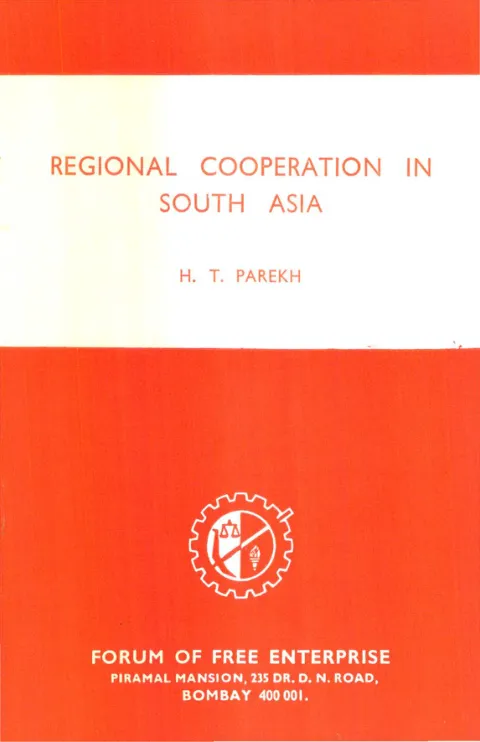
Regional Cooperation in South Asia
By H. T. Parekh
Published by M. R. PAI for the Forum of Free Enterprise, 235 Dr. Dadabhai Naoroji Road, Bombay-400 001, and Printed by S. V. Limaye at India Printing Works, 9 Nagindas Master Road Ext. 1, Fort, Bombay 400 023. · Bombay · 1981
20 pages
Part of A. D. Shroff Memorial Lecture
Regional Cooperation in South Asia
By H. T. PAREKH
Summary
Delivered as the A. D. Shroff Memorial Lecture in Bombay on 23 October 1981 and published by the Forum of Free Enterprise, H. T. Parekh’s slim pamphlet argues that regional co-operation in South Asia is no longer a diplomatic ornament but “a matter of compulsion” for India and its neighbours. Parekh opens by paying tribute to Shroff as his guru and connecting Shroff’s lifelong defence of economic freedom to the case he is about to make, then surveys India’s standing thirty years after Independence — high in the world’s military and industrial rankings, low in per-capita income, and curiously distant from the very Pakistanis, Bangladeshis, Sri Lankans and Nepalis with whom Indians share geography, culture and a common struggle against poverty.
The core argument is that competitive military build-up is the catastrophe to be avoided and that India must take the first unilateral steps — generously, on the basis of strict equality with smaller neighbours — to prove its bona fides. Parekh inventories the existing scaffolding: the Simla Agreement of 1972 with Pakistan, the Indo-Bangladesh Treaty of 1972, the Treaty of Friendship and Trade with Nepal that already functions as a customs union with free movement of people and capital, and the 1964 settlement that normalised relations with Sri Lanka. He then proposes concrete moves under three headings — communication and tourism, social and cultural exchanges, and trade, industry and finance — including liberal student scholarships, regular professional meetings of bankers and doctors, preferential tariffs, a customs union, common clearing and monetary co-operation.
Parekh insists the project must be a people’s movement rather than a government scheme, invoking the Treaty of Rome and Jean Monnet’s European success story as the relevant model, and he calls for the formation of an independent, voluntary, non-political council to promote South Asia as a community. The pamphlet closes with an appendix excerpting the Simla Agreement and the Indo-Bangladesh Treaty of Co-operation, Friendship and Peace, plus the Forum’s standard back matter inviting readers to join.
Key points
-
Frames South Asian regional co-operation as a compulsion, not a choice, and the only credible alternative to competitive military build-up in the region.
-
Anchors the lecture in A. D. Shroff’s classical-liberal legacy of economic freedom and fewer controls, treating Shroff’s policies as vindicated by 1981 conditions.
-
Argues that India must take the first generous steps unilaterally, on the basis of strict equality, to prove its bona fides to smaller neighbours.
-
Surveys the existing treaty architecture — Simla 1972, Indo-Bangladesh 1972, the Nepal Treaty of Friendship and Trade, and the 1964 Sri Lanka settlement — as foundations to build on.
-
Proposes a concrete agenda under three headings: communication and tourism, social and cultural exchanges, and trade, industry and finance — including intra-regional tourism subsidies, student scholarships and professional associations meeting across borders.
-
Calls for preferential tariffs, a customs union, common clearing, monetary co-operation and free capital flows within the region, and joint ventures with neighbours rather than only with foreign firms.
-
Invokes the European Economic Community and Jean Monnet’s Treaty of Rome as the model, insisting the movement must come from people rather than governments.
-
Recommends the formation of an independent, voluntary, non-political council of like-minded people in every country of the region to promote South Asia as a community.
-
Appends excerpts from the Simla Agreement (1972) and the Indo-Bangladesh Treaty of Co-operation, Friendship and Peace (March 1972) as documentary support.
Generated by the v1.5 extraction pipeline. Awaiting editorial review.
Metadata and summary are AI-extracted from the source PDF and reviewed for editorial accuracy. The original work is available via the Read PDF tab above (where present); paragraph-level citation inside the PDF is deferred to a future engagement.