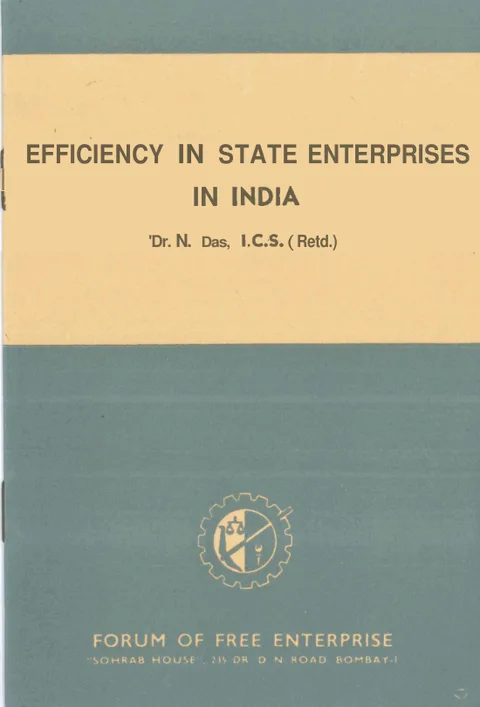
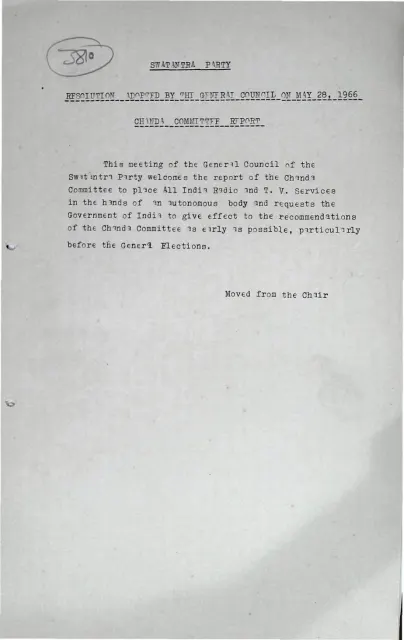
essay
PUBLIC ENTERPRISES IN INDIA
By A. K. Chanda
Published by M. R. Pai for Forum of Free Enterprise, "Soharb House", 235 Dr. Dadabhai Naoroji Road, Bombay 1, and printed by P. A. Raman at Inland Printers, 55 Gamdevi Road, Bombay 7. · Bombay · 1960
6 pages
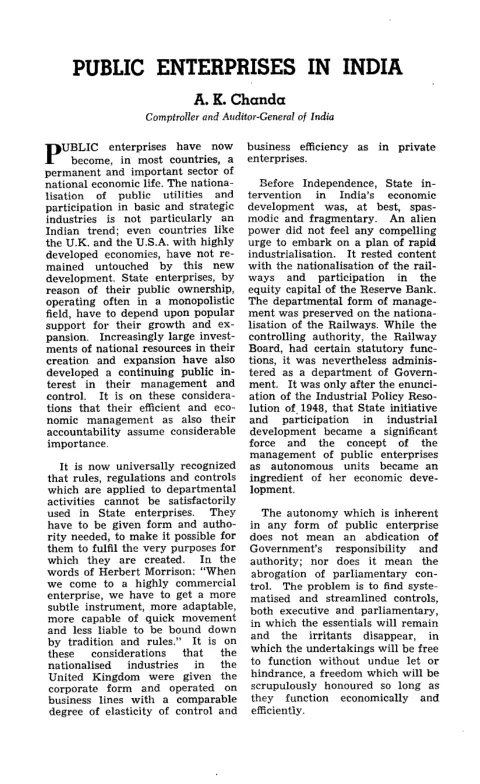
PUBLIC ENTERPRISES IN INDIA
By A. K. Chanda
Summary
A. K. Chanda, writing as Comptroller and Auditor-General of India, examines the rapid post-Independence expansion of state enterprise in India and argues that the institutional habits of departmental government are choking the very public ventures the Centre has staked its industrial future on. He traces the lineage of the public sector from the nationalisation of the railways in 1924 and the equity capital of the Reserve Bank to the Industrial Policy Resolution of 1948, which made state initiative “a significant ingredient of her economic development”. Drawing on Herbert Morrison and on British experience under nationalisation, Chanda insists that a corporate enterprise needs autonomy and elasticity if it is to deliver the very purposes for which it was created.
The essay then turns to the practical record. Chanda catalogues failures of planning, location, and execution — the loss of eighteen months at Rourkela, the eleven-crore Konar Dam dedicated by the Prime Minister but not yet producing a kilowatt of power or an irrigated acre, contracts placed with under-qualified firms despite warnings, and the political and parochial pressures determining the siting of steel refineries. He links these to defects in the constitution of the Boards (overweighted with the official block, leavened by senior officials and political chiefs) and to a finance-representative veto that drains autonomy back to the Ministry. The case of Life Insurance Corporation is offered as a classic example of non-official directors being overridden without recourse to a formal Board decision.
The closing argument is reformist rather than abolitionist: Chanda proposes wider non-official representation on Boards, the offering of roughly twenty-five per cent of equity capital for public subscription, and a constitutional re-balancing of the Minister’s role from operational control to general policy guidance. He treats parliamentary accountability and managerial autonomy as reconcilable, provided the Board is freed from the “directives, the consultations they (the Ministers) escape responsibility” and given clear policy direction from above. The pamphlet ends with a call for a re-orientation of policy capable of producing State enterprises that are genuinely competent, industrially strong, and economically viable.
Key points
-
Public enterprise is now “a permanent and important sector of national economic life”, but its growth in India was unplanned and spasmodic rather than ideologically driven.
-
The Industrial Policy Resolution of 1948 made state initiative a significant component of economic development, building on prior nationalisations such as the railways (1924) and the equity capital of the Reserve Bank.
-
Departmental rules and Treasury-style controls are unsuitable for state commercial enterprises, which require autonomy, elasticity, and managerial speed — Chanda invokes Herbert Morrison and UK nationalised industry to support the point.
-
Concrete operational failures are catalogued: the Rourkela plant lost eighteen months to indecision, the Konar Dam component of the Damodar Valley Corporation cost over Rs. 11 crores without producing power or irrigation, and steel-refinery siting was driven by political and parochial pressures rather than economic logic.
-
Boards of state enterprises are dominated by an “official block” of civil servants and political chiefs, and the finance representative’s veto over capital expenditure exceeding Rs. 10 lakhs re-imposes departmental drag on supposedly autonomous companies.
-
Parliamentary accountability for state enterprises is theoretical rather than effective: by refraining from exercise of their directional powers, Ministers escape responsibility while still influencing companies through consultation.
-
Reform proposals include enlarging the proportion of non-official Directors with industrial and labour expertise, opening 25 per cent of equity to public subscription, and confining the Minister to broad policy guidance rather than directive intervention.
-
Chanda treats the question as one of institutional design — re-orienting policy to bring “greater realism in planning, competence and wider interest in management” — not of dismantling the public sector.
Generated by the v1.5 extraction pipeline. Awaiting editorial review.
Metadata and summary are AI-extracted from the source PDF and reviewed for editorial accuracy. The original work is available via the Read PDF tab above (where present); paragraph-level citation inside the PDF is deferred to a future engagement.