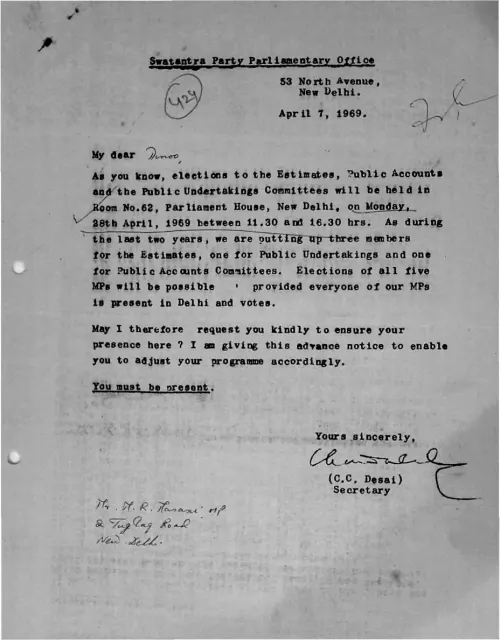
speech
PUBLIC ACCOUNTABILITY
Published by M. R. PAI for the Forum of Free Enterprise, "Sohrab House", 235 Dr. Dadabhai Naoroji Road, Bombay-1, and printed by Michael Andrades at Bombay Chronicle Press, Syed Abdullah Brelvi Road, Fort, Bombay-1. · Bombay · 1970
12 pages
PUBLIC ACCOUNTABILITY
By M. R. Masani, M.P.
Summary
M. R. Masani’s lecture, delivered under the auspices of the Forum of Free Enterprise in Bombay on 8 October 1969 and printed as a booklet on 10 February 1970, argues that public accountability — Parliament’s actual capacity to scrutinise the expenditure of public money and the conduct of public enterprises — is the indispensable instrument by which untamed power is restrained in a parliamentary democracy. Drawing on his recent two-year term as Chairman of the Public Accounts Committee (1967–69), Masani opens with the old maxim ‘no taxation without representation’ and surveys three constitutional levers available to MPs: the vote on Demands for Budget Grants, parliamentary questions, and the standing financial committees (Public Accounts, Estimates, Public Undertakings). He finds each blunted in Indian practice: budget cuts are token, questions are wasted on the trivial, and even the committees suffer from a time-lag between spending and investigation that drains their findings of bite.
The bulk of the lecture is a sharp indictment of state industrial and commercial enterprises. Citing the latest Audit Report’s finding that 70 Central Government undertakings returned only 0.8 per cent on Rs. 1,200 crores of invested capital in 1965–66, with losses already announced of Rs. 40 crores in the current year, Masani argues that the very ‘no-profit, no-loss’ doctrine Galbraith dubbed ‘post office socialism’ is the source of the malaise: an enterprise that cannot earn a profit has no right to exist, because profit is the yardstick of efficiency. He invokes C. D. Deshmukh’s 1953 Lok Sabha speech, the Administrative Reforms Commission’s October 1968 report on Public Sector Undertakings, and the Chanda Committee on AIR to argue that ministerial interference must be reduced, that ministers should be barred from chairing public undertakings, and that any directive must be reduced to writing and laid before Parliament.
Masani then deploys two notable converts to bolster his case: John Kenneth Galbraith, the former U.S. Ambassador to India, whose ‘New Industrial State’ he reads as a confession of disillusionment with aggressive public control, and Lee Kuan Yew, the socialist Prime Minister of Singapore, who in a Bombay address asked why the bustling free-enterprise economies of Japan, Hong Kong, Formosa, Thailand and Malaysia had outperformed their socialist neighbours. He concludes that the conflict between business efficiency and political control is irreconcilable: competition must be restored, state monopolies in fields like life insurance and airlines must be broken up, and infrastructure aside, enterprises that cannot run profitably should be denationalised — sold to those willing to take the risk, as Germany, Japan and France have done. He ends with an arresting anecdote: even Yugoslav communists, in conversations he had in Belgrade in 1955, told him that a failing public enterprise should be allowed to fold up and its managers sent back to the bench.
Key points
-
Public accountability is defined narrowly as parliamentary scrutiny of public money — grounded in the maxim ‘no taxation without representation’ and the principle that untamed power is a menace.
-
Three parliamentary instruments — Demand for Grants votes, Questions, and the financial Standing Committees (PAC, Estimates, Public Undertakings) — are each shown to be eroded in Indian practice by token cuts, supplementaries, and a long time-lag between spending and investigation.
-
Masani cites the latest Audit Report’s finding that 70 Central Government enterprises returned only 0.8 per cent on Rs. 1,200 crores of capital in 1965–66, with announced losses of Rs. 40 crores in the current year, to argue that the ‘no-profit, no-loss’ doctrine of state enterprise is structurally broken.
-
He endorses the Administrative Reforms Commission report on Public Sector Undertakings (October 1967) and its recommendation that no Minister should chair a public undertaking and that any ministerial interference must be reduced to writing and reported to Parliament.
-
He marshals the testimony of Galbraith (recanting via ‘The New Industrial State’) and Lee Kuan Yew (asking why East Asia’s free-enterprise economies are outpacing Asian socialism) to argue that even leading socialists have conceded the failure of state industry.
-
Masani proposes restoring competition by breaking state monopolies in life insurance, civil aviation and similar fields, and denationalising loss-making enterprises along the lines of post-war Germany, Japan and France.
-
He invokes a Yugoslav precedent — communist managers in 1955 told him that a failing public enterprise should be allowed to fold up and its managers sent back to ordinary work — to argue that even doctrinaire socialists accept the discipline of profit.
-
Throughout, Masani frames public accountability as the reconciliation of business efficiency with democratic control, and warns that without it, management becomes a ‘sovereign entity’ answerable to no one.
Generated by the v1.5 extraction pipeline. Awaiting editorial review.
Metadata and summary are AI-extracted from the source PDF and reviewed for editorial accuracy. The original work is available via the Read PDF tab above (where present); paragraph-level citation inside the PDF is deferred to a future engagement.