speech
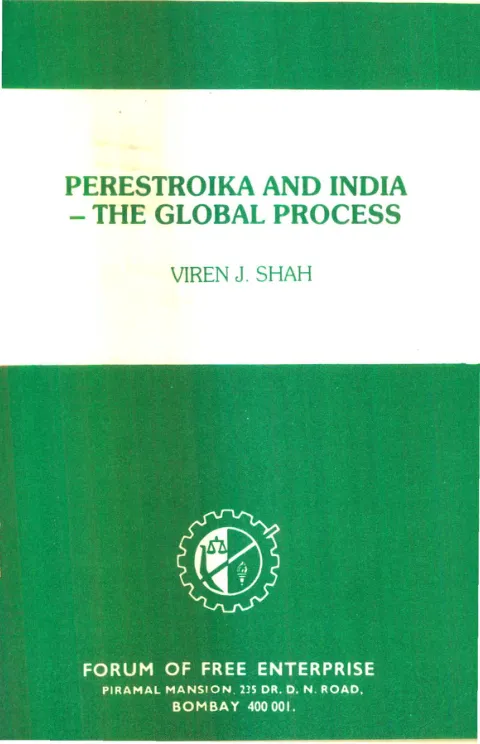
PERESTROIKA AND INDIA – THE GLOBAL PROCESS
FORUM OF FREE ENTERPRISE, PIRAMAL MANSION, 235 DR. D. N. ROAD, BOMBAY 400 001. · Bombay
28 pages
PERESTROIKA AND INDIA – THE GLOBAL PROCESS
By VIREN J. SHAH
Summary
Viren J. Shah’s 1988 Forum of Free Enterprise pamphlet treats Mikhail Gorbachev’s perestroika not as a Soviet curiosity but as the local expression of a planet-wide turn against over-centralised economic management. Drawing extensively on long block-quotations from Gorbachev’s ‘Perestroika: New Thinking for our Country and the World’, Shah lets the General Secretary make the case in his own voice: that the old Soviet machinery lacked inner stimuli for self-development, that wages had been detached from end results, that ministries had to surrender day-to-day regimentation, and that enterprises should henceforth operate on the principle ‘everything which is not prohibited by law is allowed.’ Shah pauses to note that the diagnostic passages echo, with uncanny fidelity, Milovan Djilas’s analysis of the communist ‘New Class’ written three decades earlier.
The second movement of the address widens the lens. Shah surveys the Chinese reforms after 1978 (the new law on state industrial enterprises, foreign capital in over 4,000 ventures, rural family enterprise), traces parallel impulses in Hungary, Poland, Yugoslavia and Czechoslovakia, and then crosses into the non-communist world — Mitterand’s privatisations in France, New Zealand’s liberalisation under a ‘leftist’ government, Reaganism, Thatcherism, and Kinnock’s Labour Party drifting to the centre. His conclusion is blunt: ‘Restructuring is now a truly global process,’ and its direction is the same everywhere — towards openness, competition, and respect for the individual as a citizen rather than as manpower.
The pamphlet closes by turning this global verdict on India. Shah locates an Indian opening-up beginning in 1977 and continuing under the present government’s early liberal noises on licensing, taxation, technology imports and foreign trade, but argues that the initiatives ‘got fragmented and lost all coherence in the process of execution’ — ‘the clear stream of reason has been lost in the desert sand of dead habit.’ He calls for an Indian perestroika ‘on a broad front and with determination’, flagging the loose nexus between vote-shares and parliamentary majorities, the anti-defection law, the lowering of the voting age, and the federal handling of sub-nationalism as items on the agenda. The rendered pages stop in the middle of that agenda, with the final eight pages of the pamphlet (PDF 21–28) outside this chunk.
Key points
-
Frames perestroika through a Regis Debray epigraph: revolutions tend to wear the mask of the preceding scene, and observers must learn to re-read continuity.
-
Reproduces Gorbachev at length on the operative content of perestroika — mass initiative, glasnost, retreat from management-by-injunction, and the elevation of honest skilled labour.
-
Pairs Gorbachev’s critique of the Soviet ‘plan indices’ system with Milovan Djilas’s 1957 diagnosis to argue the failure-mode of bureaucratic socialism was known thirty years before reform began.
-
Highlights the new Law on State Enterprises (effective 1 January 1988), the abrogation of thousands of normative acts, and the principle that anything not prohibited by law is allowed.
-
Reads glasnost as the institutional guarantee of irreversibility — once people grow used to openness they will not easily accept a return to the past.
-
Argues that restructuring is a global phenomenon spanning China’s post-1978 reforms, Eastern European reform traditions, Mitterand’s privatisations, New Zealand’s liberalisation, Reaganism, Thatcherism and Kinnock’s Labour.
-
Diagnoses India’s post-1977 liberalisation as fragmented in execution and lost in ‘the desert sand of dead habit’, and calls for an Indian perestroika on a broad front.
-
Opens an Indian reform agenda: tightening the vote-to-seat nexus, revisiting the anti-defection law, the voting-age question, and a Gorbachev-style accommodation of sub-nationalisms within the federal structure.
Generated by the v1.5 extraction pipeline. Awaiting editorial review.
Metadata and summary are AI-extracted from the source PDF and reviewed for editorial accuracy. The original work is available via the Read PDF tab above (where present); paragraph-level citation inside the PDF is deferred to a future engagement.