pamphlet
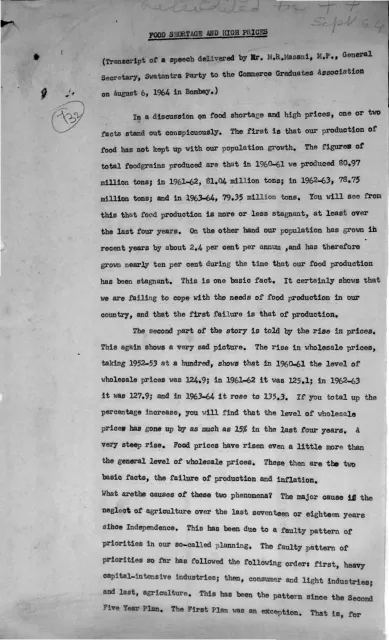
NATURAL ECONOMIC GROWTH IS VIA AGRICULTURE & CONSUMER GOODS INDUSTRIES
By B. R. Shenoy
Published by M. R. Pai for Forum of Free Enterprise, "Sohrab House", 235 Dr. Dadabhai Naoroji Road, Bombay 1, and printed by P. A. Raman at Inland Printers, 55 Gamdevi Road, Bombay 7. · Bombay · 1961
4 pages
Summary
B. R. Shenoy attacks the central premise of India’s planning model: that forced industrialisation, weighted toward heavy industry, is the road to prosperity. Reviewing the First Plan and the first three years of the Second, he concedes that industrial output has grown impressively — production rose 68 per cent over the decade, a 7.6 per cent annual rate that exceeded every Asian economy bar Japan, and capital goods such as automobiles, diesel engines and rayon yarn multiplied many times over. But he insists that this growth was ‘generally forced or induced’ in defiance of comparative cost, sustained by import controls, exchange rationing and quotas that have left consumers paying ransom prices for imported and import-substituting goods alike. Sugar surpluses go unsold because Indian production costs nearly double the world price; Pimpri-manufactured penicillin costs Rs. 2,250 a unit against an import equivalent of Rs. 1.25.
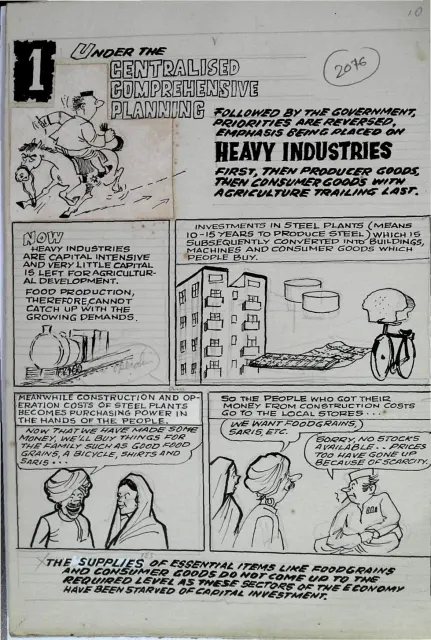
The deeper argument is that forced industrialisation has actively harmed the national product. Resources have been pulled out of agriculture and light industry — sectors with low capital-output ratios and quick employment payoffs — into heavy plants that yield neither output nor jobs in the short run. Shenoy estimates that during the First Plan and the early Second, agricultural investment produced output increases of 57 to 69 per cent of capital invested, while heavy-industry additions came in at 14 per cent or less; rough calculations suggest that 500 workers in consumer-goods industries plus 4,000 in agriculture and household industries can substitute for the 1,150 workers in heavy industry that current Plan priorities support. National product has grown at only 2.9 per cent a year when 8 to 10 per cent was achievable under a different allocation.
Shenoy closes with a historical claim and a policy prescription. Every successful industrial revolution, he argues, has been preceded by an agricultural revolution and the spread of lighter industries — these generate broad-based demand and reliable surpluses that pull heavier industries up behind them. India has inverted this sequence and produced ‘topsy-turvy’ growth that ‘must inherently render the Indian economy more and more vulnerable’. The remedy is not more planning of the same kind but a basic policy reorientation that puts agriculture and consumer goods first. The leaflet reproduces a Times of India piece of 8 June 1961 and is issued by the Forum of Free Enterprise, with the standard disclaimer that the views are the author’s alone.
Key points
-
Industrial output grew 68 per cent over the decade (7.6 per cent annual rate), outpacing every Asian economy bar Japan, but Shenoy treats this as forced rather than natural growth.
-
Heavy-industry expansion was driven by import compression — private imports fell from Rs. 812 crores in 1956-57 to Rs. 505 crores in 1958-59 — and by rationing that delivers monopoly rents to domestic producers.
-
Price comparisons reveal severe inefficiency: Indian sugar Rs. 700 vs world Rs. 400 per ton, Pimpri penicillin Rs. 2,250 vs imports at Rs. 1.25, Sindri fertiliser priced below world levels only because of state direction.
-
Forced industrialisation has been a net drag on the national product because resources diverted from agriculture and light industry produce more output and employment per rupee than heavy plants.
-
Estimated capital-output ratios during the First and early Second Plans: agriculture 57-69 per cent, cement/iron/steel/textiles only 2-14 per cent of investment recovered as added output in the first Plan period.
-
Employment arithmetic: 500 workers in consumer-goods industries plus 4,000 in agriculture and household industries can substitute for 1,150 in heavy industry, at lower real cost and shorter payoff.
-
Historical generalisation: agricultural revolutions have preceded industrial revolutions everywhere; lighter industries seed the demand that pulls heavier industries forward.
-
Policy prescription: India has reversed the natural sequence; modernisation requires basic reorientation toward agriculture and consumer goods rather than further forcing of heavy industry.
Metadata and summary are AI-extracted from the source PDF and reviewed for editorial accuracy. The original work is available via the Read PDF tab above (where present); paragraph-level citation inside the PDF is deferred to a future engagement.