speech
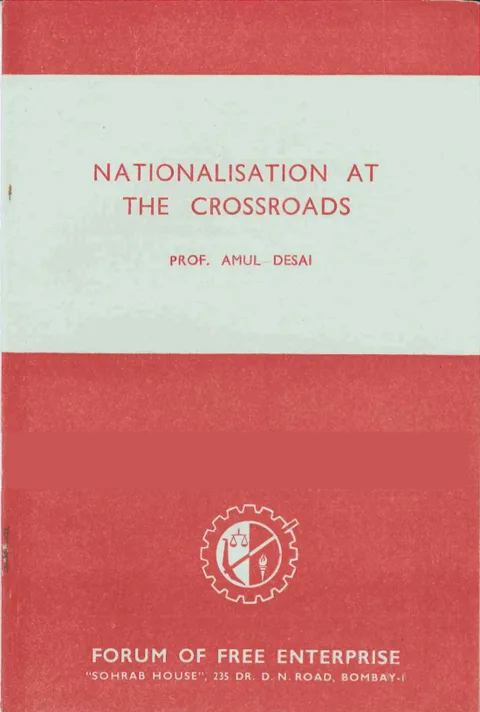
NATIONALISATION AT THE CROSSROADS
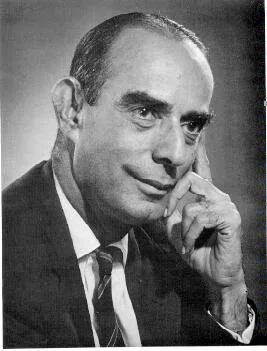
By Amul Desai
Published by M. R. Pai, for Forum of Free Enterprise, "Sohrab House", 235, Dr. Dadabhai Naoroji Road, Bombay 1, and printed by J. V. Patel at New Onlooker Printing Press Pvt. Ltd., Sassoon Dock, Colaba. Bombay-5. · Bombay · 1962
11 pages
Summary
Prof. Amul Desai’s lecture, delivered under the auspices of the Forum of Free Enterprise in Bombay on December 19, 1961, surveys the worldwide retreat from nationalisation and argues that India should rethink its commitment to state ownership as an instrument of socialism. Desai opens by historicising Marx: when Das Capital was written, labour had no right to organise or vote, parliamentary democracy was a fiction, and the welfare state did not yet exist — so violent overthrow of the capitalist order appeared to be the only remedy. With trade unionism, social legislation, adult franchise and labour parties returned by ballot, that case has collapsed, and class conflict can no longer be assumed the inevitable corollary of capitalism.
The bulk of the booklet is a tour of the international evidence. Burma’s U Nu, in an April 1960 address to parliament, formally repudiated nationalisation as a doctrine; Ceylon’s Dudley Senanayake declared in March 1960 that nationalisation as an end in itself was something to which his government was ‘certainly not wedded’. Desai walks through the British, Canadian, Italian, Swedish and Indian experiences to argue that the industries actually nationalised in the West — coal, railways, road and air transport, gas, electricity — were chronically loss-making concerns the private sector had abandoned, not commercially successful enterprises. Where it was tried on ideological grounds, as in Britain’s mood of ‘intellectual frustration’ in the 1930s and 40s, the outcome was operational decline, unfunded compensation burdens, falling investment, and a Labour Party that by the early 1960s was openly rethinking the programme.
Applied to India, Desai marshals plan-period figures to show the public sector consistently undershooting its own targets while the private sector overshot — the First Plan delivered roughly 15% of state-sector targets, and Second Plan public investment ran at Rs. 3,100 crores against a target of Rs. 2,400 crores in private investment. He cites the Sindhri Fertiliser Factory and Hindustan Aircraft as exemplars of high salaries, bloated supervisory staff, mounting bad debts and ex-gratia payments at taxpayer expense. Long-term industrial investment, he reports, fell from 65.33% (1945–47) to 22.20% (1950) as the fear of nationalisation set in.
Desai closes by drawing on C.A.R. Crosland, R.H.S. Crossman and W. Arthur Lewis — all from within the Labour tradition — to show that ends like full employment, equitable distribution and curbing monopoly can be achieved through taxation, regulation, co-operative ownership, municipal ownership and competition from autonomous state corporations, without resorting to wholesale nationalisation. His verdict: socialism’s beauty is the beauty of morning dew, and policy must rest on pragmatism rather than ‘blind faith in outmoded dogmas like nationalisation’.
Key points
-
Historicises Marx by arguing that adult franchise, trade unionism, welfare-state legislation and labour parties winning power at the ballot box have dissolved the 19th-century premise that nationalisation is the only escape from capitalist exploitation.
-
Cites Burmese Premier U Nu’s April 5, 1960 parliamentary speech and Ceylon Prime Minister Dudley Senanayake’s March 26, 1960 declaration as public repudiations of nationalisation by Asian governments that had earlier embraced it.
-
Reframes Western nationalisation (UK coal, railways, road and air transport, gas, electricity; Canada; Italy; Sweden) as a pragmatic rescue of loss-making industries the private sector had abandoned, not as a socialist victory over thriving capitalism.
-
Contrasts Indian First Plan public-sector performance (about 15% of target, with Hindustan Aircraft and Sindhri Fertiliser running heavy losses, bloated supervisory expenses and ex-gratia payouts) against a private sector that overshot its Second Plan target by roughly Rs. 700 crores.
-
Reports that the share of long-term industrial investment fell from 65.33% in 1945–47 to 22.20% by 1950 as the threat of nationalisation ‘shattered the confidence of the business and industrial community’.
-
Marshals Labour-tradition voices — C.A.R. Crosland, R.H.S. Crossman, W. Arthur Lewis — to argue that egalitarian ends can be reached through taxation, co-operative ownership, municipal ownership, and a multitude of small autonomous state corporations competing with private firms, rather than monopoly state ownership.
-
Endorses competition from state-owned regional life-insurance corporations as an alternative to nationalising existing insurance companies in India.
-
Closes with a methodological case for pragmatism: policy must measure ‘the muddy soil on which it is standing’ rather than worship outmoded socialist dogmas.
Metadata and summary are AI-extracted from the source PDF and reviewed for editorial accuracy. The original work is available via the Read PDF tab above (where present); paragraph-level citation inside the PDF is deferred to a future engagement.