occasional paper · manifesto
Manifesto for Indian Liberals
By Indian Liberal Grouporganisation
Bombay · 1985
4 pages
Part of Indian Liberal Group
Summary
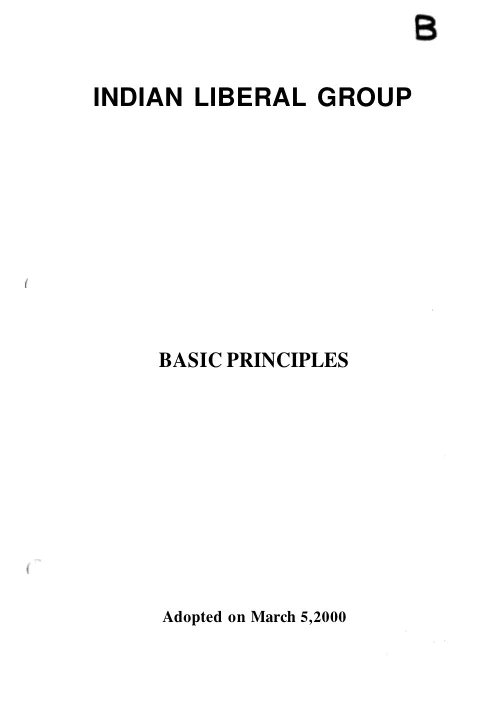
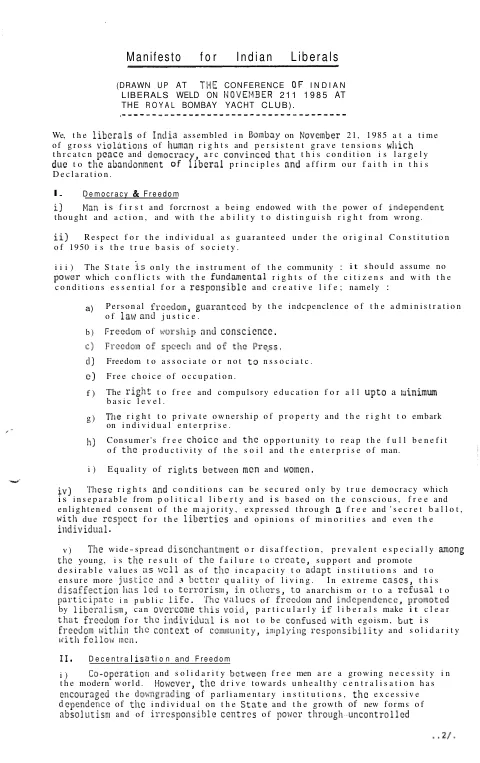
The Manifesto for Indian Liberals is a brief programmatic declaration adopted on November 21, 1985 by a conference of Indian liberals assembled at the Royal Bombay Yacht Club in Bombay. It opens by identifying the immediate context — gross violations of human rights and persistent grave tensions threatening peace and democracy — and attributes these conditions to the abandonment of liberal principles. The document affirms that only true democracy, grounded in the free and enlightened consent of the majority with due respect for minorities, can secure the rights and freedoms the manifesto enumerates.
Across six sections, the manifesto sets out the core liberal programme. The first section grounds liberal politics in individual sovereignty, affirming personal freedom, freedom of worship and speech, free choice of occupation, the right to property and private enterprise, and equality between men and women. The second warns against the drive toward unhealthy centralisation that has degraded parliamentary institutions and advocates the greatest possible devolution of power, protection of minorities, elimination of racial and oppressive discrimination, and measures against monopolies. Section III argues for continual democratic renewal through proportional representation, decentralisation to local self-government, and inclusion of civil society bodies in checks and balances. Section IV identifies education as the chief instrument for fighting cultural and political intolerance, and calls for a uniform Civil Code, freedom and pluralism in the media, and promotion of education for both sexes at all ages.
The Economic Issues section (V) directly challenges state-dominated planning in India, arguing that three decades of centralised control have produced slow growth, lawlessness, corruption, and a black-market economy. The manifesto advocates a social market economy with limited government, indicative planning only, constant review of public activities for possible return to private enterprise or voluntary organisations, and taxation balanced between individual needs and social investment. It explicitly rejects egalitarianism understood as rigid equality of conditions while strongly supporting equality of opportunity. The concluding section, ‘The Test of Character’, frames the entire project as a demand for elected representatives with integrity and competence whose motivation is achievement rather than power.
Key points
-
Adopted at the Conference of Indian Liberals, Bombay, November 21, 1985; collectively authored, no individual byline.
-
Grounds liberal politics in individual sovereignty: personal freedom, property rights, free occupation, equality of men and women, and freedom of worship and speech.
-
Opposes the drift toward centralisation; calls for maximum devolution of power to states and local self-government within the original 1950 Constitution’s framework.
-
Advocates democratic renewal through proportional representation, minority protections, and inclusion of trade unions and professional bodies in checks and balances.
-
Education identified as the primary weapon against cultural, political, and racial intolerance; demands a uniform Civil Code and media pluralism.
-
Diagnoses three decades of state-controlled planning as the root of slow growth, corruption, lawlessness, and black-market proliferation.
-
Calls for a social market economy with indicative planning, constant review of public-sector activities, and taxation that encourages enterprise.
-
Closes with a character test: liberal progress requires elected representatives motivated by achievement, not power, whose faith lies outside partisan politics.
Metadata and summary are AI-extracted from the source PDF and reviewed for editorial accuracy. The original work is available via the Read PDF tab above (where present); paragraph-level citation inside the PDF is deferred to a future engagement.