occasional paper · statement of principles
Constitution
By Indian Liberal Grouporganisation
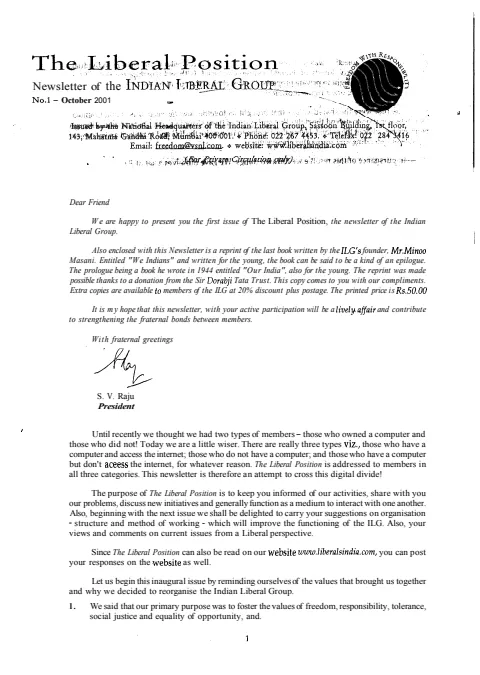
Indian Liberal Group, Sassoon Building, 1st Floor, 143, Mahatma Gandhi Road, Mumbai 400 001. · Mumbai · 2000
14 pages
Part of Indian Liberal Group
Summary
The Indian Liberal Group Constitution, adopted on 4 March 2000 in Mumbai, is the founding governing instrument of the ILG — a liberal civil-society organisation that traces its origins to 1964. The document opens with a substantive statement of objectives (Article 2) that articulates a coherent classical-liberal philosophy: individual liberty paired with personal responsibility as the foundation of civilised society; the state as servant rather than master of citizens; the inviolability of democratic accountability and the rule of law; and the defence of personal liberty, freedom of thought, expression, belief, faith and worship, the right of association, private property, free choice of occupation, and the right to information. The objectives section also commits the ILG to tolerance — with the memorable qualification that ‘while tolerance is integral to liberalism, the ILG will not tolerate intolerance’ — and opposes all forms of monopoly while affirming that ‘the business of government is governance, not business.’
The remaining twenty clauses establish a three-tier federal governance structure: a National Council (comprising Presidents and Secretaries of State Executives) that elects the National President and up to twelve members of the National Executive and is responsible for all policy pronouncements; a National Executive that conducts day-to-day activities; and State Councils, State Executives, and District Committees mirroring the national structure at sub-national levels. Membership is open to individuals and like-minded organisations that accept Article 2’s principles, with four categories — Life, Active, Ordinary, and Associate — carrying tiered subscription fees ranging from Rs.10 per year (Ordinary) to a one-time Rs.2,000 (Life). Political parties are explicitly barred from Associate Membership. The constitution caps office-bearer terms at two consecutive terms, sets a two-thirds supermajority for constitutional amendments, and requires a National Convention at least every three years. Three annexures list the 17-member Drafting Group, the 13 Founding Members of the Executive Committee, and the President and eight members of the Ad-hoc National Executive, with S. V. Raju named as President of the Ad-hoc National Executive.
Key points
-
The ILG was founded in 1964 and formally constituted on 4 March 2000 when this document was adopted by its Executive Committee, whose members thereby became Founding Members.
-
Article 2 (Objectives) is the ideological core: it enumerates individual liberty, responsibility, tolerance, social justice, equality of opportunity, the rule of law, private property, free association, and freedom of expression as foundational liberal values.
-
The ILG explicitly positions itself against monopoly in any form and holds that ‘the business of government is governance, not business.’
-
Governance is organised on a three-tier federal model — National Council / National Executive at the top, mirrored by State Councils / State Executives, and District Committees at the base.
-
Four membership categories (Life, Active, Ordinary, Associate) allow both individuals and voluntary organisations to join; political parties are explicitly excluded from Associate Membership.
-
Membership fees are split across tiers: Life and Active membership revenue flows 50% to the National Executive, 25% to State Executives, 25% to District Committees.
-
Constitutional amendments require a two-thirds majority; office-bearers are limited to two consecutive terms; a National Convention must be held at least once every three years.
-
S. V. Raju served as President of the Ad-hoc National Executive; the Drafting Group comprised 17 named members including Raju and several women (Anjali Patil Gaikwad, Kashmira Rao, Mary Thomas).
Metadata and summary are AI-extracted from the source PDF and reviewed for editorial accuracy. The original work is available via the Read PDF tab above (where present); paragraph-level citation inside the PDF is deferred to a future engagement.