occasional paper · position paper
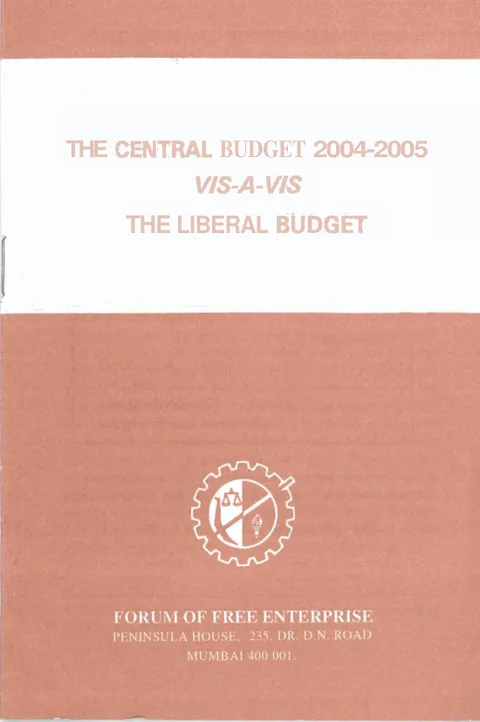
The Liberal Budget
Building An Equitable Society.
Kashmira Rao for the PROJECT FOR ECONOMIC EDUCATION, 3rd floor, Army & Navy Building, 148, Mahatma Gandhi Road, Mumbai 400 001. · Mumbai · 2004
45 pages
Part of The Liberal Budget
Summary
The Liberal Budget: Building an Equitable Society presents a model fiscal framework developed in 2004 by a Drafting Group convened by the Indian Liberal Group’s Project for Economic Education. The preface, signed by S. V. Raju as Executive Chairman, explains that the document was designed as a template and benchmark against which to evaluate actual Union Budgets, and that it draws on consultations held at the Leslie Sawhny Centre in Deviall and with economists and civil servants in Chennai. S. S. Bhandare’s Introduction characterises the fiscal environment as one of severe constraint, arguing that a genuinely liberal economic environment is a precondition for any effective budget, and closes with a postscript acknowledging the newly elected UPA government’s Common Minimum Programme while asserting that the Liberal Budget’s ‘human face’ is stronger than that of the CMP without diluting liberal reform.
The Executive Summary states that the Liberal Budget’s philosophical bedrock is that ‘man is the measure of all things’ and that the business of government is governance, not business. It sets out nine concrete human-development targets for 2007 and 2012 (including halving poverty, achieving near-universal primary schooling, and reducing infant and maternal mortality), and outlines five governing objectives: Effective Fiscal Governance, Fiscal Consolidation and Stabilisation, Efficiency and Productivity, Acceleration of Growth, and Promotion of Equity. It advocates a shift in the composition of expenditure from non-development to development spending, rationalisation and simplification of the tax system guided by the Kelkar Committee Report, accelerated privatisation of PSUs on the principle that the test is whether the state should be in an activity at all rather than whether it is profitable, and a suite of structural reforms including independent regulators, labour-law reform, agricultural deregulation, and e-governance.
Chapter 1 (‘Liberal Perspectives and Human Development’) opens with a philosophical statement of the Liberal position — citing Ludwig von Mises, Gopal Krishna Gokhale, and D. V. Gundappa — and moves into the five operational tenets of the Liberal Budget, covering Effective Fiscal Governance (including the Fiscal Responsibility Act and e-governance), Fiscal Consolidation, Efficiency and Productivity (including Kelkar Committee tax reforms and PSU divestment), Acceleration of Growth (targeting 8–9% per annum), and Promotion of Equity. Section 1.3 begins addressing human-development parameters, covering poverty and employment (including a proposed employment-generation programme for below-poverty-line families with an outlay of Rs. 30,000–35,000 crores annually), welfare for those unable to work, agriculture (documenting the decline in GCF in agriculture from 7.47% to 6.02% of GCF between 1993–94 and 2000–01), and the opening of sections on education and health.
Key points
-
The document presents itself as a ‘model Liberal Budget’ — a benchmark template against which actual Union Budgets can be measured, produced by a Drafting Group led by S. S. Bhandare under the ILG’s Project for Economic Education.
-
The philosophical foundation is that ‘man is the measure of all things’ and that the state’s role is governance, not business — referencing von Mises and the liberal tradition.
-
Nine specific human-development targets are set for 2007 and 2012, including reducing poverty by 5 percentage points by 2007, universal primary schooling by 2005–2009, and halving infant and maternal mortality.
-
The Liberal Budget advocates shifting the composition of expenditure decisively towards development spending (raising development expenditure from approximately 7% to 9% of GDP), while strictly capping overall expenditure growth to no more than real GDP growth.
-
Tax reform is framed around the Kelkar Committee Report: no increase in tax rates, rationalisation and simplification of direct and indirect taxes, abolition of search-and-seizure powers and ‘public interest provisions’, and full computerisation of tax operations.
-
Privatisation is presented as a principle not of profit-maximisation but of correct state scope — the test being whether the state should be in a given field at all.
-
Structural reforms advocated include independent regulators, labour-law flexibility, agricultural deregulation and contract farming, single-window trading procedures, judicial reforms, and e-governance leading to ‘Seamless Governance’.
-
The document explicitly distances itself from populist symbolism, stating its dictum as: ‘Everyone knows what’s wrong. The job is to offer the people what is right.’
Metadata and summary are AI-extracted from the source PDF and reviewed for editorial accuracy. The original work is available via the Read PDF tab above (where present); paragraph-level citation inside the PDF is deferred to a future engagement.