speech
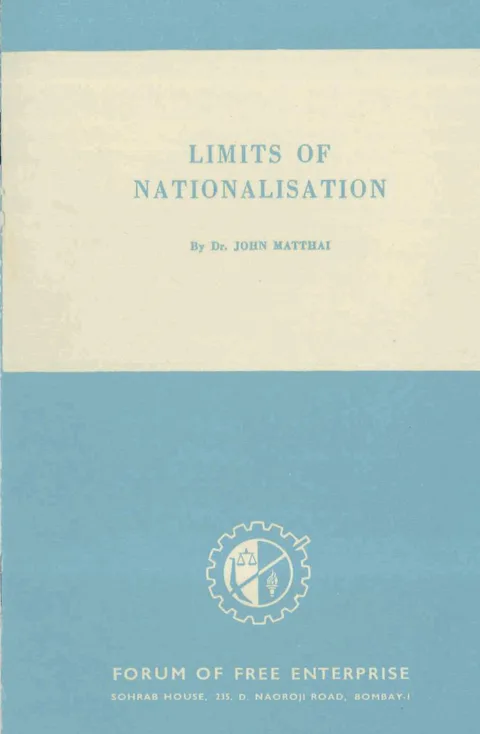
LIMITS OF NATIONALISATION
By John Matthai
FORUM OF FREE ENTERPRISE, SOHRAB HOUSE, 235, D. NAOROJI ROAD, BOMBAY-1 · Bombay
10 pages
Summary
Dr. John Matthai’s short pamphlet “Limits of Nationalisation,” reprinted by the Forum of Free Enterprise from a speech delivered at the Rotary Club, Bombay, mounts a careful, lawyerly case against the general application of nationalisation in Indian industrial policy. Matthai concedes that state enterprise has a legitimate place where there is “proved necessity” — defence-related industries are his prima facie example — but insists that free enterprise should be the rule and state ownership the narrowly justified exception, decided industry by industry on the merits rather than by a priori categories or by appeal to a Socialist Pattern of Society.
The argument rests on two main lines. First, Matthai rereads the genealogy of socialism: he argues that Marx’s thesis of socialising the means of production was a response to nineteenth-century conditions — despotic governments, propertied-class capture of the state, and the bargaining weakness of labour — which no longer obtain in democratically governed countries with adult franchise and sovereign parliaments. Keynesian state participation and Roosevelt’s New Deal, he reminds his audience, were emergency measures whose own architects warned against turning them into permanent ownership of the instruments of production. Second, Matthai questions whether the Government of India’s administrative apparatus can actually deliver the speedy development that the case for nationalisation presupposes: India is, in his judgement, one of the most under-administered countries in the world, the dynamic momentum supplied by the post-Independence leadership cannot last, and the civil service has grown too cautious, too legalistic and too risk-averse to run productive enterprises well.
A further section trains his fire on the Planning Commission, which he frankly says he has “never been happy about”: a body of experts has, through adventitious circumstances, displaced cabinet responsibility for economic policy, leaving ministers without initiative in the very areas where their political accountability is most needed. The dislocation of partition, expenditure pressures from neighbouring countries, and a fresh inflationary trend are flagged as further reasons to proceed slowly. Matthai closes with a four-point programme — nationalisation should be strictly limited in scope, applied selectively to specific industries rather than whole categories, empirical in approach, and as decentralised as possible — and a ringing defence of freedom of enterprise as “one of the greatest freedoms in a democratic community.”
Key points
-
Matthai’s controlling thesis: free enterprise should be the rule and nationalisation the narrowly justified exception, decided on the merits of each industry rather than by a priori categories.
-
He rereads Marx historically — socialisation of the means of production made sense against nineteenth-century despotism and propertied-class capture, but loses its grip in democratically governed states with adult franchise and a sovereign parliament.
-
Keynesian state participation and Roosevelt’s New Deal are read as emergency stabilisation measures, not as a doctrinal warrant for permanent state ownership of industry.
-
He distinguishes the first Five-Year Plan (essentially piecemeal projects designed before Independence) from the second, which is a genuinely comprehensive plan demanding far larger finance — and warns that deficit financing carries serious risks.
-
Implementing such a plan, he argues, will require unprecedented administrative and financial capacity, which the Government of India does not possess: India is one of the most under-administered countries in the world.
-
The civil service is now too slow, too legalistic, and too fearful of risk to run nationalised enterprises well; political chiefs are increasingly adopting officials’ caution rather than overriding it.
-
He attacks the Planning Commission as a body of “amateurs” with whom final responsibility for economic decisions has come to rest, displacing the cabinet ministers who alone are politically accountable.
-
His closing four-point programme: nationalisation should be strictly limited in scope, applied selectively to specific industries, empirical in approach, and as far as possible decentralised.
Metadata and summary are AI-extracted from the source PDF and reviewed for editorial accuracy. The original work is available via the Read PDF tab above (where present); paragraph-level citation inside the PDF is deferred to a future engagement.