speech · memorial lecture
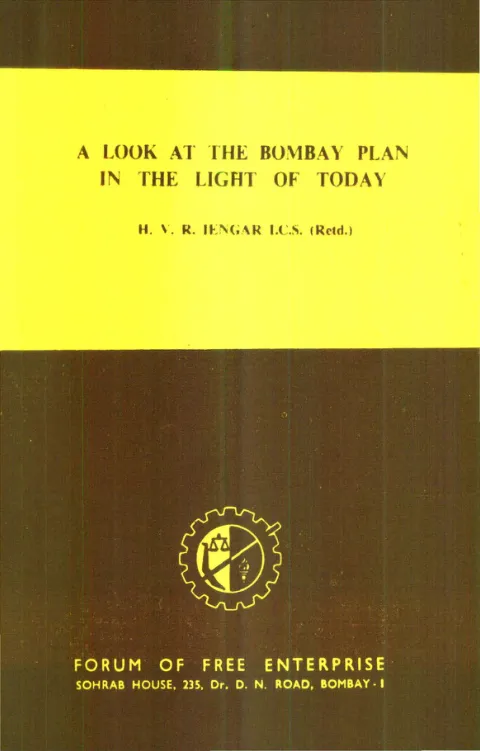
A Look at the Bombay Plan in the Light of Today
Published by M. R. Pai for the Forum of Free Enterprise, 235, Dr. Dadabhai Naoroji Road, Bombay-1, and Printed by Michael Andrades at the Bombay Chronicle Press, Horniman Circle, Bombay-1. · Bombay · 1968
20 pages
Part of A. D. Shroff Memorial Lecture
Summary
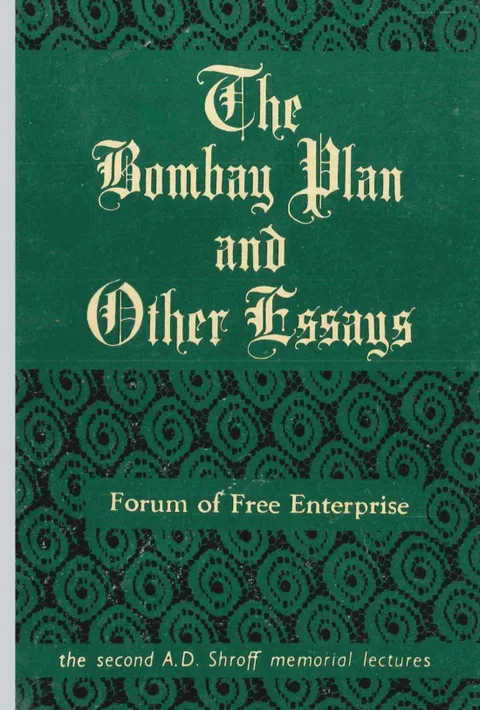
Delivered as the Second A. D. Shroff Memorial Lecture in Bombay on 27 October 1967 and published as a Forum of Free Enterprise booklet on 11 January 1968, H. V. R. Iengar’s address takes the 1944 Bombay Plan — co-authored by A. D. Shroff alongside Purshotamdas Thakurdas, J. R. D. Tata, G. D. Birla, Sriram, Kasturbhai Lalbhai and John Matthai — as a mirror for India’s later experience with state planning. Iengar reads the Bombay Plan as the prototype of the post-independence Planning Commission’s approach: massive State intervention, a mixed economy with public-sector primacy, emphasis on heavy industry, foreign capital, and deficit financing. He argues that the Planning Commission “got its inspiration from the Bombay plan”, and that A. D. Shroff himself was, in 1944, one of its principal proponents.
The core of the lecture explains why Shroff later broke with that doctrine and set up the Forum of Free Enterprise in 1956. Quoting at length from the Forum’s manifesto, Iengar locates the difference “in two things”: the Forum demands the greatest possible scope for private enterprise rather than a vast and rapidly expanding public sector, and the reduction of controls to a minimum so that a market economy can operate. He traces Shroff’s growing disillusion through the 1960 speech “Controls in a Planned Economy”, in which Shroff condemned licensing, capital-issue and foreign-exchange controls as bad in practice however defensible in theory — a “wintry despair” compared with the “high noon” of the Bombay plan.
Iengar then offers his own diagnosis of why India’s planning experiment has disappointed. The Bombay Plan and the Government plans both assumed two impossible conditions — a Government in real rapport with the people, and an efficient administrative machinery for executing controls and public-sector projects — and both assumptions, he says, have proved false. Repeated electoral dominance by a monolithic Congress bred doctrinaire intolerance of criticism; treatment of industry as “anti-social and unpatriotic”; proliferation of red tape; and a bureaucracy demoralised in the face of an impossible task. He recalls J. R. D. Tata’s call (later vindicated by events) for a “plan holiday” after the third Five-Year Plan, and his own self-censored years at the Reserve Bank as illustrations of the price India pays for the “fear complex” between business and Government.
The lecture closes with a guarded liberal optimism. The Forum’s manifesto — which rejects both nineteenth-century laissez-faire and Marxist state ownership in favour of “socially responsible private initiative” within a planned economy — would, Iengar argues, form the best foundation for economic progress. India is passing through a transitional stage between forces of property rights and the Rule of Law on one side and forces of expropriation and “revolution through chaos” on the other; survival of the liberal option depends on frank speech, governmental willingness to listen, and the special responsibility resting on business leaders — “Herein lies the great example of A. D. Shroff.” A short editorial biography of Shroff and the Forum’s standard membership pages close the booklet.
Key points
-
Iengar argues that the 1944 Bombay Plan — co-authored by A. D. Shroff with Thakurdas, Tata, Birla, Sriram, Kasturbhai Lalbhai and John Matthai — supplied the template of massive State intervention later adopted by the Planning Commission of India.
-
The Bombay Plan envisaged doubling per-capita income in 15 years at a total outlay of Rs. 10,000 crores (about Rs. 50,000–60,000 crores at late-1960s prices), and explicitly required rigorous State controls including price-fixation, dividend limits and licensing.
-
Shroff’s subsequent founding of the Forum of Free Enterprise in 1956 and his 1960 lecture “Controls in a Planned Economy” mark a substantive break from his Bombay-Plan-era acceptance of “rigorous” State control.
-
The Forum’s manifesto, which Iengar endorses, rejects both nineteenth-century laissez-faire and Marxist state-ownership, advocating instead “socially responsible private initiative” within a planned but market-led economy.
-
Iengar identifies two false assumptions behind Indian planning: real rapport between Government and people, and an efficient bureaucracy capable of administering controls and public-sector projects.
-
He attributes the Congress regime’s intolerance of criticism, doctrinaire posture and proliferation of red tape to the monolithic dominance of a single party — a condition only now beginning to loosen.
-
He invokes J. R. D. Tata’s earlier proposal for a ‘plan holiday’ after the third Five-Year Plan, noting that events ultimately forced Government to adopt it.
-
The lecture closes by framing India as passing through a transitional contest between forces of property rights and the Rule of Law and forces of expropriation and revolutionary chaos, and assigns a ‘special responsibility’ to business leaders to defend the liberal option.
Metadata and summary are AI-extracted from the source PDF and reviewed for editorial accuracy. The original work is available via the Read PDF tab above (where present); paragraph-level citation inside the PDF is deferred to a future engagement.