pamphlet
LIMITATIONS OF NATIONALISATION
With best compliments from : THE FORUM OF FREE ENTERPRISE, "Sohrab House", 235, Dr. Dadabhai Naoroji Road, BOMBAY 1. · Bombay · 1956
3 pages
Summary
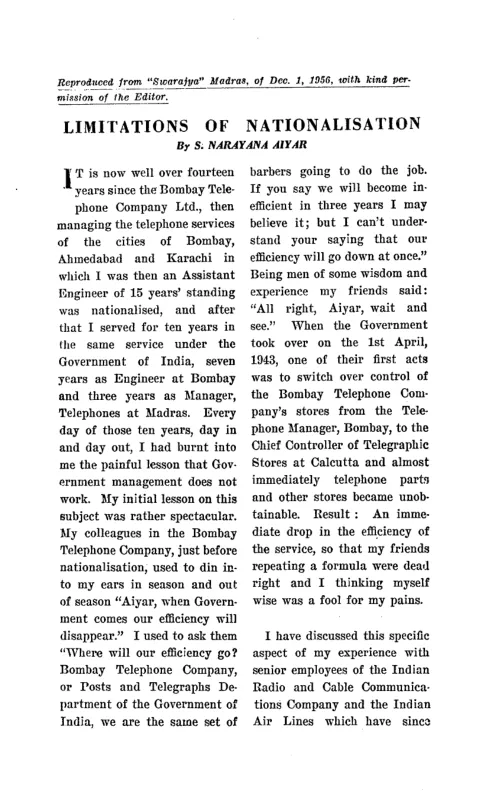
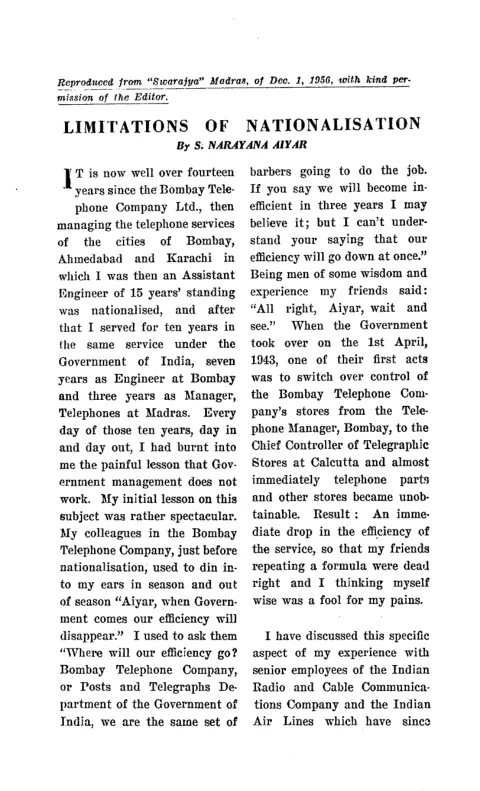
S. Narayana Aiyar’s “Limitations of Nationalisation” — reprinted by the Forum of Free Enterprise from Swarajya (Madras), 1 December 1956 — is a first-person indictment of state ownership drawn from the author’s own career. Aiyar served as an Assistant Engineer at the privately run Bombay Telephone Company before its nationalisation, then spent ten further years inside the Government of India’s telephone service (seven as Engineer at Bombay, three as Manager of Telephones, Madras). Day after day, he writes, he had “burnt into” him the lesson that government management does not work. When the State took over on 1 April 1943, one of its first acts — switching stores control from the Bombay Telephone Manager to the Chief Controller of Telegraphic Stores at Calcutta — produced an immediate collapse in service: telephone parts became unobtainable and his old colleagues, who had warned him “when Government comes our efficiency will disappear,” were proved “dead right.”
The core argument is that nationalisation degrades work not by accident but by structure. Expenses go up, service goes down “almost immediately,” and the tempo of effort “goes down with immediate effect” because what had been “honest work for wages” becomes “the paper-pushing routine characteristic of every Government office.” Aiyar offers two concrete illustrations: a quotation from the Government Press, Madras, of Rs. 21,500 to print and bind 13,000 copies of the Madras Telephone Directory for which he had been paying just over Rs. 6,000 in the private market; and the report of Mr. Scaife, a tool-man invited from England under the Colombo Plan by Sri T. T. Krishnamachari to examine the Prototype Machine Tool Factory at Ambernath and the Hindustan Machine Tool Factory at Jalahalli, who concluded that “any reputable private agency would have obtained five times the result at one-fifth the total cost.”
Aiyar generalises from these cases into a structural claim: government institutions return to the public only about a third of the sums they expend, partly because public-sector employees take pride in not being “governed by the profit motive,” partly because audit-driven inquiries and routine displace any return-to-the-office discipline that operates in commercial life. His conclusion is the Forum of Free Enterprise’s house position rendered in workplace prose — the private sector should have the exclusive right to manage all commercial, industrial and public utility services, while government confines itself to “planning, regulating and controlling at the bar of public opinion in India.” Even if the State were to own the means of production outright, he argues, the best route to output is to break the work into independent units placed on long-term contracts with fair operational independence, rather than “trying to run it all with its own monolithic organisation.”
Key points
-
Aiyar grounds his case against nationalisation in 25 years of personal service — 15 with the privately-owned Bombay Telephone Company and 10 inside the Government of India’s nationalised successor as Engineer (Bombay) and Manager (Madras).
-
He dates the operational collapse to a specific act: on 1 April 1943, the State switched stores control from the Bombay Telephone Manager to the Chief Controller of Telegraphic Stores at Calcutta, and parts “almost immediately” became unobtainable.
-
The structural cost of state ownership, in Aiyar’s reading, is the conversion of “honest work for wages” into “paper-pushing routine,” producing an “immediate” drop in tempo even with the same workforce.
-
He offers a price comparison as illustrative evidence: the Government Press, Madras, quoted Rs. 21,500 to print 13,000 copies of the Madras Telephone Directory against the just-over-Rs. 6,000 he had been paying privately.
-
He cites Mr. Scaife — brought from England by Sri T. T. Krishnamachari under the Colombo Plan — who, after examining the Ambernath and Jalahalli machine tool factories, told the Government of India that a private agency “would have obtained five times the result at one-fifth the total cost.”
-
Aiyar generalises: government institutions return only about a third of the value of the sums they expend, with the rest dissipated in audit-driven routine and the absence of a profit-motive check on activity.
-
His prescription is a strict division of labour — private exclusivity in commercial, industrial and public-utility operation; government confined to planning, regulation and answerability “at the bar of public opinion.”
-
Even under public ownership, he argues, the right delivery model is decentralised: breaking work into independent units under long-term contracts rather than running it through a single monolithic state organisation.
Metadata and summary are AI-extracted from the source PDF and reviewed for editorial accuracy. The original work is available via the Read PDF tab above (where present); paragraph-level citation inside the PDF is deferred to a future engagement.