pamphlet
LIMITATIONS OF NATIONALISATION
With best compliments from : THE FORUM OF FREE ENTERPRISE, "Sohrab House", 235, Dr. Dadabhai Naoroji Road, BOMBAY 1. · Bombay
3 pages
Summary
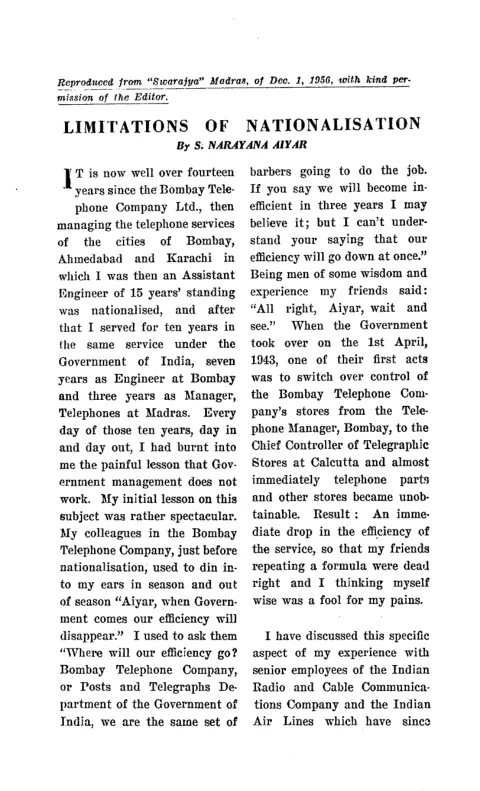
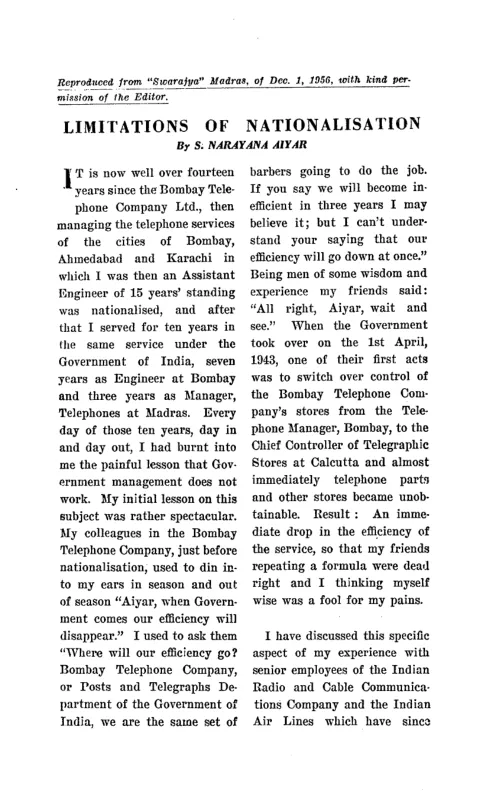
S. Narayana Aiyar draws on twenty-four years of firsthand telephone-administration experience — fourteen-plus years with the Bombay Telephone Company Ltd. before nationalisation, and ten years thereafter under the Posts and Telegraphs Department (seven as Engineer at Bombay, three as Manager at Madras) — to argue that government management of commercial undertakings is, in his words, an inherent failure. He recalls his pre-nationalisation colleagues warning him that efficiency would ‘disappear’ once the state took over, and recounts how, within days of the April 1, 1943 takeover, the transfer of the Telephone Company’s stores from the Bombay Manager to the Chief Controller of Telegraphic Stores at Calcutta made telephone parts ‘unobtainable’ and produced an immediate drop in service quality.
Aiyar marshals concrete cost evidence to extend the indictment. The Madras Telephone Directory, which he had previously printed and bound through private contractors for just over Rs. 6,000 for 13,000 copies, drew an estimate of Rs. 21,500 from the Government Press, Madras — with a proviso that the final bill might be higher still. He cites an episode in which T. T. Krishnamachari invited an English expert, Mr. Scaife, under the Colombo Plan to examine the Prototype Machine Tool Factory at Ambernath and the Hindustan Machine Tool Factory then under construction at Jalahalli; Scaife reported that a reputable private agency would have obtained five times the result at one-fifth the total cost. Aiyar generalises that across a wide range of his experience, government institutions deliver in the shape of value to the public about a third of what they spend, dragged down by ‘unnecessary work’, ‘offensive inquiries’ and audit-department harassment that crowd out productive effort.
The essay closes with a programmatic distinction that has since become a touchstone of the Forum of Free Enterprise literature: government should plan, regulate and control, but should not administer or operate commercial, industrial and public-utility services. Drawing on experience ‘both here and in other countries’, Aiyar argues that government agency is ‘a very unsuitable instrument for trade, manufacture and the operation of public utility services’, and that the state, even when it owns the means of production, is best advised to lease them to competent private operators on long-term contracts rather than attempting monolithic administration. The pamphlet is a reprint of an article first published in Swarajya (Madras) of December 1, 1956, issued by the Forum of Free Enterprise.
Key points
-
Author served fourteen-plus years with the Bombay Telephone Company Ltd. before its 1943 nationalisation and ten years under the Posts and Telegraphs Department thereafter, giving the essay an unusual insider’s vantage on the transition.
-
Within days of the April 1, 1943 government takeover, control of the Telephone Company’s stores was shifted from the Bombay Manager to the Chief Controller of Telegraphic Stores at Calcutta, after which telephone parts and other stores became ‘unobtainable’ and service quality dropped immediately.
-
Cost comparison on the Madras Telephone Directory: Rs. 6,000-plus for 13,000 copies under private contract, against an estimate of Rs. 21,500 from the Government Press, Madras with a proviso that the actual bill might be larger.
-
T. T. Krishnamachari engaged Mr. Scaife from England under the Colombo Plan to evaluate the Prototype Machine Tool Factory at Ambernath and the Hindustan Machine Tool Factory at Jalahalli; Scaife concluded a competent private agency would have achieved five times the output at one-fifth the cost.
-
Aiyar generalises that government institutions return to the public roughly one-third of the value of the sums they spend, dragged down by unnecessary work, offensive inquiries and audit-department checks that crowd out productive effort.
-
Programmatic conclusion: government should be confined to planning, regulation and control; the exclusive right to manage commercial, industrial and public-utility services should rest with the private sector.
-
Even where the state owns means of production, Aiyar argues, it should split them into independent units leased to private operators on long-term contracts rather than attempt monolithic administration.
-
The essay is a December 1, 1956 Swarajya article reprinted as a Forum of Free Enterprise pamphlet from ‘Sohrab House’, 235 Dr. Dadabhai Naoroji Road, Bombay 1.
Metadata and summary are AI-extracted from the source PDF and reviewed for editorial accuracy. The original work is available via the Read PDF tab above (where present); paragraph-level citation inside the PDF is deferred to a future engagement.