pamphlet
Telephone Communication and Urban Development In India
FORUM OF FREE ENTERPRISE, PIRAMAL MANSION, 235 DR. D. N. ROAD, BOMBAY 400 001. Published by M. R. PAI for the Forum of Free Enterprise, "Piramal Mansion", 235 Dr. Dadabhai Naoroji Road, Bombay-1, and printed by B. D. Nadirshaw at Bombay Chronicle Press, Sayed Abdulla Brelvi Road, Fort, Bombay-1. · Bombay · 1977
19 pages
Telephone Communication and Urban Development In India
By Dr. Rashmi Mayur
Summary
Dr. Rashmi Mayur, a futurologist and Director of the Urban Systems Centre at NITIE Powai, examines the failing state of telephone services in Bombay and argues that adequate telecommunications infrastructure is a precondition for India’s economic development. Opening with a Parisian visitor’s coinage of the word ‘telefrustration’ after two days of failed attempts to call Colaba from Malad, Mayur sets a paradox: in an age when humans can speak to one another across 238,000 miles to the moon, it remains agonising to place a 25-mile call within a single city. He frames the telephone as ‘a vital force for modernization and development’, noting that more than fifty per cent of Indian telephones sit in major urban centres even though only twenty per cent of the population lives there, and that urban life — business, government, medical emergency, fire, police — has become inconceivable without it.
The booklet builds its case from a sample survey of 3,000 Bombay subscribers and operational data from the Bombay Telephone Company. India has 1.8 million telephones for a population of 605 million (one for every 333 persons); Bombay alone has 179,000 direct exchange lines, a waiting list of 67,324 as of October 1976, an annual complaint volume of about 75,000, and roughly 14 per cent of telephones out of order on a normal day (rising to 25 per cent during the monsoon). The survey records the litany of defects — difficulty reaching operator services (61%), defective hearing (58%), cross-connections (54%), rude operators (51%), wrong numbers (43%) — and Mayur estimates that 42 person-days a day are wasted in the city merely dialling numbers. Seventy per cent of public telephones are out of order on any given day, and management problems include low productivity in the repair department, poor co-ordination among linesmen and mechanics, and the technologically overloaded Cross-bar exchange system adopted in 1967.
The second half lays out recommendations across three tracks. For the Bombay Telephone Company: dedicated complaint numbers for each exchange, underground cabling, adequate spare parts, working air-conditioning in exchanges (the Powai exchange has had none for six months), an end to the multiple-telephone-to-one-subscriber scheme that allows some homes to hoard half-a-dozen lines, an expert public grievances committee, time-bound repair commitments, and dropping the wasteful ‘Namaskar’ operator greeting in favour of efficient courtesy. For the public: brief and precise calls, hanging up on cross-connections rather than abusing the other party, and a strong stricture against subscribers who profit by charging neighbours a rupee a call. For public telephones — Mayur’s structural answer to chronic shortage — he proposes a city-wide network of self-contained, attended booths of three sizes (Type I two phones, Type II four phones, Type III six phones, costing Rs. 7,557 to Rs. 15,770), beginning with 1,500 booths in critical areas which he estimates would alleviate 70 per cent of the city’s telephone problems, financed by booth-side advertising and joint ventures between the Bombay Municipal Corporation, the Telephone Company, the State Government and ‘enlightened industrialists’.
The work closes with the judgement that ‘Bombay cannot afford to have the best service or the worst service because both of them would be very expensive. It has to find the best out of the worst’ — and that what is true of Bombay is true of the rest of the country. The pamphlet is based on a presentation given at a Bombay Civic Trust meeting on 6 November 1976.
Key points
-
Frames the telephone as essential infrastructure for India’s economic development: business, government, medicine, fire, and police functions are inconceivable without it.
-
India has 1.8 million telephones for 605 million people (1 per 333), against the United States’ 145 million for a population giving 1 per 1.5 persons; over 50% of Indian telephones sit in major urban centres where only 20% of the population lives.
-
Bombay-specific data: 179,000 direct lines, 300,000 instruments for 7 million people, 3,000 public telephones, a waiting list of 67,324 as of October 1976, and 75,000 complaints a year.
-
A 3,000-subscriber survey ranks defects: operator-service difficulty (61%), defective hearing (58%), cross-connections (54%), rude operators (51%); Mayur estimates 42 person-days a day are lost in the city to dialling alone.
-
Identifies the Cross-bar exchange system (adopted in 1967 in preference to Strowger step-by-step) as overloaded, with poor service following because Cross-bar efficiency is inversely proportional to load.
-
Recommends rationalising the Bombay Telephone Company: dedicated complaint numbers per exchange, underground cabling, adequate spare parts, working air-conditioning in exchanges, ending the multiple-telephones-per-subscriber abuse, a public grievances committee, time-bound repairs, and dropping the wasteful ‘Namaskar’ operator greeting.
-
Proposes a city-wide network of attended public-telephone booths (Type I, II and III, costing Rs. 7,557 to Rs. 15,770), beginning with 1,500 in critical areas — Mayur projects this would alleviate 70% of Bombay’s telephone problems and could be financed by booth-side advertising and a Municipal Corporation-Telephone Company-State Government-industrialist joint venture.
-
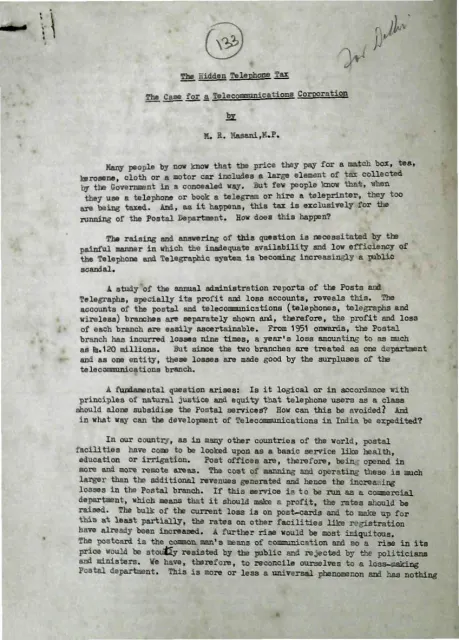
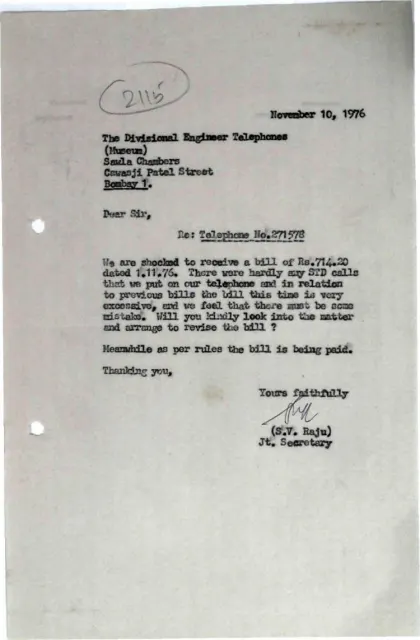
Raises but does not resolve the governance question of whether the telephone system should remain a government department or be reconstituted as a public corporation subject to Parliament; flags the need for an independent pricing commission to scrutinise unilateral tariff hikes and for a public remedy against overbilling.
Generated by the v1.5 extraction pipeline. Awaiting editorial review.
Metadata and summary are AI-extracted from the source PDF and reviewed for editorial accuracy. The original work is available via the Read PDF tab above (where present); paragraph-level citation inside the PDF is deferred to a future engagement.