speech
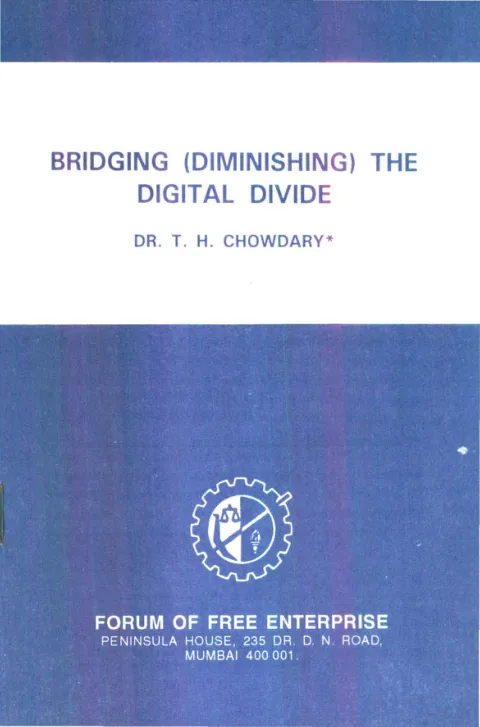
BRIDGING (DIMINISHING) THE DIGITAL DIVIDE
FORUM OF FREE ENTERPRISE, PENINSULA HOUSE, 235 DR. D. N. ROAD, MUMBAI 400 001 · Mumbai · 2002
32 pages
Summary
Dr. T. H. Chowdary’s lecture, delivered in Mumbai on 16 August 2002 under the joint auspices of the Forum of Free Enterprise and the Indian Merchants’ Chamber, reframes the much-discussed ‘digital divide’ as a tractable policy problem rather than an indictment of technology. He opens with a long historical arc — from oral transmission to Gutenberg’s moving type, from libraries to electronified information — to argue that prosperity has always tracked the diffusion (not the concentration) of knowledge. The 19th-century take-off in per-capita world GDP, charted from Angus Maddison’s data, is for him the visible signature of widely accessible information and skill.
He then walks through the cost economics of telecommunications: the dramatic fall in trans-Atlantic cable costs from 1956 to 1996, the collapse in storage costs per megabyte, the rise of optical-fibre and satellite backbones, and the convergence of voice, video, text and data on the Internet. From this he draws his central operational claim — ‘carriage will be free but the content will be priced’ — and argues that the Internet is best understood as a universal post office, broadcast studio, classroom, shop and clearing house rolled into one.
On the divide itself, Chowdary distinguishes a populist usage (favoured, he says, by ‘sociologists and politicians, especially the populist variety’) from an engineer’s diagnosis. India has already solved the ‘missing link’ problem for telephony — 450,000 of 650,000 villages now have a public telephone, and Very Small Aperture Terminals will pick up the remainder. The next step, he argues, is to upgrade Public Telephones into Public Tele-Information Centres (PTICs) staffed by a trained attendant — the village grocer, tailor or teacher — who can broker Internet access on behalf of illiterate or non-English-speaking users, much as he already does for the telephone. This ‘attendant model’ converts illiteracy and language from blocking constraints into routable problems.
The final stretch is a classical-liberal indictment of Indian telecom policy circa 2002. Despite seven years of de-monopolisation, government has ‘made the service costlier than what it could be’ by piling on entrance fees, revenue share, cost-unrelated interconnection charges and inflated spectrum prices — extractions, he insists, that bear no relation to network costs and are simply revenue-grabs. He contrasts this with the IT Task Force’s accepted recommendation that Internet service carry no such imposts, and with China, which adds 50 million mobile and 20 million fixed lines annually against India’s 3 and 5 million. His prescription: scrap the punitive levies driven by the incumbent Bharat Sanchar, license-free entry for rural telephony and Internet kiosks, and a system designed so that the rise in per-capita income and the fall in telecom prices together make affordability rise non-linearly.
Key points
-
Frames technology diffusion — not technology itself — as the historical driver of prosperity, citing literacy gains and Maddison’s per-capita GDP series.
-
Uses falling TAT cable costs (1956–1996) and storage cost curves to argue that telecom carriage is approaching free, with pricing migrating to content.
-
Distinguishes the engineer’s ‘missing link’ framing from the populist ‘digital divide’ framing, and proposes the latter is solvable with the same incrementalism that delivered village telephony.
-
Proposes upgrading rural Public Telephones into Public Tele-Information Centres (PTICs) operated by a trained local attendant who brokers Internet access for illiterate or non-English users.
-
Argues that India’s main barrier to bridging the divide is not technology but government rent extraction — entrance fees, revenue share, interconnection charges, spectrum prices — that have no relation to network costs.
-
Cites China’s lead in mobile, fixed and Internet uptake as proof that removing extraneous burdens unlocks non-linear growth in affordability.
-
Recommends a near-licence-free regime for rural Internet kiosks: registration with TRAI/DOT, technology compatibility as the only condition, and competition over revenue share with the network operator.
Metadata and summary are AI-extracted from the source PDF and reviewed for editorial accuracy. The original work is available via the Read PDF tab above (where present); paragraph-level citation inside the PDF is deferred to a future engagement.