speech · memorial lecture
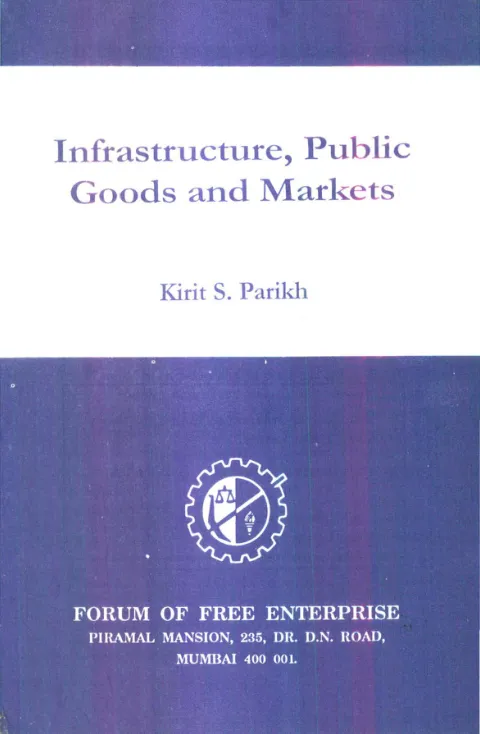
Infrastructure, Public Goods and Markets
FORUM OF FREE ENTERPRISE PIRAMAL MANSION, 235, DR. D.N. ROAD, MUMBAI 400 001. · Mumbai
28 pages
Summary
Delivered as the Dr. M. H. Gopal Memorial Lecture at the 81st Annual Conference of the Indian Economic Association in December 1998 and reprinted by the Forum of Free Enterprise, Kirit S. Parekh’s lecture diagnoses India’s infrastructure deficit and prescribes market-based remedies. He opens with a survey of bottlenecks — peak power shortages around 10 percent, congested ports that impose demurrage running into hundreds of crores, crawling Mumbai traffic, polluted rivers and air, and a telephone density of 13 per 1000 persons against a world average of 110. The root cause, he argues, is chronic underinvestment driven by public-sector enterprises that cannot charge appropriate user fees, by political capture (notably the agricultural electricity subsidy that has grown from 3.9 percent of demand in 1950-51 to nearly 30 percent today) and by overstaffed State Electricity Boards whose T&D losses largely mask outright theft.
The rest of the lecture builds a positive programme for using markets and price signals to deliver infrastructure and manage public goods. Parekh proposes open electronic limit-order-book markets for electricity (with the distribution company as market-maker and a separate independent regulator for the transmission monopoly), competitive distribution at taluka or district scale, and BOT-style auctions for roads where bidders compete on the minimum present-discounted value of revenue rather than on toll levels. For open-access roads he sketches a land-value-capture mechanism using auctioned FSI to finance flyovers and expressways, and for telecommunications — where optical fibre has driven the marginal cost of carrying traffic close to zero — he urges complete deregulation, letting anyone enter and leasing only bandwidth at internationally comparable rates.
The closing sections turn to environmental public goods. Citing suspended-particulate-matter levels in Delhi at eight times WHO standards and rising 40 percent in two years, Parekh argues that command-and-control approaches built on best-available-technology emission standards are both informationally and economically inferior to tradable emission permits. He works through a stylised two-firm example to show that equalising the marginal cost of abatement across emitters minimises social cost, and proposes that municipal authorities issue and auction permits which then trade like shares on India’s existing stock-market infrastructure, with futures and options to guide investment under price volatility. The lecture is, in effect, a sustained case that the design of competitive markets — not the multiplication of regulators or the renegotiation of bilateral PPAs — is the cheapest route to infrastructure adequacy and environmental quality.
Key points
-
India’s growth is constrained by acute infrastructure shortages: ~10% peak power deficit, port congestion costing hundreds of crores in demurrage on petroleum imports alone, and a telephone density of 13 per 1000 versus 110 worldwide.
-
The root cause is underinvestment by public-sector enterprises that cannot charge appropriate user fees, compounded by political interference and soft budget constraints.
-
Agricultural electricity subsidies have ballooned from 3.9% of demand in 1950-51 to ~30% in 1993-94, totalling Rs 7,000 crore per year and crippling State Electricity Boards’ capacity to invest or supply reliably.
-
Parekh proposes splitting electricity into competitive generation (via open electronic limit-order-book spot and futures markets), a regulated transmission monopoly under an independent regulator, and small-scale distribution monopolies at taluka or district level so that local bodies can recycle surplus into schools, roads and clinics.
-
Roads should be financed via BOT auctions on minimum present-discounted revenue (rather than minimum toll), with open-access roads funded by capturing land-value uplift through auctioned floor space index (FSI).
-
Telecommunications already shows the gains from competition; with optical fibre making the marginal cost of carrying traffic nearly zero, Parekh urges complete deregulation and leasing of bandwidth at internationally comparable rates.
-
Tradable emission permits — issued by municipal authorities up to the ambient absorptive capacity (e.g. 100,000 1-kg permits for a 100-tonne Mumbai cap) and traded on existing stock-exchange infrastructure — would equalise marginal abatement costs and outperform best-available-technology standards.
-
Across sectors the recurring claim is that well-designed competitive markets, not bilateral PPAs or stand-alone regulators, are the simplest route to economic efficiency in infrastructure and public-goods provision.
Metadata and summary are AI-extracted from the source PDF and reviewed for editorial accuracy. The original work is available via the Read PDF tab above (where present); paragraph-level citation inside the PDF is deferred to a future engagement.