essay
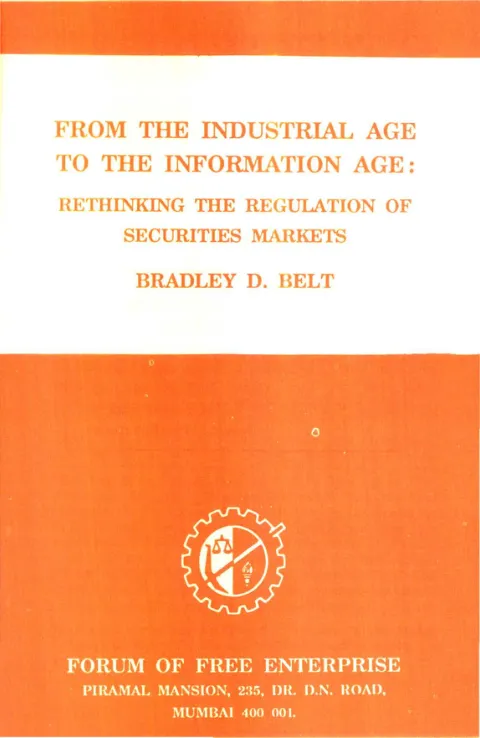
FROM THE INDUSTRIAL AGE TO THE INFORMATION AGE
RETHINKING THE REGULATION OF SECURITIES MARKETS
FORUM OF FREE ENTERPRISE, PIRAMAL MANSION, 235, DR. D.N. ROAD, MUMBAI 400 001. · Mumbai
28 pages
Summary
First published in The Washington Quarterly (Summer 1996 issue) and reproduced as a Forum of Free Enterprise pamphlet (published November–December 1996) with the sponsorship of the Economics Research Centre founded by the late Prof. B. R. Shenoy, Bradley D. Belt’s essay makes the case that the U.S. securities regulatory framework — erected in the shadow of the Great Depression and administered by the SEC for more than 60 years — is fundamentally obsolete and, unless substantially revised, will impair the competitive position of American capital markets in a globalised, technology-driven world. Belt wrote from his position as Director of Capital Markets at the Centre for Strategic and International Studies (CSIS) in Washington, DC, having previously served as Counsel to the SEC and the Senate Banking Committee.
Belt begins with a historical contrast: when Congress enacted the Securities Act of 1933 and the Exchange Act of 1934 in the wake of the Pecora hearings’ revelations of large-scale fraud, the NYSE had a total equity capitalisation of just $16 billion, listed some 800 companies, and traded roughly one million shares a day — a volume now executed every minute. The regulatory framework that emerged from that era, though remarkably resilient, was designed for self-contained national markets in an industrial age. Four forces have since fundamentally transformed the landscape: internationalisation (U.S. equities traded by foreign investors grew from $125 billion in 1984 to $700 billion in 1994; foreign equities traded by U.S. investors rose from $30 billion to $815 billion, nearly 40 percent per year); institutionalisation (institutions now hold nearly half of all U.S. equities and account for three-quarters of listed exchange trading volume); product innovation (notional value of derivatives markets grew from just over $1 trillion in 1986 to more than $20 trillion in 1994); and technological advance (transactions worth trillions of dollars now occur electronically and instantaneously).
Belt then identifies five constraints that will erode the SEC’s capacity to provide meaningful oversight: the sheer power of global capital flows (foreign exchange trading exceeds $1.3 trillion per day); regulatory arbitrage by market participants; resource constraints (the SEC’s entire annual budget of $300 million equals roughly one day’s cross-border securities trading); competence gaps as private firms recruit world-class technologists at salaries the government cannot match; and the inherent temporal lag of bureaucratic rulemaking versus market-speed adaptation. He concludes with six design principles for a twenty-first-century regulatory framework: regulation must facilitate rather than impede capital formation; balance competing goals; demonstrate that benefits exceed costs; be integrated and integrative (including potentially merging the SEC and CFTC, harmonising international standards, and considering a supranational regulatory framework); provide clarity and certainty; and be based on performance standards rather than command-and-control edicts.
Key points
-
Reproduced from The Washington Quarterly, Summer 1996; published as a Forum of Free Enterprise / Economics Research Centre pamphlet in November–December 1996. Author is Director of Capital Markets, CSIS, Washington, DC, and former SEC and Senate Banking Committee Counsel.
-
Central argument: U.S. securities regulation, unchanged in structure for more than 60 years since the Depression era, is dangerously obsolete and risks ceding competitive advantage to less regulated global markets.
-
Four transformative forces since 1934: internationalisation (foreign equities traded by U.S. investors rose ~40 percent per year to $815 billion by 1994), institutionalisation (institutions now hold ~50 percent of U.S. equities and 75 percent of exchange trading volume), product innovation (derivatives notional value grew from $1 trillion in 1986 to $20 trillion in 1994), and technological advance.
-
Historical baseline: NYSE market cap was $16 billion in 1930 with ~800 listed companies and 1 million shares traded per day — roughly what is now traded every minute.
-
Five constraints on future SEC oversight: power of global capital ($1.3 trillion/day in foreign exchange); regulatory arbitrage; resource mismatch (SEC annual budget ~$300 million vs. $1 trillion+ in daily cross-border trading); competence gap in recruiting technology talent; and temporal lag of regulatory decision cycles.
-
London already leads the NYSE in international listings: 464 foreign issuers with $3 trillion market cap versus fewer than 300 foreign issuers and $200 billion on the NYSE — illustrating the competitive threat.
-
Six design principles for a 21st-century framework: facilitate capital formation; balance competing goals; ensure benefits exceed costs; integrate domestic and international regulatory structures (possibly merging SEC and CFTC and creating a supranational framework); provide regulatory clarity; and adopt performance standards over command-and-control rules.
-
Published for an Indian audience under the Forum of Free Enterprise imprint, making it a case study in how globalisation arguments about securities market deregulation were disseminated within India’s liberal-market intellectual tradition.
Metadata and summary are AI-extracted from the source PDF and reviewed for editorial accuracy. The original work is available via the Read PDF tab above (where present); paragraph-level citation inside the PDF is deferred to a future engagement.