essay
IS INDIAN AIRLINES CORPORATION FAIR TO THE PUBLIC?
By Forum of Free Enterpriseorganisation
Forum of Free Enterprise, 235 Dr. Dadabhai Naoroji Road, Bombay 1 · Bombay · 1961
4 pages
Summary
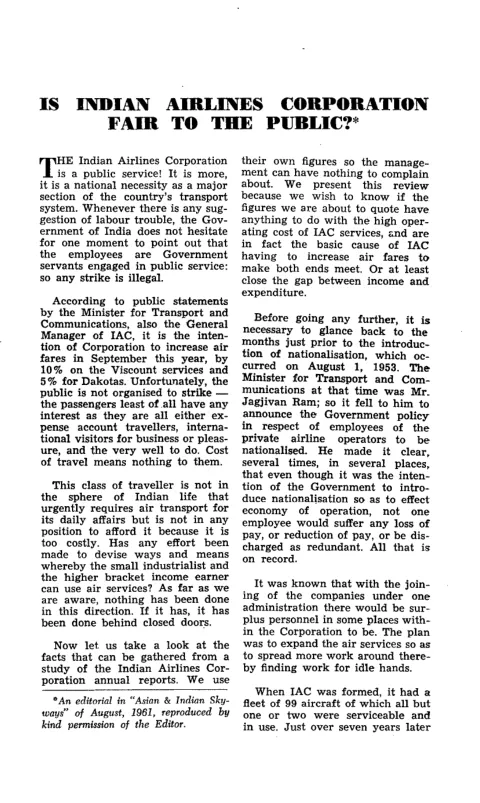
This Forum of Free Enterprise leaflet — reproduced from an August 1961 editorial in Asian & Indian Skyways — mounts a sustained critique of the Indian Airlines Corporation (IAC) as a case study in the inefficiencies that follow nationalisation. The author opens by conceding that air transport is a national necessity and a public service, but argues that IAC has betrayed both its private-sector predecessors and the travelling public through cost-padding, fare hikes, and an absolute refusal to be challenged. Returning to the August 1953 takeover under Minister for Transport and Communications Jagjivan Ram, the leaflet recalls the original promise that no employee would suffer from nationalisation, then walks through eight years of IAC annual reports to show that this guarantee curdled into a permanent expansion of payroll bearing no relationship to operational need.
The heart of the pamphlet is an audit of staffing trends against the active fleet. While the number of aircraft on the active list fell from 99 to 73 and the surviving aircraft were flown harder, IAC’s headcount climbed from 7,107 at formation to 9,553 by 1959–60 — a 34.4 per cent increase. The engineering department added 1,119 employees (a 46.6 per cent jump) even though additional flying hours per extra engineer worked out to just 2 hours 41 minutes per annum; Accounts and Audit nearly doubled before drifting back; Administration and Miscellaneous rose to 1,578. The author treats these ratios as ‘absolutely unique in airline operation history’ and quips that the IAC annual reports read as if written by Lewis Carroll.
From staffing the critique broadens to operational waste — twelve serviceable Viking aircraft left to rust in the open after the Viscounts arrived, ground time exceeding flying time, and ‘a variety of other drains’ through which revenue leaks: pilferage of in-flight food, mishandling of excess-luggage charges, and unpaid commissions on credit-card bookings because IAC has refused membership in the International Air Transport Association (IATA). The leaflet closes by arguing that the General Manager’s pleas about rising maintenance costs do not survive arithmetic: with income growing more than 13 per cent a year, the Corporation’s financial troubles trace not to external pressures but to a managerial approach to business that the author calls ‘peculiar’ and unworthy of public sympathy.
Key points
-
Frames IAC as a public service that has nevertheless failed the public by raising fares and refusing to be questioned because strikes by ‘Government servants’ are illegal.
-
Recovers the August 1953 nationalisation moment under Jagjivan Ram, when the government promised no employee would suffer — and treats that promise as the seed of permanent overstaffing.
-
Builds a granular eight-year staffing audit from IAC’s own annual reports: total employees up from 7,107 to 9,553 (+34.4%) while the active aircraft list fell from 99 to 73.
-
Highlights a 46.6% growth in engineering staff yielding only 2 hours 41 minutes of additional flying per extra engineer — a ratio the author calls unique in world airline history.
-
Catalogues operational waste: twelve serviceable Viking aircraft scrapped instead of redeployed, excessive ground time, pilferage of food and spares, and mishandled excess-luggage billing.
-
Faults IAC for not joining IATA, costing it commissions on credit-card bookings made through other carriers — a self-inflicted revenue leak.
-
Concludes that with income rising more than 13% per year, IAC’s financial troubles are managerial, not structural, and reflect an approach to business ‘so peculiar’ that no sympathy is warranted.
Metadata and summary are AI-extracted from the source PDF and reviewed for editorial accuracy. The original work is available via the Read PDF tab above (where present); paragraph-level citation inside the PDF is deferred to a future engagement.