edited volume · proceedings
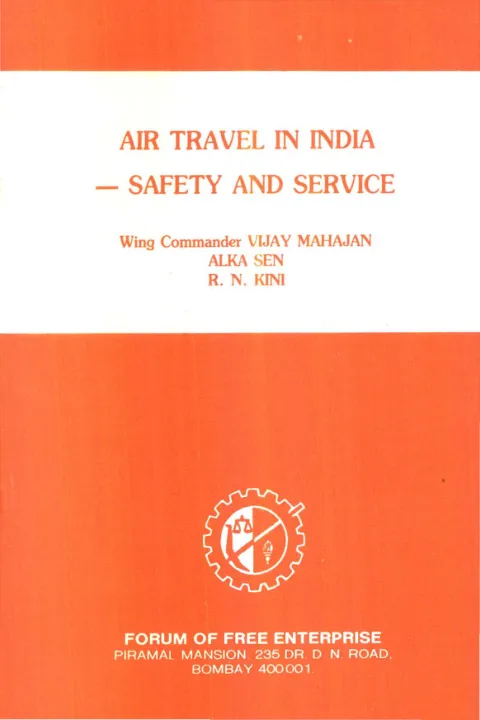
AIR TRAVEL IN INDIA — SAFETY AND SERVICE
By Wing Commander Vijay Mahajan
Published by M. R. PAI for the Forum of Free Enterprise, 235, Dr. Dadabhai Naoroji Road, Bombay 400001, and Printed by S. V. Limaye at India Printing Works, 9, Nagindas Master Road Ext. 1, Fort, Bombay 400023. · Bombay · 1990
20 pages
Summary
This Forum of Free Enterprise booklet, dated 14 June 1990, gathers three talks delivered at a public meeting in Bombay on 13th March 1990, in the shadow of the Indian Airlines A-320 crash at Bangalore the previous month. Wing Commander Vijay Mahajan, a former Indian Air Force officer with over 6,000 flying hours, argues that India lacks a national aviation policy, that political and bureaucratic meddling has corroded the airlines’ selection, training and route-planning, and that the country’s airports, navigational aids and air traffic control are unfit for the traffic that the 1990s will bring. Aviation journalist Alka Sen, editor of Indian Aviation - Civil and Military, locates the problem in indiscipline among employees and in government neglect of infrastructure and senior appointments. R. N. Kini, a survivor of the Bangalore A-320 crash, distils his experience into ten commandments for passengers.
The argumentative centre of the volume is a Forum-house case for retreat of the state from civil aviation: Mahajan ends with three options — making the corporations autonomous, deregulating, or privatising — and defends privatisation by comparing British Airways, Lufthansa, KLM, Quantas and Singapore Airlines with their state-owned Indian counterparts. The Tata Commission’s recommendations, the booklet repeatedly notes, have been “consigned to the dustbin” by the bureaucracy.
Key points
-
Wing Commander Vijay Mahajan argues India lacks a national aviation policy and that political and bureaucratic interference has corroded pilot selection, training, and route planning.
-
Mahajan catalogues India’s four international airports as unfit for growing traffic and proposes three reform paths, autonomy, deregulation, or privatisation, defending privatisation through comparisons with British Airways, Lufthansa, KLM, Qantas, and Singapore Airlines.
-
Alka Sen, editor of Indian Aviation - Civil and Military, locates the safety problem in employee indiscipline and government neglect rather than inadequate training, endorsing the National Transport Safety Board’s tougher pilot-rating and Cockpit Voice Recorder checks.
-
Sen calls for follow-through on the Ramdas Committee Report into the Airbus A320 induction and praises Civil Aviation Minister Arif Mohammed Khan for treating discipline as a non-negotiable issue.
-
She also faults the government for leaving DGCA, IAAI, Indian Airlines, and Vayudoot leadership posts unfilled and for stalling the Rs. 300 crore Bombay-Delhi airport modernisation programme.
-
R. N. Kini, General Manager of Voltas Systems and a survivor of the 14 February 1990 Bangalore A-320 crash, distils his experience into ten commandments for passenger survival.
-
His commandments include fastening seatbelts, learning the emergency-exit literature, heeding the safety briefing, leaving hand baggage behind, and running from wreckage without looking back.
-
He insists a crash is not the moment for participative decision-making and records public appreciation for the air hostesses and the Bangalore hospital staff who attended the injured.
-
Across the three talks the volume repeatedly notes that the Tata Commission’s recommendations on civil aviation reform have been consigned to the dustbin by the bureaucracy.
Essays
AIR TRAVEL IN INDIA — SAFETY AND SERVICE
By Wing Commander VIJAY MAHAJAN
Wing Commander Vijay Mahajan opens with four indictments of Indian civil aviation: no national aviation policy, failure to attract the best young talent into the field, three national airlines whose internal policies do not complement each other, and pervasive political and bureaucratic interference in day-to-day operations. He contrasts U.S. “aviation management science” training — selection boards, months as cockpit observers, flight-engineer apprenticeships — with Indian boys returning from American flying clubs with a Commercial Pilot’s Licence and 200 hours of flying who are seated straight away as co-pilots. He notes that the heads of Indian Airlines, Vayudoot and Air-India are all non-aviation men, more preoccupied with logos, liveries and hostesses’ saris than with the safety of those whose lives depend on the men at the controls.
The second half catalogues infrastructural decay: none of India’s four international airports meets ICAO standards; air-traffic control at Bombay is manned at two-thirds of its 1980 sanction with ninety per cent of controllers “unrated”; VOR, DME, VHF/HFR/T and NDB equipment is erratic or broken; runway lights fail without standby generators; the DGCA, IAAI and NAAI work at cross-purposes; and the Tata Commission’s recommendations sit ignored. Mahajan closes with three options — autonomy, deregulation, or privatisation — and argues that privatisation is the best, citing British Airways, Aeroflot, Quantas, Lufthansa, KLM and Singapore Airlines as evidence that privately owned carriers have better safety records and that 90 per cent of India’s current airline management would not survive accountability to private owners.
- India has no national aviation policy; selection and training of pilots, personnel and equipment is bureaucratic and quota-driven.
- Chairmen and managing directors of Indian Airlines, Vayudoot and Air-India are non-aviation men focused on image rather than flight safety.
- None of India’s four international airports meets full ICAO standards; ATC at Bombay is manned far below sanction and most controllers are unrated.
- Three overlapping agencies (DGCA, IAAI, NAAI) do not coordinate; merging IAAI and NAAI would relieve NAAI’s fund shortage by ending IAAI’s tax outflow.
- Tata Commission recommendations have been consigned to the dustbin by the bureaucracy.
- Privatisation is the best of three reform options (autonomy, deregulation, privatisation) because privately owned carriers worldwide show lower accident rates.
[Section II — untitled, by ALKA SEN]
By ALKA SEN
Alka Sen, editor of Indian Aviation - Civil and Military, frames the safety problem at Indian Airlines, Vayudoot, Pawan Hans and Air-India less as a training failure than as a discipline failure. She endorses the National Transport Safety Board’s recent measures — random Cockpit Voice Recorder checks, stricter procedures for pilot-in-command rating, prohibiting pilots from flying more than one type of aircraft — and calls for serious follow-through on the Ramdas Committee Report, which had found Indian Airlines unprepared to induct so many Airbus A320s in so short a time. She defends Indian pilots from foreign condescension, citing Capt. Xavier Baral of the French Pilots’ Union and Capt. V. K. Mehta on the Ahmedabad 737 crash.
The essay then widens to industrial action: continual employee agitations over A320 training and engineer training abroad. She praises Civil Aviation Minister Arif Mohammed Khan for making discipline “a non-negotiable issue” and faults the government for letting key posts (DGCA, IAAI chairman, Indian Airlines MD after Prasad’s resignation, Vayudoot MD after Harsh Vardhan’s exit following the Pune Dornier 228 crash) lie unfilled. She closes by faulting the government for stalling on a Rs. 300 crore Bombay-Delhi airport modernisation programme and on infrastructure for the smaller airports beyond.
- Indian Airlines’ safety problems are mainly indiscipline, not inadequate training syllabus.
- Cockpit Voice Recorder random checks, tougher pilot rating procedures and the Ramdas Committee findings on A320 induction must be acted on.
- Indian pilots are as competent as their foreign counterparts; foreign condescension (Baral’s “Mercedes Benz to a camel driver”) is misplaced.
- Continual employee agitations — over which pilots train on the A320, over engineers’ training abroad — disrupted maintenance.
- Civil Aviation Minister Arif Mohammed Khan’s hard line on discipline is welcome; government delay in filling DGCA, IAAI, Indian Airlines and Vayudoot top posts is not.
- Approved Rs. 300 crore modernisation of Bombay and Delhi airports has yet to be cleared, and the rest of the airport network is being ignored.
[Section III — TEN COMMANDMENTS, by R. N. KINI]
By R. N. KINI
R. N. Kini, General Manager of Voltas Systems Ltd. and a survivor of the Indian Airlines A-320 crash at Bangalore on 14th February 1990, offers a short address that opens with thanks to God for his lease of life and sorrow for his fellow passengers who did not survive. He then sets out “Ten Commandments” for passengers drawing on what he saw: fasten seatbelts always; read the emergency exit literature; listen to air-hostess safety briefings; do not retrieve hand baggage from the overhead rack in danger; keep running once off the aircraft and do not look back; report previous medical history and blood group at hospital; be alert at take-off and landing; and recognise that “this is not the time for decision-making on a participative basis.” He closes by recording public appreciation for the air hostesses who opened the door as soon as the plane crashed and for the Bangalore hospital and Indian Airlines staff who attended the injured.
- Author is a survivor of the Indian Airlines A-320 crash at Bangalore on 14 February 1990.
- Ten commandments for passenger conduct: seatbelts, emergency-door literacy, listen to safety briefings, leave bags behind, run from the wreck without looking back, observe no-smoking, share medical history at hospital.
- A crash is not a moment for participative decision-making — passengers must act on training and instructions, not deliberate.
- Public acknowledgement for the air hostesses’ presence of mind and for the Bangalore hospital and Indian Airlines staff.
Metadata and summary are AI-extracted from the source PDF and reviewed for editorial accuracy. The original work is available via the Read PDF tab above (where present); paragraph-level citation inside the PDF is deferred to a future engagement.