speech · memorial lecture
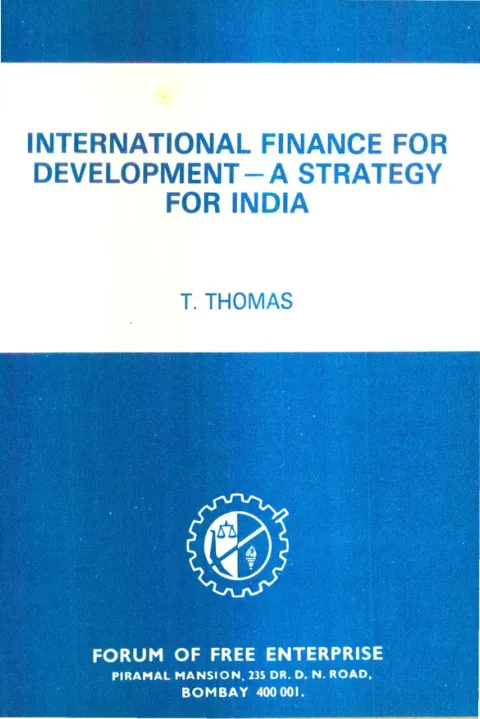
INTERNATIONAL FINANCE FOR DEVELOPMENT — A STRATEGY FOR INDIA
By T. Thomas
FORUM OF FREE ENTERPRISE, PIRAMAL MANSION, 235 DR. D. N. ROAD, BOMBAY 400 001. · Bombay · 1982
38 pages
Part of A. D. Shroff Memorial Lecture
Summary
Delivered as the A. D. Shroff Memorial Lecture in Bombay on 25th October 1982 and published by the Forum of Free Enterprise, T. Thomas — the first Indian Director of Unilever and a former chairman of Hindustan Lever — sets out a businessman’s strategy for financing Indian development in a decelerating world economy. He opens by surveying the global landscape: unemployment near 10% in the OECD, world GDP growth falling from over 4% in the 1970s to barely 1% in 1981, and sovereign debts of Poland, Argentina and Mexico ballooning into crisis. Unlike the 1930s, he argues, professionally managed institutions like the IMF and the World Bank, together with determined Western restructuring, should permit a modest recovery to 2–3% growth by 1984, and India’s strategy must be built on this hopeful but unoptimistic outlook.
Turning inward, Thomas identifies three phases in independent India’s economic evolution — Initiation, Introversion and Isolation — and calls for a fourth phase of Innovation: opening more sectors to private industry, dismantling the obsession with self-reliance, importing modern technology, and rolling back the public sector. He treats the deteriorating capital-output ratio (from 2.5 to 3.3 over twenty years) as the central inefficiency to be reversed and warns that restoring it to 2.5 could lift growth by nearly 3% per annum at no fiscal cost. Citing Britain’s struggle with the “British Disease” and its subsequent privatisations, he argues that India, being a growing economy, can shift course without the convulsive U-turns of the West.
The second half of the lecture focuses on enhancing investment capital by raising foreign financial flows from about 6% to 12% of total investment. Thomas evaluates three channels — official flows (multilateral and bilateral loans), private financial institutions (commercial banks and bond markets), and direct foreign investment — and finds the first two limited and risky: official funds tend to flow into the already-bloated bureaucracy and public sector, and create what he calls a “charity” image he believes India does not deserve, citing China as a contrast. Through an extended analysis of Mexico’s 1976–81 borrowing binge and 1982 default, he draws five lessons against over-reliance on short-term bank loans and in favour of direct equity investment, which he begins enumerating at the close of the rendered pages.
Key points
-
Frames the lecture as a businessman’s perspective (distinct from academic or political economists) on India’s investment strategy, invoking the Bombay Plan precedent associated with J. R. D. Tata and A. D. Shroff.
-
Diagnoses world GDP growth as having dropped from over 4% in the 1970s to 1.12% in 1981, with developing-country per-capita GDP falling for the first time in 25 years.
-
Periodises post-independence India into three phases — Initiation, Introversion and Isolation — and calls for a fourth phase of Innovation through openness to private industry and foreign technology.
-
Identifies the deteriorating Capital:Output ratio (2.5 to 3.3 over twenty years) as the binding constraint, attributing it to public-sector reservations, technology import restrictions and the obsession with self-reliance.
-
Argues that restoring the Capital:Output ratio to 2.5 would raise growth by nearly 3% per annum, treating efficiency gains as a free lever within India’s control.
-
Recommends doubling external capital inflows from 6% to 12% of total investment, with the additional flow weighted away from official channels toward private equity.
-
Warns that official multilateral loans gravitate toward the bureaucracy and public sector, deepening inefficiency, and create a psychological image of dependence — contrasting India’s standing with China’s relative independence from concessional aid.
-
Uses Mexico’s 1976–81 over-borrowing and 1982 crisis as a cautionary template, drawing lessons against substituting domestic savings, against short-term bank loans, and in favour of direct foreign equity investment.
Metadata and summary are AI-extracted from the source PDF and reviewed for editorial accuracy. The original work is available via the Read PDF tab above (where present); paragraph-level citation inside the PDF is deferred to a future engagement.