
pamphlet
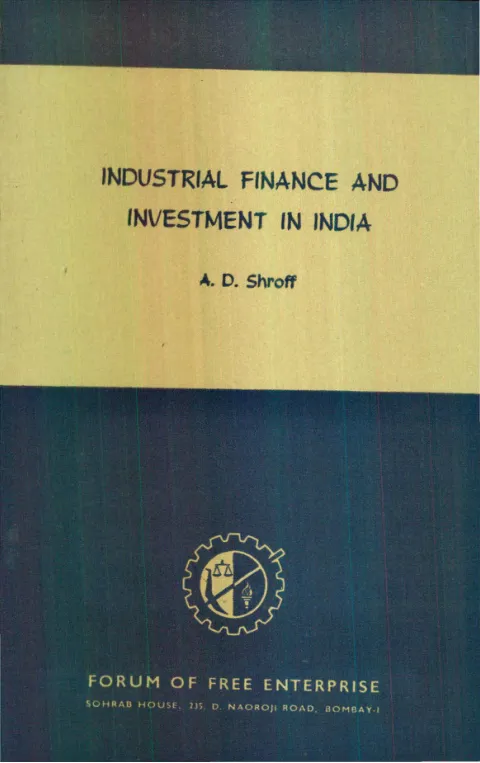
Industrial Finance and Investment in India
By A. D. Shroff
Published by M. R. Pai, for Forum of Free Enterprise, "Sohrab House", 235 Dr. Dadabhai Naoroji Road, Bombay 1, and printed by P. A. Raman at Inland Printers, Victoria Mills Building, 55, Gamdevi Road, Bombay 7. · Bombay · 1961
20 pages
Summary
A. D. Shroff’s pamphlet, issued by the Forum of Free Enterprise in October 1961, is a two-part primer on how Indian industry raises long-term capital and on how the resulting securities are bought and sold. Part I walks the reader through the architecture of industrial finance: capital expenditure versus working capital, the gatekeeping role of the Controller of Capital Issues, and the distinct functions of equity, cumulative preference, debenture and (now-abolished) deferred capital. Shroff uses the Tata Iron and Steel Company’s Rs.30 deferred shares — which rose to Rs.1,600 during the First World War — to illustrate both the upside and the speculative dangers of that vanished instrument. He notes that India lacks the issue houses and underwriting firms of Western markets, surveys the recent founding of ICICI (1955) as a partial remedy, and singles out Section 23-A(1) of the income-tax law as a perverse statute that punishes medium- and small-scale industries by forcing them to distribute 50% of profits and so prevents the very capital formation the country needs.
Part II turns to investment as an art rather than a science. Drawing on a thirty-seven-year career as a stockbroker, Shroff defends speculation as the legitimate practice of “taking a view” — the same activity that every industrialist performs — and distinguishes it from gambling, which begins only when a man trades beyond his capacity to support. He sharply rebukes the Prime Minister’s remark that stock exchanges should be abolished, arguing that in any non-communist economy they remain indispensable for the liquidity and mobility of capital. The pamphlet closes with an extended case for introducing Mutual Funds (Unit Trusts) to India, citing the explosive growth of these vehicles in the U.S. and U.K. as evidence that they can mobilise small and medium savings, foster the saving habit, and channel a continuous flow of capital into industrial expansion — a model he urges Delhi’s short-sighted tax-gatherers to embrace rather than resist.
Key points
-
Industrial finance divides into capital expenditure and working capital; under Indian law no company can be floated without the Controller of Capital Issues being satisfied that the capital determined is sufficient.
-
Shroff surveys the spectrum of instruments — equity, cumulative preference, debentures, and the now-abolished deferred capital — illustrating speculative excess with Tata Iron and Steel’s Rs.30 deferred shares that rose to Rs.1,600 during the First World War.
-
India lacks the Issue Houses and Underwriting Firms common in Western countries; the 1955 founding of ICICI (with 10% American, 20% British and 70% Indian capital plus a Rs.7.5-crore interest-free Government deposit) was a partial remedy that has helped sugar, paper and engineering ventures get off the ground.
-
Section 23-A(1) of the income-tax law is described as obnoxious because it forces closely-held companies to distribute 50% of profits, suffocating the medium and small-scale industries that should be ploughing earnings back.
-
Shroff defends the stock exchange and rebukes Nehru’s remark that exchanges should be abolished, arguing that liquidity of capital is indispensable to a non-communist economy.
-
Speculation is reframed as the legitimate act of “taking a view” — the same thing every industrialist does — and is distinguished from gambling, which begins only when one trades beyond capacity.
-
Investment is an art, not a science: two simple lessons from a 37-year career are that profit taken is never lost and that learning to cut one’s losses is the harder discipline.
-
Shroff makes an extended case for introducing Mutual Funds / Unit Trusts to India on the U.S. and U.K. model, as a mechanism to mobilise small savings and provide a continuous pipeline of capital for industrial expansion.
Metadata and summary are AI-extracted from the source PDF and reviewed for editorial accuracy. The original work is available via the Read PDF tab above (where present); paragraph-level citation inside the PDF is deferred to a future engagement.
People in this work
Related across the archive
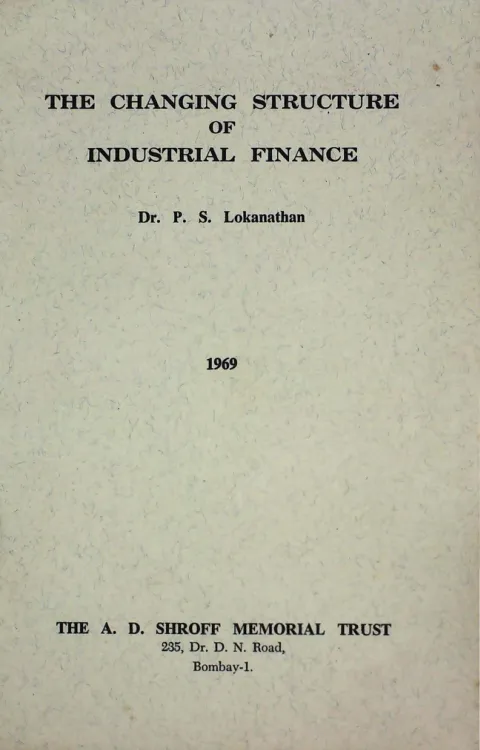 Primary workThe Changing Structure of Industrial Finance
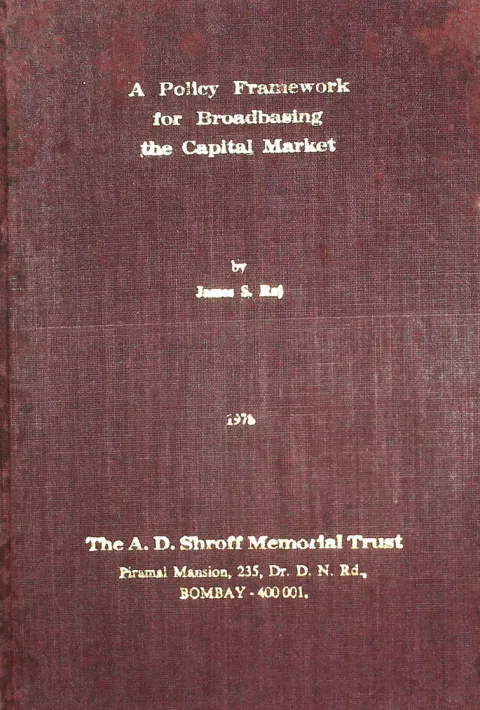 Primary workA Policy Framework for Broadbasing the Capital Market
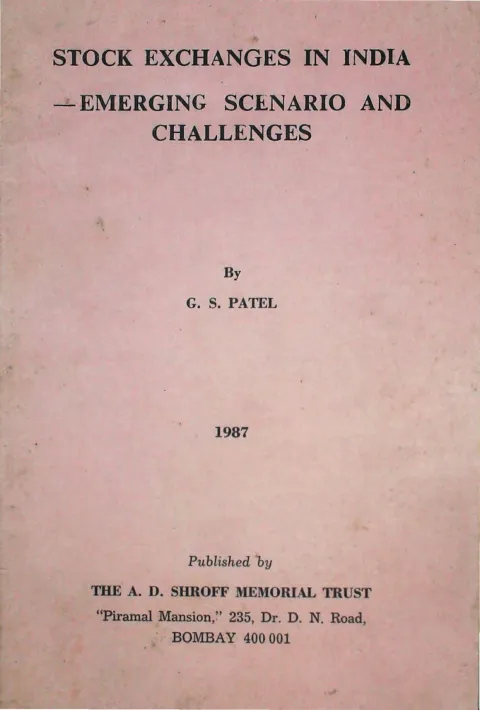 Primary workStock Exchanges in India — Emerging Scenario and Challenges
 ThePrintPrivate enterprise built India’s industries. Now it’s strangled by Gods in Delhi
 ExcerptHas Private Enterprise Failed?