
speech · memorial lecture
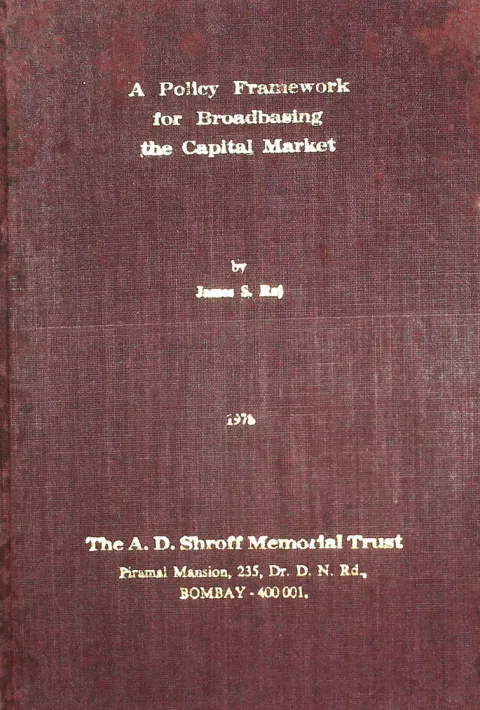
A Policy Framework for Broadbasing the Capital Market
By James S. Raj
The A. D. Shroff Memorial Trust, Piramal Mansion, 235, Dr. D. N. Rd., BOMBAY - 400 001. · Bombay · 1978
26 pages
Part of A. D. Shroff Memorial Lecture
Summary
James S. Raj’s 1978 A. D. Shroff Memorial Lecture — delivered in Bombay on 18 January 1978 and published by the A. D. Shroff Memorial Trust — sets out a policy framework for broadbasing India’s capital market. Raj, then Chairman of the Reserve Bank’s Committee on Public Sector Banks and Deputy Chairman of ICICI, argues that a ‘broadbased and expanding capital market is absolutely essential for any developing country which has chosen a mixed economy in preference to a completely State-run one.’ His central diagnostic move is to visualise the policy environment as a series of concentric circles surrounding the capital market: basic attitudes towards economic administration on the outside, industrial policy next, monetary policy nearer the core, and the capital-market regulations themselves at the centre. He works his way inward, identifying at each layer the constraints that inhibit the volume and diversity of savings reaching the market.
On attitudes, Raj names ‘the all-pervading mistrust of the market mechanism, and the firm belief that all prices can be controlled by administrative fiat’ as the binding constraint that policy-makers and the public share. He treats this as politically immovable, but draws out its consequences for equity investment: pervasive price controls turn most large-industry shares into instruments of risk without upside, and dividend limitation — a ‘plank in the Janata Party’s economic policy’ — punishes the very middle-class shareholders, widows and orphans who have been caught when ‘the music’ stopped. On industrial policy he is sceptical that the small-scale and ‘tiny’ sector emphasis matters for the capital market, since a single fertiliser project at Rs. 150 crores dwarfs thousands of tiny units; what matters is the pace at which nationalisation and the establishment of new public-sector units pre-empt the savings pool.
Moving to the inner layers, Raj documents how monetary and capital-market regulation now operate as a ‘captive supply’ system: banks must invest roughly 33% of deposit liabilities in Government securities at under 6% interest, LIC and Provident Funds are similarly bound, and a 4.5% gap between Government and industrial-debenture rates has been rationalised on grounds that Government projects do not even earn 5% on capital employed. Tax policy is ‘loaded against equity shares’; institutional underwriters end up holding new issues; and growth companies’ shares are gradually ‘soaked up’ by public financial institutions, hollowing out small-shareholder oversight. Raj closes the rendered section by arguing that India must abandon the consumption-oriented model it has imitated and ‘build up a savings-oriented society, using the same methods of marketing to popularise savings,’ and that the first order of business is a Government policy decision restoring the attractiveness of direct equity, debenture, and preference-share investment relative to deposits in monolithic financial institutions. The lecture pivots at the end of these rendered pages to begin outlining specific modifications to industrial-sector policy, which continue beyond this chunk.
Key points
-
Raj frames the capital-market policy environment as concentric circles: basic economic attitudes on the outside, industrial policy, monetary policy, and the capital-market regulations themselves at the core.
-
He identifies the binding ideological constraint as an ‘all-pervading mistrust of the market mechanism’ and a belief that all prices can be set by administrative fiat — a creed shared by authorities and the urban public alike.
-
Dividend limitation, described as a plank of the Janata Party’s economic policy, is criticised on the ground that it hurts middle-class shareholders, widows and orphans rather than ‘bloated capitalists’.
-
Industrial policy’s tilt towards small-scale and ‘tiny’ units is largely irrelevant to the capital market, because those units do not draw on it; what matters is the public-sector’s pre-emption of savings via nationalisation and new units.
-
Roughly 33% of bank deposit liabilities are locked into Central and State Government securities at under 6% interest, with LIC and Provident Funds similarly captive — creating a hidden 4.5% gap between Government and industrial-debenture rates.
-
Tax policy is ‘loaded against equity shares’: dividend deduction at source, liquidity penalties via holding-period rules for capital-gains treatment, and no incentive for subscribers to new issues that may yield no dividend for years.
-
Public financial institutions are gradually ‘soaking up’ the equity of attractive growth companies (Larsen & Toubro, TELCO, Century Enka, CAFI), shrinking the small-shareholder base both relatively and in vigilance.
-
Raj’s prescription: stop imitating a consumption-oriented society and build a savings-oriented one, beginning with a Government policy decision restoring direct investment in equities, debentures and preference shares to attractiveness.
Metadata and summary are AI-extracted from the source PDF and reviewed for editorial accuracy. The original work is available via the Read PDF tab above (where present); paragraph-level citation inside the PDF is deferred to a future engagement.
People in this work
Related across the archive
 Primary workThe Changing Structure of Industrial Finance
 Primary workIndustrial Finance and Investment in India
 Primary workCHANGING SCENARIO OF INDUSTRIAL FINANCE & CAPITAL MARKET IN THE NEW MILLENNIUM
 ExcerptOBSTACLES TO LIBERALISATION AND MARKET ECONOMY
 ExcerptEconomic Reforms In India: Where Are We And Where Do We Go?