book · collected works
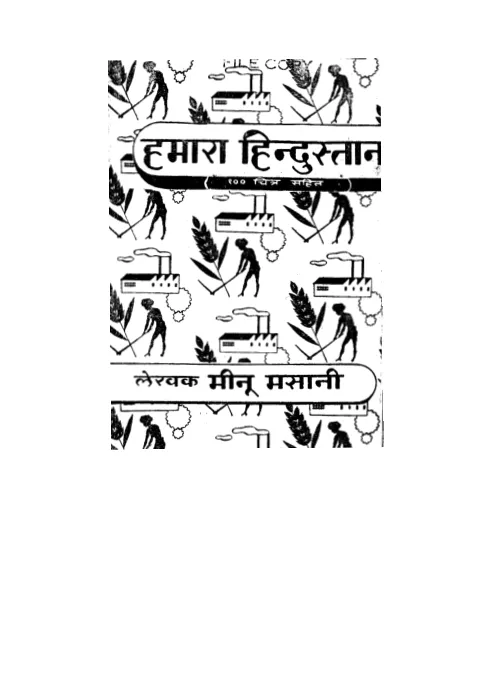
हमारा हिन्दुस्तान
१०० चित्र सहित
Hamārā Hindustān
By Minoo Masani
ऑक्सफर्ड यूनिवर्सिटी प्रेस · Bombay · 1942
77 pages
Summary
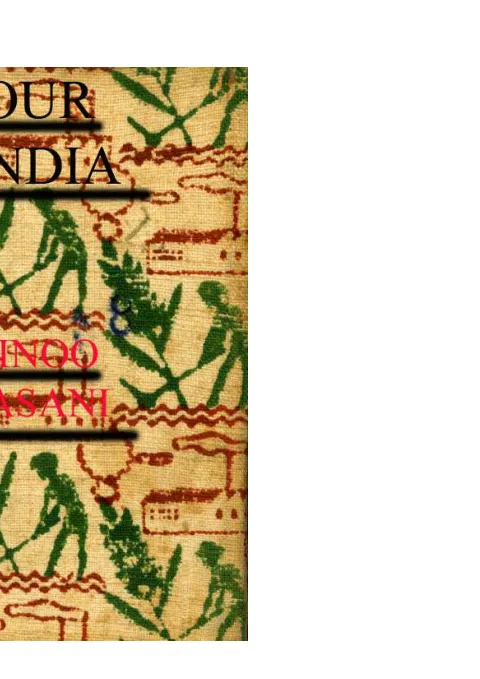
हमारा हिन्दुस्तान (Hamārā Hindustān) is a 1942 Hindi translation, by V. P. Sinha (वी. पी. सिन्हा), of Minoo Masani’s English popular primer Our India, published by Oxford University Press Bombay. The book is addressed to a general Hindi-reading audience and sets out to introduce India’s geography, population, climate, agriculture, and economic life in plain, conversational prose illustrated with approximately 100 diagrams and woodcut-style images. In the rendered pages Masani opens with an appeal to national pride: one in every five human beings on earth is an Indian, a fact that ought, he argues, to stir every reader to engage with the country’s problems and potential.
The first chapter (पाँच में एक, ‘One in Five’) covers India’s physical geography — its vast extent from east to west and north to south, its three broad physiographic zones (the Himalaya, the great river plains, and the peninsula), the monsoon system, and the diversity of peoples and occupations. The second chapter (क्या हम सूर्य को खा सकते हैं?, ‘Can We Eat the Sun?’) turns to political economy: it explains how plants fix solar energy and why India’s agricultural abundance is undermined by poverty, low yields, and the failure to use land and labour to full productive capacity, drawing comparative data on tea, coal, manganese, and jute against output in the USA, Russia, and other countries. The third chapter (एक पहेली, ‘A Riddle’), only partially visible in the rendered pages, poses the central paradox of Indian poverty amid natural plenty — asking why a country so richly endowed should have a population that is overwhelmingly poor and undernourished. The very opening of the fourth chapter (नाश का घर, ‘House of Destruction’) appears on the last rendered page and begins to characterise the typical Indian as represented by a cross-section of ten people.
Throughout the rendered pages Masani deploys vivid comparative statistics — India’s population as nearly one-fifth of the world, the average Indian family’s annual income, calorie intake, and infant mortality relative to counterparts in Britain, the USA, and Australia — to make the case that India’s resources are underused and that informed citizens must understand and act on this gap. The tone is that of popular civic education aimed at ordinary readers, consistent with the book’s origin as a mass-circulation primer written during the independence movement.
Key points
-
In the rendered pages, Masani frames India’s enormous population (one in five humans is Indian) as a source of national pride and civic responsibility, not merely a demographic fact.
-
Chapter 1 presents a geographic overview of India — three physiographic zones, the monsoon, river systems — using comparison with European countries to convey scale.
-
Chapter 2 explains agricultural productivity through an accessible account of photosynthesis and solar energy, then uses comparative charts to show India’s underperformance in tea, coal, manganese, and jute production relative to its potential.
-
In the rendered pages, Masani cites specific figures: India produces roughly 20 crore maunds of coal annually compared to much higher outputs in the USA and USSR; India accounts for the largest share of world jute and manganese output but lags in per-capita industrial goods.
-
Chapter 3 poses the central ‘riddle’ of Indian poverty amid plenty, noting that the average Indian’s annual income is extremely low (around 64–74 rupees per year according to figures cited) and that this traps families in a cycle of under-nutrition and debt.
-
In the rendered pages, the book argues that land fragmentation, landlordism, and lack of rural credit and health infrastructure are the structural causes of rural poverty.
-
The illustrated format (comparative pictograms, maps, woodcuts) is integral to the pedagogical design, making statistical arguments accessible to readers with limited formal education.
-
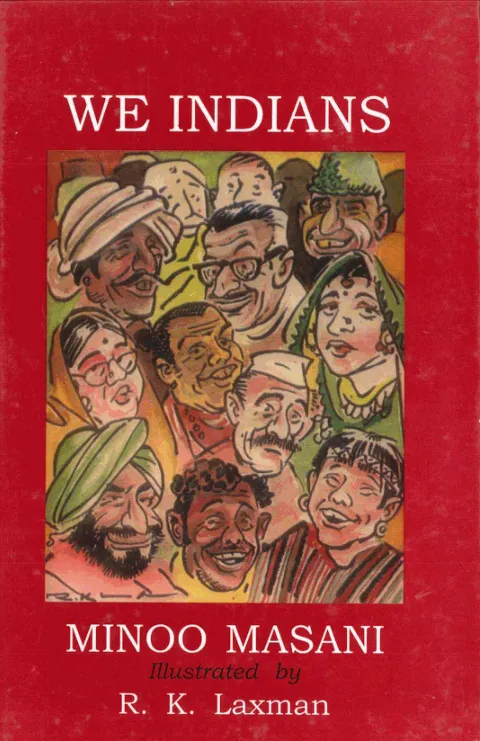
The opening of Chapter 4 (नाश का घर) introduces a typology of ten representative Indians, setting up a structural analysis of occupational distribution.
Metadata and summary are AI-extracted from the source PDF and reviewed for editorial accuracy. The original work is available via the Read PDF tab above (where present); paragraph-level citation inside the PDF is deferred to a future engagement.