
book · collected works
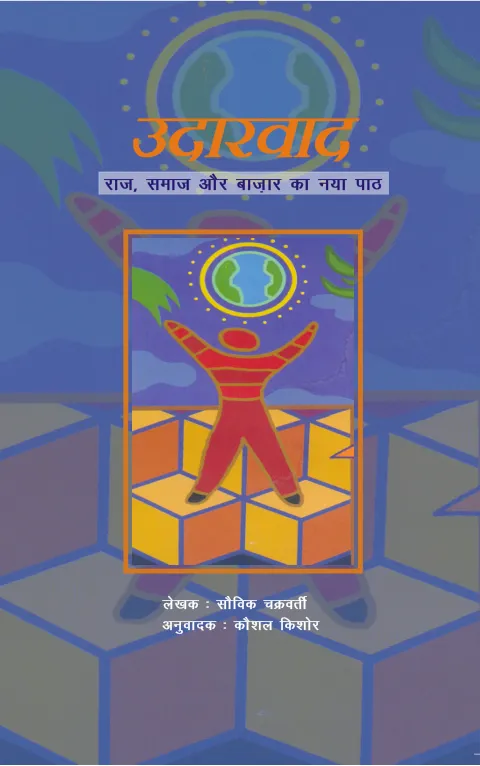
उदारवाद
राज, समाज और बाज़ार का नया पाठ
उदारवाद : राज, समाज और बाज़ार का नया पाठ
Udārvād: Rāj, Samāj aur Bāzār kā Nayā Pāṭh
सेंटर फॉर सिविल सोसाइटी · New Delhi · 2006
97 pages
Summary
This is a Hindi translation of Sauvik Chakraverti’s English primer ‘Free Your Mind: A Beginner’s Guide to Political Economy’, published by the Centre for Civil Society in 2006 and translated by Kaushal Kishore. Titled उदारवाद: राज, समाज और बाज़ार का नया पाठ (Liberalism: A New Reading of State, Society and Market), the book is addressed explicitly to young Indians and first-time voters who, in the rendered pages, are described as having been educated by a state-sponsored curriculum that teaches them to accept socialist premises uncritically. The preface argues that a free society rests on three pillars — political democracy, free-market economic freedom, and liberal education in the value of liberty — and charges that India, ranked 120th on the 1999 World Economic Freedom Index, possesses only the first.
In the rendered pages, chapters 1–3 develop the book’s foundational arguments. Chapter 1 (‘Know Yourself’) opens with the claim that the uniquely human capacity for voluntary exchange — व्यापार करने की योग्यता — is what distinguishes Homo Economicus from all other animals and is the root of all economic life. Chapter 2 (‘Population: A Cause of Prosperity’) directly challenges the Malthusian consensus in Indian public discourse, arguing that because humans alone can generate wealth through the division of labour (श्रम विभाजन), a larger population is a source of prosperity rather than poverty; the chapter uses urbanisation data and the example of Singapore to sustain the argument. Chapter 3 (‘The Failure of Political Markets’) opens the introduction to public-choice reasoning, distinguishing private market choices from public or political choices and beginning to explain why political markets systematically fail where private markets succeed. This last chapter was only beginning at the end of the rendered pages.
Key points
-
In the rendered pages, the book is framed as a corrective to state-sponsored socialist education, aimed at young Indians who are about to exercise their right to vote.
-
India’s ranking of 120th on the 1999 World Economic Freedom Index is cited in the rendered pages as evidence that political democracy alone is insufficient without economic freedom.
-
Chapter 1 grounds the entire argument in a single premise: the capacity for voluntary exchange (व्यापार) is unique to humans and is the biological basis of all economic activity.
-
Chapter 2 inverts the standard Malthusian argument, contending in the rendered pages that population density — not smallness — is a driver of prosperity through the division of labour and the deepening of markets.
-
The civilisation-as-city etymology (Latin civitas) is deployed in the rendered pages to argue that urbanisation, commerce, and civilisation are inseparable, and that dispersed rural self-sufficiency is ‘economic suicide’ (आर्थिक आत्महत्या).
-
Self-sufficiency (स्व-पर्याप्तता) is explicitly condemned as a policy goal in the rendered pages, with the argument that it destroys the specialisation gains that markets make possible.
-
Chapter 3 introduces the concept of ‘choice’ as the central problem of economics and distinguishes individual market choice from collective political choice, setting up a public-choice critique that was only beginning at the end of the rendered pages.
Metadata and summary are AI-extracted from the source PDF and reviewed for editorial accuracy. The original work is available via the Read PDF tab above (where present); paragraph-level citation inside the PDF is deferred to a future engagement.