pamphlet
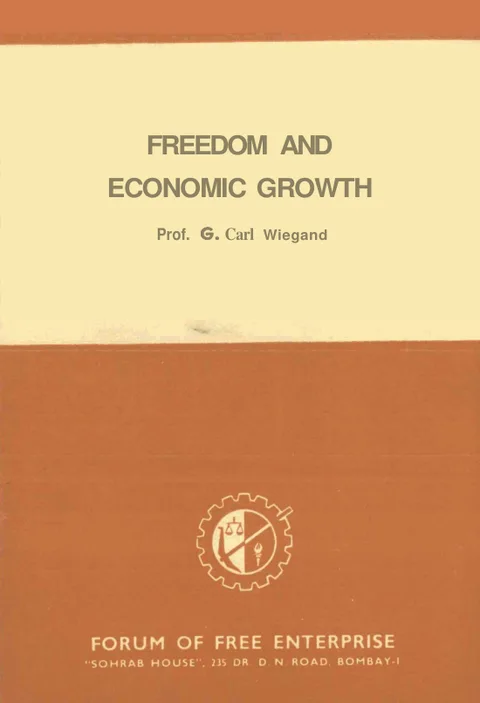
Freedom and Economic Growth
Is Socialism the Answer?
Published by M. R. Pai for Forum of Free Enterprise, "Sohrab House", 235 Dr. Dadabhai Naoroji Road, Bombay 1, and Printed by B. G. Dhawale at Karnatak Printing Press, Chira Bazar, Bombay 2. · Bombay · 1962
9 pages
Summary
Freedom and Economic Growth is a short Forum of Free Enterprise pamphlet by Prof. G. Carl Wiegand of Southern Illinois University, published in Bombay on 8 June 1962 and subtitled “Is Socialism the Answer?”. Wiegand argues that mass hunger in Asia, Africa and Latin America is not a problem of natural resources or capital scarcity but of ideology: the leaders of underdeveloped countries have absorbed European-style statism, Keynesian deficit thinking, and Fabian welfare-state slogans precisely at the moment when the West is paying the price for them. He marshals a series of national comparisons — Switzerland against Brazil, post-war West Germany against fifteen years of regimentation, Malaya against Indonesia, Japan against an India that for two hundred years “lived for almost 200 years under British colonial rule” yet remained behind — to insist that institutions, private property rights and personal freedom, not endowment or aid, determine growth.
The pamphlet’s central polemic is directed at the conviction, which Wiegand attributes to Jawaharlal Nehru and to “many American economists and politicians,” that a totalitarian or socialist state is “a ‘people’s republic’ in which the people have a choice.” Against this he sets a long passage from Gandhi describing the state as “a soulless machine” that “can never be weaned from violence,” and against the welfare-state slogan of “freedom from want” he argues a semantic confusion: men under such regimes surrender freedom for security and end with neither. Forced industrialisation, displacement of private investment by inter-governmental loans (the “Alliance for Progress” is cited as a cautionary example), and growth-through-inflation policies are presented as wrong remedies that mimic the European absolutism and mercantilism Europe itself had to defeat.
The closing pages turn to a constructive recommendation aimed squarely at Indian planners. Wiegand argues that agricultural surplus, not steel mills, has historically preceded industrialisation — citing eastern Germany and the early United States — and that India would gain more from “100,000 steel plows at $20 each” than from a single $2 million machine tool. He warns that India’s Second Five-Year Plan misreads the tempo of progress, that public-sector competition with private firms scares away investment, and that the “growth-through-inflation” formula makes Indian economic development possible only “on a totalitarian basis.” The pamphlet closes with the standard Forum of Free Enterprise membership appeal and a flanking A. D. Shroff epigraph: “Free Enterprise was born with man and shall survive as long as man survives.”
Key points
-
Hunger in the underdeveloped world is framed as an ideological failure, not a resource or capital shortage — “Neither capital nor natural resources assure economic growth.”
-
Cross-country comparisons (Switzerland vs Brazil, West Germany’s recovery, Malaya vs Indonesia, Japan vs India) are used to argue that private property, private initiative and respect for individual rights are the real growth variables.
-
Nehru’s collectivist premise — that a socialist state is a “people’s republic” in which the people have a choice — is rejected as resting on a false equation of state and people.
-
Gandhi is enlisted as an ally against state planning, via his characterisations of the state as a “soulless machine” and as concentrated violence that “unmans the people and deprives them of initiative.”
-
Fabian “freedom from want” rhetoric is attacked as a semantic confusion that trades political freedom for economic security and yields neither.
-
Foreign aid and inter-governmental loans (Inter-American “Alliance for Progress”) are argued to crowd out private investment rather than complement it, especially when channelled into public-sector industries that compete with private enterprise.
-
Agricultural surplus is presented as the historical precondition for industrialisation; capital-light, labour-intensive agriculture — “100,000 steel plows at $20 each” — is recommended over showcase heavy industry.
-
The “growth-through-inflation” formula is named as the chief threat to both the US economy and India’s development, making Indian growth possible only on “a totalitarian basis.”
Metadata and summary are AI-extracted from the source PDF and reviewed for editorial accuracy. The original work is available via the Read PDF tab above (where present); paragraph-level citation inside the PDF is deferred to a future engagement.