speech
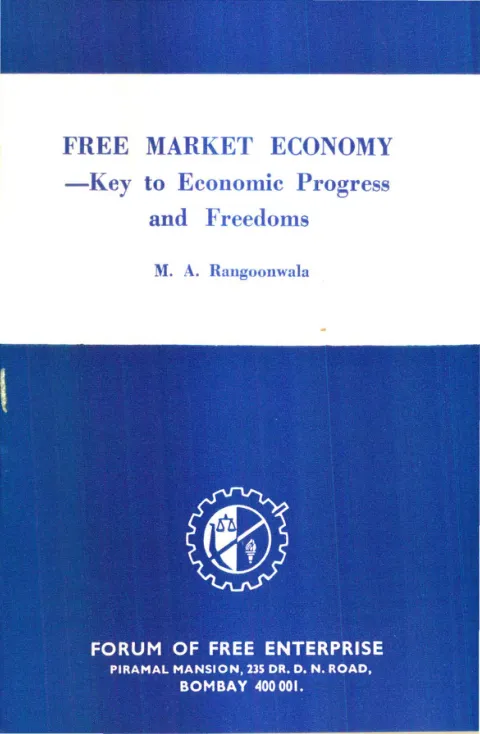
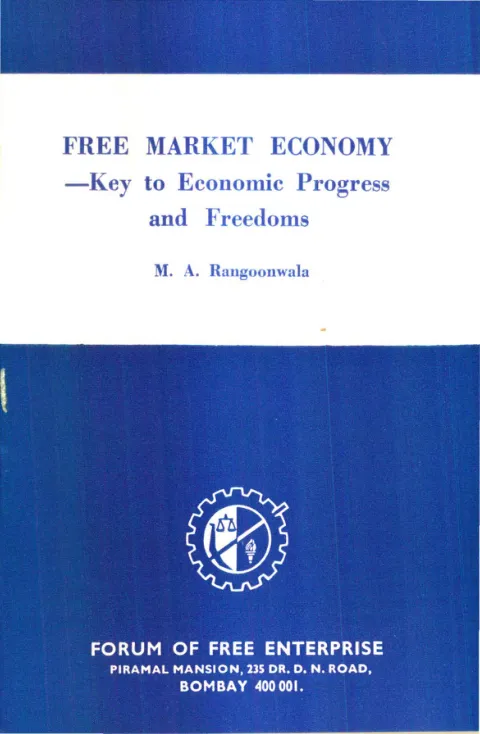
FREE MARKET ECONOMY —Key to Economic Progress and Freedoms
FORUM OF FREE ENTERPRISE, PIRAMAL MANSION, 235 DR. D. N. ROAD, BOMBAY 400 001. · Bombay · 1982
31 pages
Summary
This Forum of Free Enterprise booklet reproduces the inaugural address delivered by M. A. Rangoonwala, then immediate past President of the International Chamber of Commerce, at the Forum’s Silver Jubilee celebrations in Bombay on 12 January 1982. It is framed by an introduction from the Forum’s President N. A. Palkhivala and a short biographical note on the Forum’s founder A. D. Shroff. Palkhivala’s introduction sets up Rangoonwala’s argument as a plea for the return of market forces, attacks the “permit-licence-quota raj” that Rajaji had named, and quotes Daniel Webster on civic responsibility.
Rangoonwala’s central claim is that the free market is not merely an instrument of efficiency but synonymous with freedom itself. He insists that government controls, whatever their stated rationale, are always “people control” rather than control of goods, prices or services, and that economic planning by definition requires compulsion even when dressed up in the consultative language of “indicative” rather than “imperative” plans. He treats profit as morally legitimate, frames entrepreneurship as a unifying force, and argues that politicians’ attachment to specific growth-rate targets reflects a “profound mystical belief in the power of words.”
He distinguishes three methods of organising an economy — the free market, the socialist or centralised method, and a “compromising way” that pretends to occupy a middle path. The compromising way, in his account, is in substance the socialist method, because once the principle of coercion is admitted there is no defensible ground on which to stop the proliferation of controls. The half-free economy, while preferable to none at all, is inherently unstable and expansionist in its coercive component.
The rendered pages close with the opening of an extended critique of developing-country policy. Rangoonwala argues that intervention has gone far beyond protecting the weak and now placates organised, vocal interests; that the fetish of industrialisation has caused governments to oppress and exploit agriculture; and that this neglect must eventually trigger a rebound as peasants retreat to subsistence farming. The chunk ends mid-argument on page 14 of the printed text, with the remainder of the address not yet rendered.
Key points
-
Text of M. A. Rangoonwala’s address at the Forum of Free Enterprise Silver Jubilee, Bombay, 12 January 1982, prefaced by N. A. Palkhivala’s introduction and a biographical sketch of A. D. Shroff.
-
Core thesis: the free market and freedom are synonymous; the only thing governments can ever control is people, not goods, prices or services.
-
Planning is inherently coercive — “indicative” planning is a euphemism, since a plan that genuinely accommodated everyone’s voluntary choices would be pointless.
-
Government targets for growth rates rest on a “mystical belief in the power of words”; rapid growth is a by-product of good policy, never a policy in itself.
-
Three methods compared — free market, socialist/centralised, and a “compromising way” middle path that Rangoonwala argues collapses into socialism because it admits coercion without limit.
-
Critique of developing-country interventionism as placation of organised, vocal interest groups irrespective of their economic condition.
-
Critique of industrialisation bias: agriculture has been squeezed to subsidise industry, and a peasant retreat to subsistence farming will follow.
-
Palkhivala’s introduction reinforces the address with Rajaji’s “permit-licence-quota raj” and a Daniel Webster epigraph on civic responsibility.
Metadata and summary are AI-extracted from the source PDF and reviewed for editorial accuracy. The original work is available via the Read PDF tab above (where present); paragraph-level citation inside the PDF is deferred to a future engagement.