book · memorial volume
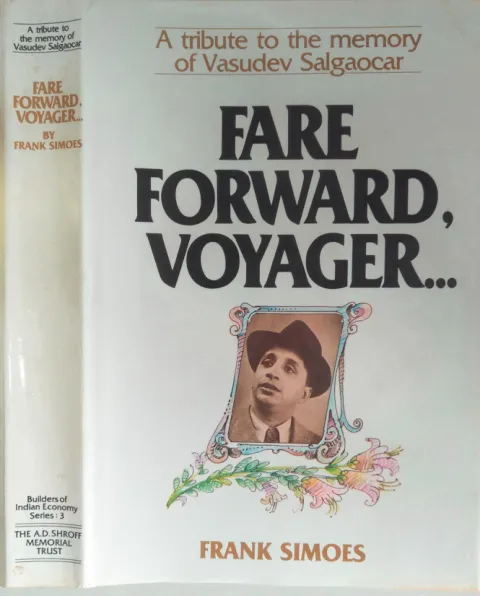
Fare Forward, Voyager...
A tribute to the memory of Vasudev Salgaocar
By Frank Simoes
Published by Mr. M.R. Pai, Trustee, The A.D. Shroff Memorial Trust, 'Piramal Mansion', 235, Dr. D.N. Road, Bombay-400 001. Printed by Mr. Arun Mehta at Vakil & Sons Ltd., Vakils House, Sprott Road, 18, Ballard Estate, Bombay-400 038. · Bombay · 1990
301 pages
No. 3 in Builders of Indian Economy
Summary
Frank Simoes’s “Fare Forward, Voyager…” is a biographical tribute to the Goan industrialist Vasudev M. Salgaocar (1916-1984), published in May 1990 by the A.D. Shroff Memorial Trust as Volume 3 of its “Builders of Indian Economy” series. In the rendered pages — the dust jacket, family tree, copyright page, contents, epigraph, prologue and the opening of the first chapter “Childhood’s End” — the book positions itself as a journey of discovery undertaken by the author, a fellow Goan, drawing on roughly one hundred and fifty interviews and two hundred hours of taped material to assemble what the jacket calls “a democratic consensus” on its subject.
The prologue, set in the pre-dawn hours of a single day at the Salgaocar mansion in Chicalim above Vasco da Gama, sketches the man at sixty-eight: a pioneer industrialist still negotiating with the Mormugao Port Trust, scanning the Financial Times and the Economist for international iron-ore signals, and dispatching telex messages to a grandchild. In the rendered pages, the chapter “Childhood’s End” then turns backward to 1916 Raibander, locating Salgaocar in a Goud Saraswat Brahmin family that had collapsed from gilded gentry into shopkeeping poverty under Portuguese colonial rule, and laying out the rigid colonial-Catholic hierarchy of Goa under the rising shadow of Salazar’s Estado Novo.
The rendered pages frame Salgaocar’s later industrial achievement against this colonial pyramid: a Goan Hindu boy “disenfranchised” by religion and language, schooled in the markets of Vasco rather than in any classroom, who would later become “Goa’s first true renaissance man.” The polemical scaffolding of the book in the rendered pages is the contrast between the dismantling of liberal political thought in Portugal under Salazar — “the slender scaffolding of liberal political thought” — and the slow rise of an autodidact entrepreneur in its colonial periphery.
Key points
-
Biographical tribute volume on Vasudev M. Salgaocar (1916-1984), Goan iron-ore industrialist and philanthropist, written by journalist-photographer Frank Simoes.
-
Published May 1990 by the A.D. Shroff Memorial Trust (M. R. Pai, Trustee) as ‘Builders of Indian Economy Series: 3’; not for sale, distributed free to schools, colleges and libraries.
-
Jacket copy frames the project as a journey of discovery built from roughly 150 interviews and 200 hours of tape, ranging from Cabinet ministers to mine labourers.
-
Prologue depicts the 68-year-old Salgaocar before dawn in his Chicalim mansion negotiating with the Mormugao Port Trust, reading the Financial Times and Economist, and sending a playful telex to his grandson Vishal in Pune.
-
Opening chapter ‘Childhood’s End’ locates Salgaocar’s birth in 1916 to a Goud Saraswat Brahmin family in Raibander whose gilded fortune collapsed into petty shopkeeping under his father.
-
The rendered pages sketch the rigid Portuguese colonial pyramid in Goa — administrators and clergy at the top, landed gentry beneath, peasantry at the base — and the disenfranchisement of Goan Hindus.
-
Salazar’s Estado Novo is invoked as the political backdrop, with the regime described as dismantling ‘the slender scaffolding of liberal political thought’ and reducing Parliament to a rubber stamp.
-
Table of contents lists six body sections — Childhood’s End (3), The Sunday Club (25), The Good Earth (67), A Man For All Seasons (135), The Gathering Dusk (211), Journey’s End (257) — none of which beyond the opening of the first are visible in the rendered pages.
Metadata and summary are AI-extracted from the source PDF and reviewed for editorial accuracy. The original work is available via the Read PDF tab above (where present); paragraph-level citation inside the PDF is deferred to a future engagement.