
speech · memorial lecture
Embracing Corporate Social Responsibility
The Saner Alternative
By Anu Aga
FORUM OF FREE ENTERPRISE, PENINSULA HOUSE, 235 DR. D. N. ROAD, MUMBAI 400 001 · Mumbai · 2003
27 pages
No. 37 in A. D. Shroff Memorial Lecture
Summary
Delivered as the 37th A. D. Shroff Memorial Lecture in Mumbai on 5 November 2003 and published by the Forum of Free Enterprise, Anu Aga’s address makes a brisk, example-driven case for Corporate Social Responsibility as the ‘saner alternative’ to a narrow, profit-only conception of business. Aga frames CSR not as charity or PR but as a stewardship obligation that flows from the fact that companies draw their talent, customers and licence-to-operate from the wider community. She invokes Adam Smith (the author of A Theory of Moral Sentiments as well as The Wealth of Nations) and Gandhi’s trusteeship model to argue that ethical conduct and commercial success have always been intertwined, and that the live question today is not whether but how CSR should be measured, audited and reported.
The heart of the talk is a six-sided ‘stakeholder hexagon’—customers, employees, shareholders and investors, environment and community, suppliers, and government—with the Board of Trustees at the centre balancing short-term shareholder interests against long-term stewardship. Aga works through each face with international and Indian illustrations: Merck’s free distribution of the river-blindness drug, Starbucks’s low employee turnover, Brazil’s Semco under Ricardo Semler (35–40% annual growth with an open work culture), Michael Porter’s ‘Green and Competitive’ thesis, Nike’s reluctant supply-chain reform after a sweatshop scandal, and Indian exemplars such as the Tatas at Jamshedpur, Godrej, the Birlas, and the NDDB’s Operation Flood. A 1992 World Bank study, The Cost of Inaction, is cited to put Indian environmental damage at Rs 34,000 crores a year (4.5% of GDP).
The political-economy register is recognisably classical-liberal: Aga thanks liberalisation for restoring the customer’s ‘no-confidence vote’ that India’s closed economy had suppressed, criticises Indian regulation as simultaneously over-prescriptive and unenforced (corrupt pollution inspectors, labour rules that push firms away from permanent hiring), and argues for a partnership model between government and business in place of the adversarial ‘erring children to be chided’ frame. The booklet’s rendered pages cover the introduction by Minoo R. Shroff and Aga’s address through the ‘Government’ section; the final stretch—Aga’s specific recommendations for the Indian scene—lies in pages not rendered here.
Key points
-
Frames CSR as a duty arising from the fact that companies draw talent, customers and resources from the community in which they operate, not as discretionary philanthropy.
-
Anchors the case in Adam Smith’s Theory of Moral Sentiments and Gandhi’s trusteeship doctrine to insist that ethics and capitalism are not in tension.
-
Proposes a six-sided stakeholder ‘hexagon’—customers, employees, shareholders/investors, environment/community, suppliers, government—with the Board as steward balancing present and future interests.
-
Argues that liberalisation gave Indian customers the power to cast a ‘no-confidence vote’ that the closed economy had denied them, making CSR a competitive variable rather than a moralism.
-
Treats environmental neglect as a balance-sheet risk, citing the World Bank’s 1992 ‘Cost of Inaction’ study that pegged Indian environmental damage at Rs 34,000 crores—4.5% of GDP.
-
Holds up Merck (river-blindness drug), Starbucks (employee retention), and Brazil’s Semco under Ricardo Semler as proof that CSR and profitability reinforce rather than cancel each other.
-
Reads Indian over-regulation as self-defeating: cheap non-functional pollution equipment plus bribed inspectors, and labour rules so onerous that firms avoid hiring permanent workers.
-
Calls for government and business to abandon the adversarial frame and act as ‘mature adults’ building a common, actionable agenda.
Metadata and summary are AI-extracted from the source PDF and reviewed for editorial accuracy. The original work is available via the Read PDF tab above (where present); paragraph-level citation inside the PDF is deferred to a future engagement.
People in this work
Related across the archive
 Primary workEXCELLENCE IN INDUSTRY THROUGH LEADERSHIP
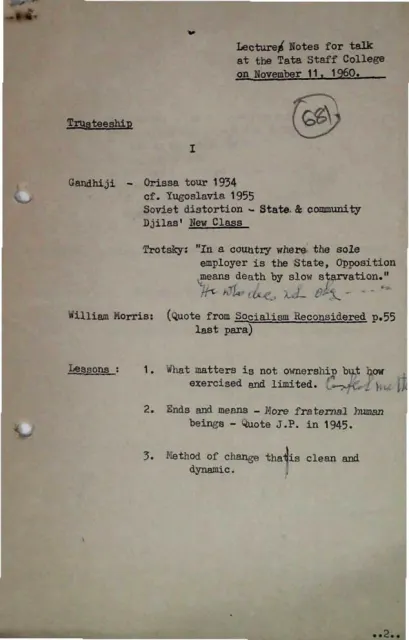 Primary workLectures Notes for talk at the Tata Staff College on November 11, 1960.
 Primary workA New Approach to Overcome Constraints on Private Sector
 ExcerptTHE APPLICATION OF SCIENCE AND TECHNOLOGY TO SOCIO-ECONOMIC DEVELOPMENT
 ExcerptThe Liberal Budget: Building an Equitable Society