pamphlet
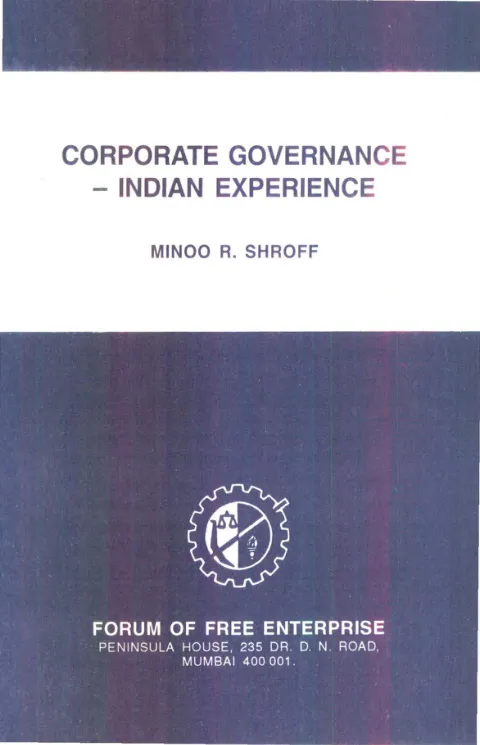
CORPORATE GOVERNANCE – INDIAN EXPERIENCE
By Minoo Shroff
FORUM OF FREE ENTERPRISE, PENINSULA HOUSE, 235 DR. D. N. ROAD, MUMBAI 400 001. · Mumbai · 2000
20 pages
Summary
In this Forum of Free Enterprise booklet (published December 2000), the management consultant and Forum president Minoo R. Shroff offers a brisk practitioner’s history of corporate governance in India and an argument for why the moment has arrived to take it seriously. He defines governance as ‘management assuming the role of trusteeship’ with checks and balances that lift performance, employee morale, shareholder value and social responsibility, insisting that ‘the spirit is more important than the form’ — codes alone do nothing without commitment at the top.
Shroff traces the Indian corporate landscape from a family-dominated, board-as-formality past — with notable exceptions like the House of Tatas, which adopted worker welfare and even social audits decades ahead of legislation, and the 1956 Forum of Free Enterprise Code of Conduct (reproduced as an appendix). He then walks through the institutional arrivals that pushed change: post-Independence joint ventures with foreign collaborators who demanded real board engagement; the 1960s rise of nominee directors from public financial institutions (whose track record he judges ‘far from inspiring’); and the formation of large public sector corporations whose civil-servant boards he charges with being ‘largely ineffective’, meticulous on compliance but unfit for strategy. He underscores the scale of the state’s grip — funds ‘exceed Rs 15,000 billion, almost 75% of the gross national product’ — and calls for a total overhaul of how state enterprises are governed.
The second half turns prescriptive. The chairman must be ‘the custodian of corporate ethics’ and run the board as ‘a constellation of stars’; SEBI’s reclassification of institutional directors as independent makes it urgent that nominees act on their own judgement and that institutions cultivate genuinely independent panels. He welcomes the CII and SEBI codes, mandatory retirement ages, the broadening of director pools to academics, scientists and foreign experts, and notes that ‘shareholder activism, now becoming visible, and the growing threat of hostile takeovers will spur entrenched managements to ensure better governance.’ The pamphlet closes with the full text of the Forum’s 1956 Code of Conduct addressing obligations to consumers, labour, investors, professional ethics and the community, and an Eugene Black epigraph asking that private enterprise be accepted ‘not as a necessary evil, but as an affirmative good.‘
Key points
-
Defines corporate governance as management-as-trusteeship: checks and balances that produce high performance, customer satisfaction, employee morale, shareholder value, and societal sensitivity — with the spirit of the code mattering more than its form.
-
Reads Indian corporate history as dominated by family/patriarchal control with boards ‘for form’s sake’, flagging the House of Tatas (welfare measures, worker participation, social audit) and the Forum of Free Enterprise’s 1956 Code of Conduct as far-sighted exceptions.
-
Credits post-Independence joint ventures and 1960s public-financial-institution nominee directors with professionalising boards, but argues the nominee directors’ record is ‘far from inspiring’ — peripheral, passive, often awakened only by media disclosures.
-
Indicts public sector boards staffed by civil servants as largely ineffective: meticulous on procedure but contributing little to policy formulation or business monitoring, with leaderless PSUs and short tenures compounding the problem.
-
Quantifies the stakes: nationalised banks, FIs, insurers, mutuals and provident funds manage roughly Rs 10,000 billion of citizens’ savings, and total state-controlled deployment exceeds Rs 15,000 billion — almost 75% of GNP — making overhaul urgent.
-
Argues the chairman is the pivot — ‘custodian of corporate ethics’ and orchestra leader of ‘a constellation of stars’ — responsible for tone, talent renewal, and a vision that mobilises employees.
-
Welcomes the CII and SEBI codes, mandatory retirement ages, second-generation promoters appointing competent non-executive directors, and the widening of board talent pools to academics, scientists, ex-civil servants and global experts.
-
Concludes that codes, regulators and research analysts can only do so much — the real cutting edge is self-assessment, with shareholder activism and hostile-takeover threats as final disciplines on entrenched managements.
-
Appendix reproduces the Forum of Free Enterprise’s 18 July 1956 Code of Conduct, articulating producer/consumer, employer/labour, management/investor, professional and civic obligations as a charter for ethical free enterprise.
Metadata and summary are AI-extracted from the source PDF and reviewed for editorial accuracy. The original work is available via the Read PDF tab above (where present); paragraph-level citation inside the PDF is deferred to a future engagement.