speech
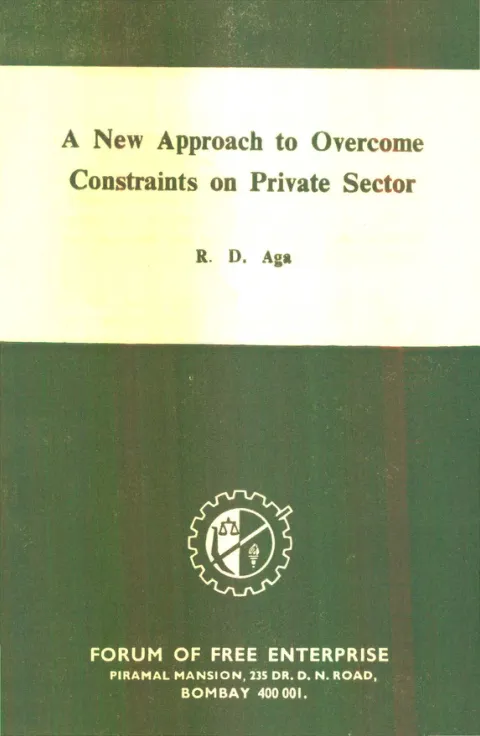
A New Approach to Overcome Constraints on Private Sector
By RD Aga
FORUM OF FREE ENTERPRISE, PIRAMAL MANSION, 235 DR. D. N. ROAD, BOMBAY 400 001. · Bombay · 1980
24 pages
Summary
Delivered at the Eleventh Annual Convention of the Bombay Management Association on 3rd December 1980 and reissued as a Forum of Free Enterprise pamphlet, R. D. Aga’s address recasts the standard Indian industrialist’s grievance list — MRTP, FERA, licensing, price controls, FERA, labour and tax law — as a self-defeating monologue. Aga, chairman and managing director of Thermax (India), opens by distinguishing the entrepreneur from the administrator: the administrator treats boundary conditions as given, while the entrepreneur stretches them. From this distinction he argues that the post-1950 Indian preoccupation with external constraints, far from being an honest diagnosis, has become a cultural reflex that crowds out the search for opportunities.
The argument is then made empirically. Drawing on the Assocham Parliamentary Digest’s data for the twenty largest industrial houses under MRTP Section 26 (1972–78) and on Bombay Stock Exchange data for twelve large multinationals under FERA (1972–79), Aga shows wide dispersion in asset growth, turnover and profit before tax within both groups — from declines and losses at the bottom to gains of 200–300 per cent at the top. If external constraints applied uniformly to all units in a category, he reasons, performance variance this large can only be explained by what management does inside the firm. He develops this into four propositions: that mindset matters more than the constraint, that intra-industry variance reveals the secondary role of constraints, that strategic response to environment distinguishes the high-flyer from the also-ran, and that for smaller firms internal management decides growth more than external policy does.
A long autobiographical section walks through Thermax’s growth from a small-scale boiler unit in 1966 to a three-company group with Rs. 30 crores turnover and 1,500 employees by 1980. The ‘critical areas’ that required management attention, Aga insists, had nothing to do with government: finance, the learning curve in new technology, organisation structure as the firm grew from single-product to multi-product, and the motivation of people as the company moved from a compact group to a formalised hierarchy. The closing pages widen the indictment of the licensing regime — it has, in his phrase, bred a ‘sheltered economy’ culture of waste, obesity, evasion of the law and customer apathy — and propose replacing classical economics’ ‘Economic Man’, who reacts only to profit and survival, with a ‘Professional Man’ who upholds standards out of competence rather than competitive compulsion.
The pamphlet ends with a rhetorical device: an ‘Imaginary Address by the President of an industrial and trade apex body’ to a cabinet minister chief guest, breaking with the genre’s traditional litany of complaint to offer partnership in delivering the Sixth Five-Year Plan and lifting the standard of life of 600 million Indians.
Key points
-
Aga frames the entrepreneur as one who stretches boundary conditions while the administrator merely operates within them — the difference between fault-finding and target-setting.
-
Indian industry’s habitual catalogue of woes (MRTP, FERA, licensing, price controls, power, credit) is, in Aga’s view, a 30-year monologue of negativism that has proved ‘self-fulfilling’.
-
Empirical evidence from the 20 MRTP houses (1972–78) and 12 large FERA multinationals (1972–79) shows growth dispersion so wide — from losses to 200%+ gains — that external constraints cannot be the dominant limiting factor.
-
The four critical management challenges in Aga’s own company, Thermax, were internal: finance, the learning curve on new technology, evolving organisation structure, and motivation in a growing firm.
-
Industrial licensing has, beyond its direct economic costs, bred ‘a whole new business and social culture’ of waste, evasion and customer apathy that has acted as ‘an insidious opiate’ on the private sector.
-
Aga proposes replacing the ‘Economic Man’ of classical doctrine with a ‘Professional Man’ whose standards are warranted by competence and commitment, not by the invisible hand.
-
The closing ‘Imaginary Address’ offers a cabinet minister partnership in implementing the Sixth Five-Year Plan, dropping the traditional litany of complaint in favour of placing the private sector’s ‘reservoir of talent’ at the government’s disposal.
Metadata and summary are AI-extracted from the source PDF and reviewed for editorial accuracy. The original work is available via the Read PDF tab above (where present); paragraph-level citation inside the PDF is deferred to a future engagement.