speech
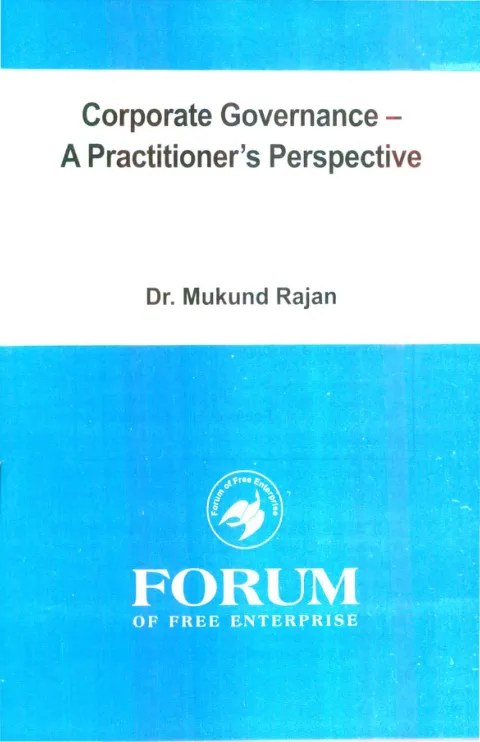
Corporate Governance – A Practitioner's Perspective
Forum of Free Enterprise
44 pages
Summary
Corporate Governance — A Practitioner’s Perspective is the printed text of Dr. Mukund Rajan’s inaugural keynote at the Forum of Free Enterprise’s residential program on taxation held 2–4 August 2018 at the Gateway Hotel, Nashik. Speaking as a self-described practitioner who spent two decades inside the Tata Group, latterly as its Chief Ethics Officer, Rajan distinguishes ethics — ‘doing the right things by stakeholders’ and following the ‘spirit’ of right conduct — from compliance, which is rule-based and tracks the ‘letter’ of the law. He uses the Tata structure of Company and Local Ethics Counsellors and a separate cadre of Compliance Officers (for anti-bribery, anti-money-laundering, insider-trading and POSH matters) to illustrate how a large group operationalises both.
Rajan’s central diagnosis, framed early in the address, is that ‘corporates today operate in an environment of significantly diminished trust.’ He marshals roughly a decade-and-a-half of crises — the dot-com bust, Enron, the 2008 global financial crisis, Volkswagen’s emissions fraud and the resulting USD 15+ billion in fines, and the 2018 collapse in Facebook’s market capitalisation (a USD 119 billion single-day loss after the Cambridge Analytica/data-privacy fallout) — to argue that even the world’s largest firms now suffer brand-equity erosion or extinction when governance fails. The Indian half of the picture is a ‘catharsis’ against corruption: the Satyam, 2G and coal scams, sitting CEOs and politicians being jailed, the rise of the Aam Aadmi Party in 2012 on an anti-corruption platform, and the EY Asia Pacific Fraud Survey 2017 finding that 78% of Indian respondents agree bribery and corrupt practices occur widely in India.
The rendered pages then map the policy and civic responses. On the state side, Rajan reads spectrum auctions, more objective allocation of mining rights and bank licences, demonetisation, the Insolvency and Bankruptcy Code and the Goods and Services Tax as a deliberate attempt to clean up ‘crony capitalism’ — a phrase he uses bluntly. On the civic side, he points to social-media-enabled scrutiny (the #MeToo movement, rapper Sofia Ashraf’s viral ‘Kodaikanal Won’t’ song against Unilever’s mercury-thermometer plant), cross-jurisdictional reach of laws such as the UK Bribery Act, and the Panama Papers fallout that contributed to Nawaz Sharif’s exit in Pakistan. He cites a 2017 PwC study showing more CEOs being dismissed for ethical lapses — interpreted not as worsening behaviour but as tighter scrutiny.
The last section in the rendered chunk pivots to what Rajan calls genuinely new pressures on corporate ethics: the environmental crisis and rising inequality. He introduces the concept of Earth Overshoot Day — the date when humanity’s annual demand on ecological resources exceeds what Earth can regenerate — and notes it now arrives in August rather than 31 December. The Paris Climate Accord, he argues, gets the world to a 2°C ceiling at best; the real target is 1.5°C. Urbanisation compounds the strain — over a billion people will move to cities in the next decade, and 10 of the top 20 most polluted cities in the WHO ambient-air database are in India. The text breaks off mid-discussion of urban environmental disasters, with Rajan citing the 2015 Chennai floods.
Key points
-
Rajan defines the ethics/compliance distinction operationally: ethics is value-based and follows the ‘spirit’ of right conduct (‘even when nobody is looking’), while compliance is rules-based and follows the ‘letter’ of the law.
-
He describes the Tata Group’s two-track governance plumbing — Company Ethics Counsellors backed by Local Ethics Counsellors drawn from HR, admin and internal audit, alongside a separate set of Compliance Officers for anti-bribery, AML, insider-trading and POSH matters.
-
The framing diagnosis is a trust deficit: corporates today operate in ‘an environment of significantly diminished trust’, evidenced by the dot-com bust, Enron, the 2008 crisis, Volkswagen’s emissions fraud and Facebook’s USD 119 billion one-day market-cap loss after the data-privacy scandal.
-
On India, Rajan reads the past decade as a corruption catharsis — Satyam, 2G, coal, jailed CEOs and politicians, the rise of the Aam Aadmi Party in 2012 — and cites the EY Asia Pacific Fraud Survey 2017 (78% of Indian respondents say bribery and corrupt practices occur widely; 58% would still work for organisations involved in fraud).
-
Policy responses he endorses as anti-cronyism: public spectrum auctions, more objective mining/banking-licence allocation, demonetisation, the Insolvency and Bankruptcy Code, and GST.
-
Civic scrutiny has gone global and viral — the UK Bribery Act has extra-territorial reach against Indian firms, the Panama Papers contributed to Nawaz Sharif’s exit, and #MeToo plus Sofia Ashraf’s ‘Kodaikanal Won’t’ show how no firm can outrun its past.
-
Two genuinely new ethical pressures, in Rajan’s reading, are environmental impact and inequality: Earth Overshoot Day now falls in August, the Paris Accord at best caps warming at 2°C while 1.5°C is the real need, and 10 of the world’s 20 most polluted cities are Indian.
-
Rajan invokes the Tata ‘4Es’ framework (Education, Entrepreneurship, Employment, Employability) and the Tata Code of Conduct/Brand Equity and Business Promotion Agreement as practical instruments of corporate governance.
Metadata and summary are AI-extracted from the source PDF and reviewed for editorial accuracy. The original work is available via the Read PDF tab above (where present); paragraph-level citation inside the PDF is deferred to a future engagement.