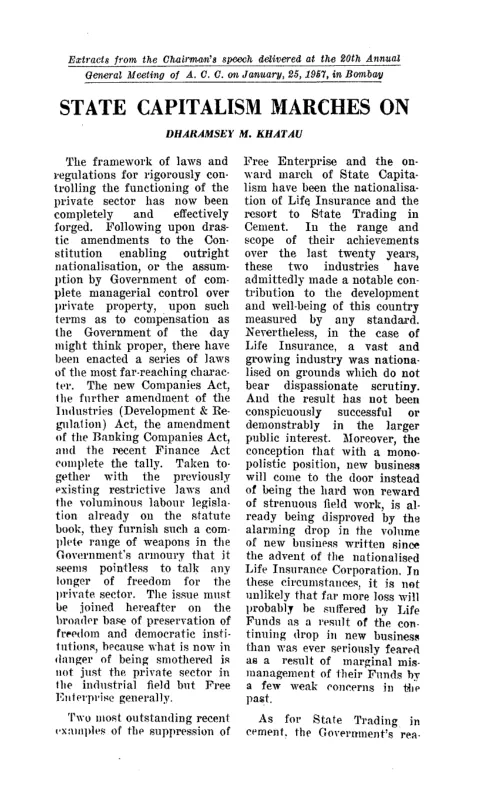
speech
CONTROLS IN A PLANNED ECONOMY
By A. D. Shroff
Published by M. R. Pai, for Forum of Free Enterprise, "Sohrab House", 235 Dr. Dadabhai Naoroji Road, Bombay 1, and printed by P. A. Raman at Inland Printers, Victoria Mills Building, 35, Gamdevi Road, Bombay 7. · Bombay · 1960
15 pages
Summary
A. D. Shroff’s lecture, delivered under the auspices of the Forum of Free Enterprise in Bombay on September 1, 1960 and issued as a pamphlet, argues that the apparatus of controls erected to implement India’s Second Five-Year Plan has grown so dense that it has begun to obstruct the very development it was meant to serve. Shroff invokes Hayek’s warning that economic control is the control of the means for all our ends, and surveys, sector by sector, the maze of statutes — the Companies Act, the Industries (Development and Regulation) Act, foreign-exchange control, the Controller of Capital Issues, textile control, sugar control, banking control — that an industrialist must navigate before a project can begin.
The second half of the lecture moves from incident to indictment. Controls, Shroff contends, distort competition, breed vested interests inside the bureaucracy, and reliably generate black markets — a point he reinforces by quoting Winston Churchill. He illustrates the lop-sidedness of administration through the diversion of scarce foreign exchange to import 160 Dodge cars for ministers and officials at the height of an austerity drive, and through stricter rules on share issues by established companies. He also cites Northcote Parkinson’s laws as a portrait of the kind of officialdom that planned controls inevitably grow. The closing pages turn to monetary policy: the Reserve Bank’s increased Cash Reserve Ratios in March and May 1960 have failed to halt prices, because the government continues to pump new money into circulation faster than goods can match it.
Shroff frames the Labour Party’s recanting of nationalisation (citing Douglas Jay) as a cautionary tale India should heed before committing further to a “socialistic pattern of society.” His remedy is not technocratic but civic: only the mobilisation of informed public opinion, he argues, can arrest the inflation and force a retreat from the “crazy and mad race for unrealistic development through excessive and frustrating control.”
Key points
-
Shroff opens by accepting that some planning controls are necessary but argues India’s controls have crossed the line into hindering the development they are meant to foster.
-
He cites Hayek’s Road to Serfdom to frame economic control as control of the means for all human ends, not merely one sector.
-
He catalogues the regulatory stack — Companies Act, Industries (Development and Regulation) Act, Controller of Capital Issues, foreign-exchange control, local-authority approvals — that any industrialist must clear before raising capital or importing machinery.
-
Controls, he argues, breed vested interests inside the bureaucracy itself: the Ministry of Commerce & Industry and Finance Ministry posts (Joint, Deputy, Under Secretaries) exist to administer controls and will resist their removal.
-
Controls inevitably create black markets (quoting Churchill on the corrosion of respect for law) and produce lop-sided enforcement, exemplified by the diversion of scarce foreign exchange to import 160 Dodge cars for ministers and officials.
-
He invokes Northcote Parkinson’s laws to characterise an officialdom that expands to fill the time and revenue available, and warns the same dynamic is entrenched in India’s Soviet-type planned economy.
-
On monetary policy, Shroff argues the Reserve Bank’s March and May 1960 Cash Reserve Ratio hikes cannot halt prices while the government continues to pump crores of new money into circulation without matching production.
-
Citing the British Labour Party’s public retreat from nationalisation (via Douglas Jay), he urges India to learn from foreign experience before extending the “socialistic pattern of society”, and closes by calling on the thinking public to mobilise opinion against the system of controls.
Metadata and summary are AI-extracted from the source PDF and reviewed for editorial accuracy. The original work is available via the Read PDF tab above (where present); paragraph-level citation inside the PDF is deferred to a future engagement.