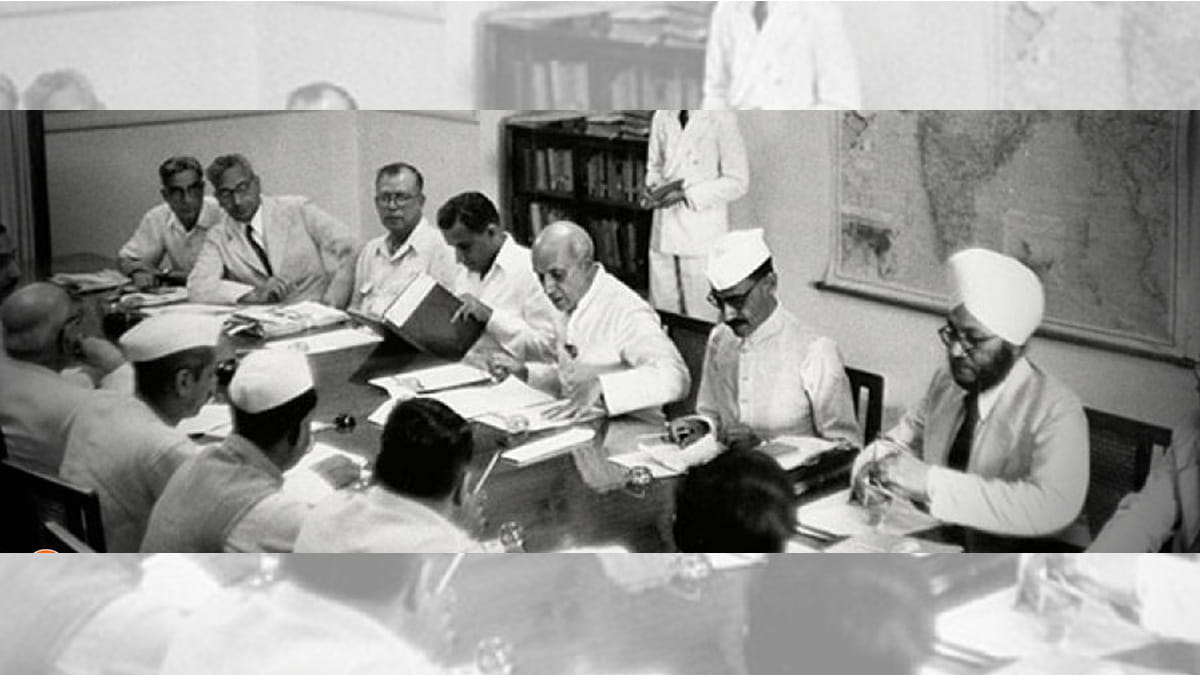
pamphlet
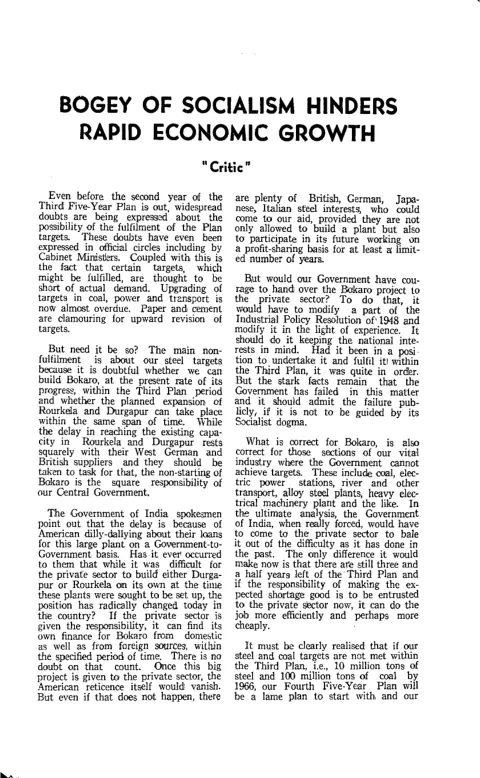
Bogey of Socialism Hinders Rapid Economic Growth
By Forum of Free Enterpriseorganisation
Published by M. R. PAI for Forum of Free Enterprise, "Sohrab House", 235 Dr. Dadabhai Naoroji Road, Bombay 1, and printed by B. G. DHAWALE at KARNATAK PRINTING PRESS, Chira Bazar, Bombay 2 · Bombay · 1962
2 pages
Summary
This short Forum of Free Enterprise leaflet, reproduced from the Financial Express of 31 May 1962, is an anonymous polemic signed by “Critic” arguing that the Government of India’s ideological attachment to socialism — what the title calls a “bogey” — is the principal obstacle to fulfilling the Third Five-Year Plan’s most critical targets. The writer focuses on steel and the long-delayed Bokaro plant, contrasting the relatively contained problems at Rourkela and Durgapur (where West German and British suppliers are to blame for delays) with the much bigger failure at Bokaro, which lies “squarely” with the Central Government’s refusal to consider any role for the private sector.
The leaflet’s central pragmatic claim is that Indian and foreign private capital — British, German, Japanese, Italian — are now ready and willing to build Bokaro on a profit-sharing basis for a limited number of years, and that the public-sector dogma keeping them out is incompatible with national economic interest. The argument extends from steel to coal, power, and transport: official estimates concede shortages of half a million volts of electricity a year and a 10,000-crore ton-mile gap in transport capacity by 1966, and the writer warns that without private participation the Fourth Plan will begin “lame” and the 1972 target of 18 million tons of steel will remain “a pipe dream.”
The piece closes with a broader audit of Indian planning to date: the First Plan was “hardly a plan in the true sense of the word” but a conglomeration of projects; the Second Plan had better groundwork but collapsed into a foreign-exchange crisis because planners ignored international trade trends; and the Third Plan now risks the same fate unless dogmas give way to a “more realistic road.” The leaflet ends with the standard Forum disclaimer that views expressed do not necessarily represent the Forum’s, and the imprint of M. R. Pai as publisher.
Key points
-
Written under the pseudonym “Critic” and reproduced from the Financial Express (31 May 1962), the leaflet treats steel as the test case for whether the Third Five-Year Plan can be saved.
-
Delays at Rourkela and Durgapur are blamed on West German and British suppliers, but the failure to start Bokaro is attributed “squarely” to the Central Government’s refusal to admit private capital.
-
Foreign private interests — British, German, Japanese, Italian — are described as ready to build Bokaro on a profit-sharing basis for a limited number of years, contradicting the official line that only the State can deliver heavy industry.
-
Power and transport projections are used to extend the argument: a shortage of 4–5 million volts of electricity a year and a transport gap of around 7,000 crore ton-miles by 1966 are flagged as evidence that public-sector capacity alone cannot keep pace.
-
If the Third Plan misses its targets of 10 million tons of steel and 100 million tons of coal by 1966, the Fourth Plan begins “lame” and the 1972 target of 18 million tons of steel becomes “a pipe dream.”
-
The leaflet retrospectively grades earlier plans: the First Plan was “hardly a plan,” the Second Plan had better groundwork but underestimated population growth and foreign trade trends, leading to the foreign-exchange crisis.
-
The polemic is framed as a choice between “dogmas and shibboleths” and a “more realistic road” of mixed public–private development.
-
Published by M. R. Pai for the Forum of Free Enterprise from 235 Dr. Dadabhai Naoroji Road, Bombay, and printed at Karnatak Printing Press; dated 8 July 1962.
Metadata and summary are AI-extracted from the source PDF and reviewed for editorial accuracy. The original work is available via the Read PDF tab above (where present); paragraph-level citation inside the PDF is deferred to a future engagement.