speech · memorial lecture
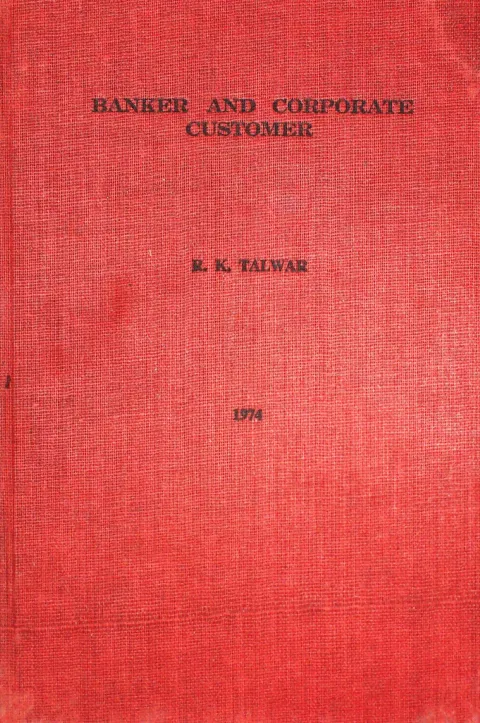
BANKER AND CORPORATE CUSTOMER
By R. K. Talwar
Published by THE A. D. SHROFF MEMORIAL TRUST, 235 Dr. D. N. ROAD, BOMBAY - 400 001. Colophon: Published by M. R. Pai on behalf of The A.D. Shroff Memorial Trust, 235, Dr. Dadabhai Naoroji Road, Bombay 400 001, and Printed by Michael Andrades at The Bombay Chronicle Press, Horniman Circle, Bombay 400 001. · Bombay · 1974
23 pages
Part of A. D. Shroff Memorial Lecture
Summary
Delivered as the 1974 A. D. Shroff Memorial Lecture by R. K. Talwar, then Chairman of the State Bank of India, this short volume sets out how the relationship between banks and their large corporate borrowers had been transformed in the two decades since the 1953–54 Committee on Finance for the Private Sector (the Shroff Committee). Talwar opens with a careful tribute to A. D. Shroff — recovering Shroff as a pragmatist who founded the Forum of Free Enterprise but who had also served on the National Planning Committee and helped author the Bombay Plan of 1944 — and insists that Shroff’s name was unfairly linked to a discredited laissez-faire doctrine.
Against that backdrop Talwar argues that the banker can no longer be primarily a guarantor of security. With managing agency houses gone, banks nationalised, and top-management increasingly professionalised, the banker must assess the quality of management, the end-use of funds, the cash flows and the viability of operations. Bank credit, he insists, is not a substitute for capital; the comforting fiction that cash-credit and overdraft advances are short-term and repayable on demand is a ‘myth’. The banker must therefore involve himself more deeply in the corporate customer’s affairs — calling for budgets, stipulating limits on dividends and inter-corporate investments, and even placing nominee directors — while channelling credit toward priority sectors and weaker sections in line with social policy.
The lecture frames this new ‘discipline’ as a meeting ground rather than a clash of interests: the banker safeguards depositors and shareholders, detects danger signals, and takes responsibility for revival rather than abandoning the company to government takeover under the Industries (Development and Regulation) Act. Talwar closes by extending the same logic to the joint sector and to the auditor’s role, calling for a tripartite cooperation between banker, customer and auditor in the interest of preserving the safety of bank funds and the profitability of enterprise.
Key points
-
Talwar recovers A. D. Shroff as a pragmatist who served on the National Planning Committee and co-authored the Bombay Plan, rejecting the popular pairing of his name with a 19th-century laissez-faire doctrine.
-
He cites the 1953–54 Reserve Bank Committee on Finance for the Private Sector (the Shroff Committee) as the first organised attempt to assess the banking system’s capacity to meet the targets of the First Plan.
-
Bank deposits had grown from roughly Rs. 850 crores at the time of the Shroff Committee to Rs. 10,000 crores by 1974, with more than half of total credit now going to large and medium industry.
-
Talwar argues that the disappearance of managing agency houses and the nationalisation of the big commercial banks have shifted the banker’s emphasis from security to quality of management.
-
He insists bank credit is no substitute for capital, and that the supposed liquidity of cash-credit and overdraft advances ‘repayable on demand’ is a myth in practice.
-
The new credit discipline requires budgets, cash-flow data, end-use monitoring, conditions on dividends and inter-corporate investment, and occasionally nominee directors on boards.
-
Banks must also direct an increased share of credit to priority sectors and weaker sections, consistent with the socio-economic priorities of the post-nationalisation era.
-
Talwar prefers banker-led rehabilitation of sick units over takeover by Government under the Industries (Development and Regulation) Act, and calls for tripartite cooperation between banker, customer and auditor.
Metadata and summary are AI-extracted from the source PDF and reviewed for editorial accuracy. The original work is available via the Read PDF tab above (where present); paragraph-level citation inside the PDF is deferred to a future engagement.