
speech · memorial lecture
QUALITY IN BANKING
By N. VAGHUL
Published by THE A. D. SHROFF MEMORIAL TRUST, "Piramal Mansion," 235, Dr. D. N. Road, BOMBAY 400 001. · Bombay · 1989
24 pages
Part of A. D. Shroff Memorial Lecture
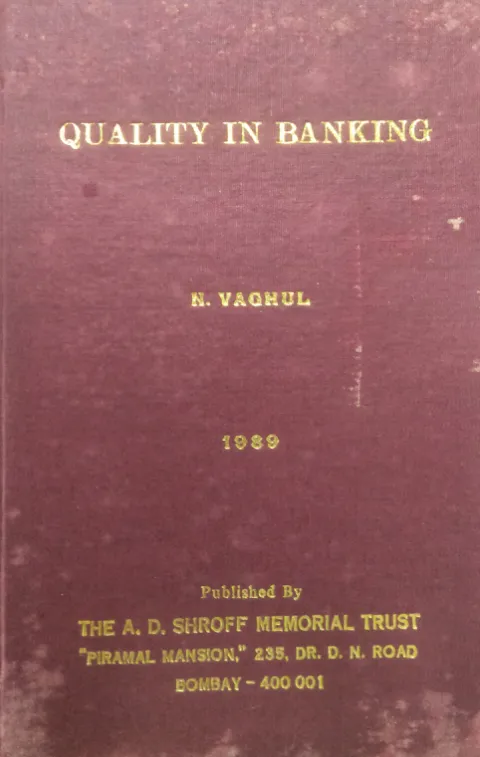
QUALITY IN BANKING
By N. VAGHUL
Summary
Quality in Banking is the text of the 1989 A. D. Shroff Memorial Lecture, delivered in Bombay on 12 October 1989 by N. Vaghul, then Chairman and Managing Director of the Industrial Credit & Investment Corporation of India Ltd (ICICI) and earlier Chairman of Bank of India. The lecture, published as a booklet by The A. D. Shroff Memorial Trust with an introduction by N. A. Palkhivala, opens by paying tribute to Shroff’s early defence of free enterprise at a time when ‘the nation was riding a wave of socialism’, and argues that the collapse of communism in Russia, Poland and Hungary has now vindicated Shroff’s stand. Vaghul then narrows his subject from the broader question of liberalisation to a problem he believes Indian bankers have systematically dodged — the relentless emphasis on quantity over quality.
The core argument is that Indian banking has confused growth metrics — branch openings, deposit mobilisation, priority-sector targets — with health, and that ‘the banking quality has indeed declined’ across service, housekeeping and, most seriously, the quality of assets. Vaghul calls for what he terms a ‘quality movement’ and frames its principal lever as a regulatory one: Indian banks should be required to make full public disclosure of their non-performing assets, the provisions held against them, and the bad debts written off each year. The existing secrecy law, he argues, is a hangover from British banking practice; the international banking system has already abandoned it without any loss of public confidence. He also wants an objective accounting rule — interest unreceived for two or three years triggers a non-performing classification — to remove discretion and end the fiction of booking notional interest on which banks then pay real tax.
Vaghul defends Indian banks’ developmental and risk-bearing role against any naive comparison with conservative banks in the developed world, but insists that the alternative to disclosure is to bequeath a hidden problem to the next generation. He extends the diagnosis to customer service and housekeeping, rejecting the view that the deterioration began with nationalisation in July 1969: bankers did not become ‘angels’ the day before takeover, and the rot has been steady. The closing pages turn to systems, arguing that Indian banking still runs on procedures inherited from 1920s Scottish bankers that cannot cope with a thousand-fold rise in transactions, while trade-union resistance treats computers as ‘a man-eating tiger’. The rendered pages stop at printed page 15, mid-discussion of systems reform; the remainder of the booklet (PDF pages 21–24) is not in view.
Key points
-
Vaghul opens by crediting A. D. Shroff for boldly preaching free enterprise during India’s socialist tide and treats the fall of communism in Russia, Poland and Hungary as posthumous vindication of Shroff’s stand.
-
He invokes Swami Ranganathananda’s reading of Saraswati and Lakshmi as concepts of knowledge and welfare, and proposes that India now needs a ‘third goddess’ symbolising quality.
-
The central thesis is that Indian banking is obsessed with quantitative achievements — branches, deposits, priority targets — while service, housekeeping and especially asset quality have visibly deteriorated.
-
He calls for mandatory public disclosure of doubtful loans, non-performing assets, aggregate provisions and bad debts written off, breaking with a British-era secrecy law that the rest of the banking world has already abandoned.
-
He proposes an objective, non-discretionary accounting rule: a loan on which interest has not been received for two or three years should be classified as non-performing, ending the practice of booking notional accrued interest (on which banks then pay real tax).
-
He concedes initial disclosure will be ‘traumatic’ but argues it will impose internal discipline on branch managers and force timely rehabilitation of sick units, instead of postponing losses to protect the balance sheet.
-
Deterioration in service, he insists, is not caused by the 1969 nationalisation — employees did not switch character overnight — but is a slow, structural decline.
-
The systems running Indian banks were designed by Scottish bankers in the 1920s for a fraction of today’s transaction volume; ideological resistance from trade unions, who view computers as ‘a man-eating tiger’, is blocking modernisation.
Generated by the v1.5 extraction pipeline. Awaiting editorial review.
Metadata and summary are AI-extracted from the source PDF and reviewed for editorial accuracy. The original work is available via the Read PDF tab above (where present); paragraph-level citation inside the PDF is deferred to a future engagement.
People in this work
Related across the archive
 Primary workCrisis in Indian Banking Industry
 Primary workINDIAN BANKING IN INTERNATIONAL PERSPECTIVE
 Primary workFinancial Sector Reforms: The Unfinished Agenda
 ThePrintBank nationalisation will be a blow to India’s mixed economy, lead to totalitarianism: Phiroze Shroff
 ExcerptEconomic Reforms In India: Where Are We And Where Do We Go?