speech · memorial lecture
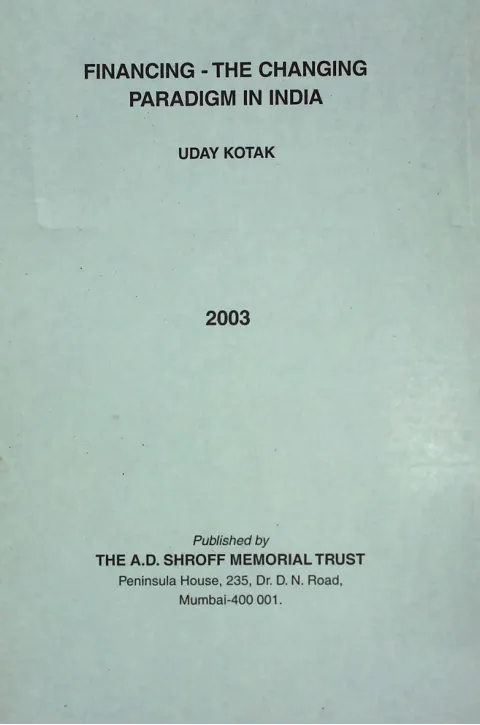
FINANCING - THE CHANGING PARADIGM IN INDIA
By Uday Kotak
Published by THE A.D. SHROFF MEMORIAL TRUST, Peninsula House, 235, Dr. D. N. Road, Mumbai-400 001. · Mumbai · 2003
23 pages
Part of A. D. Shroff Memorial Lecture
Summary
Delivered as the A. D. Shroff Memorial Lecture on 11 February 2003 and published as a booklet that August, this address by banker Uday Kotak surveys what he calls the ten paradigm shifts reshaping financial services in India. Kotak opens with everyday analogies — the arrival of the black-and-white television, the mobile phone, the Internet bubble — to argue that the financial sector is condemned to absorb every paradigm shift in the real economy, but that it must do so without abandoning the bedrock principles of prudence, trust and conservatism. The lecture is staged as a friendly amendment to Shroff’s own classic on industrial finance, banking and insurance: where Shroff defended compartments, Kotak argues that the compartments themselves are dissolving.
The nine shifts he develops in the rendered pages move from the conceptual to the structural. The vocabulary of “financing” gives way to “financial services”; product-pushing gives way to customer-centric solutions and cross-selling; wholesale industrial term-lending gives way to retail consumer credit (with the telecom sector as the only real project-finance exception); development lending gives way to commercial discipline, with agriculture singled out as a frontier where free pricing of risk could outperform priority-sector mandates; security-backed lending gives way to cash-flow underwriting; institutional silos blur as banks, NBFCs, insurers and asset managers begin to do everything; derivatives return as a parallel trading layer disconnected from underlying paper; and global capital flows turn money into water that moves wherever returns are highest. He closes the rendered portion by elevating risk management — credit, market, operational, counter-party and the new “event risk” born of 9/11 and India–Pakistan tensions — to the central preoccupation of the modern financial-services CEO.
Throughout, Kotak balances bullishness on India’s services-led growth and consumer-leverage runway against cautionary tales drawn from the dot-com bust, the Korean consumer-credit bubble, the East Asian crisis, and the Enron and WorldCom conflicts-of-interest scandals. The rendered set ends mid-discussion of a final cluster of concerns — the AAA bias of India’s bond market and the difficulty of pricing lower-rated paper — with the booklet’s last three pages unseen.
Key points
-
Frames the lecture as a tribute to A. D. Shroff that updates his “compartmentalising” thesis: institutions now do everything, and the old walls between industrial finance, banking and insurance are dissolving.
-
Argues that the word “financing” itself is obsolete and should be replaced by “financial services” — a customer-solutions mindset rather than a product-supply mindset.
-
Identifies a pivot from wholesale industrial term-lending to retail consumer and small-business credit, with telecom as the only large wholesale exception in the prior two years.
-
Predicts that lifting RBI priority-sector targets would unleash more genuine commercial lending to agriculture than mandates ever produced, because mandated credit attracts only token effort.
-
Reframes lending as cash-flow underwriting (security as cover, not as the asset financed) and notes the return of derivatives as a layered market disconnected from underlying paper.
-
Treats global capital flows as water — drawn to interest-differential arbitrage between dollar and rupee positions — and warns that the same liquidity surfeit that funds Indian growth can reverse violently, as in the East Asian crisis.
-
Elevates risk management to the central CEO concern, naming a new category — “event risk” — that emerged with 9/11 and the India–Pakistan tensions of May 2002.
-
Cites Enron, WorldCom and the international commercial-bank/investment-bank conflict of interest as warnings India must heed as its own institutions become universal financial supermarkets.
Metadata and summary are AI-extracted from the source PDF and reviewed for editorial accuracy. The original work is available via the Read PDF tab above (where present); paragraph-level citation inside the PDF is deferred to a future engagement.