speech
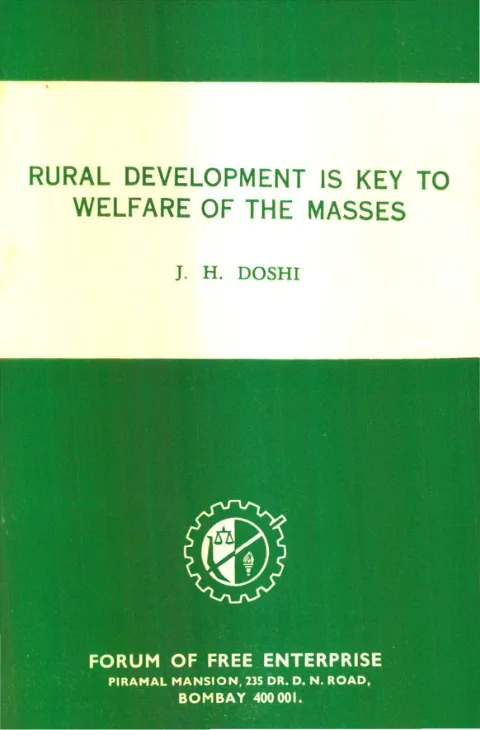
Rural Development is Key to Welfare of the Masses
By J. H. Doshi
Published by M. R. PAI for the Forum of Free Enterprise 235 Dr. Dadabhai Naoroji Road, Bombay-400 001, and printed by H. NARAYAN RAO at H. R. Mohan & Co., 9-B Cawasji Patel Street, Bombay-400 001. · Bombay · 1977
16 pages
Summary
Note: the file is labelled “An Analysis of the Bonus Problem — M. C. Munshi (September 14, 1977)” in the pipeline, but the rendered booklet is in fact “Rural Development is Key to Welfare of the Masses” by J. H. Doshi, President of the Forum of Free Enterprise, based on his presidential address at the Forum’s 21st Annual General Meeting in Bombay on 17 October 1977.
Doshi opens with a stock-taking of three decades of independence and twenty-six years of planning: real progress, he concedes, but small compared to the country’s potential — a record of lost opportunities driven by policymakers who ignored India’s most favourable assets, especially entrepreneurial talent and the Indian diaspora. He marshals an extended quotation from agriculture minister Bhanu Pratap Singh to show that, despite headline buffer stocks and foreign-exchange reserves, per capita consumption of foodgrains, pulses, edible oils, sugar and cloth has fallen; that growth in major crops has stalled since 1960-61; and that industrial growth slipped from 7.9% (1950–65) to 3.3% (1965–75). Taiwan, South Korea and Singapore are held up as the contrasting model.
Doshi then offers a four-part post-mortem of “what has gone wrong”: (1) deficit financing from the Second Plan onwards, driven by a confusion of expenditure with investment; (2) misdirection of planned outlays towards heavy industry and urban areas while neglecting agriculture, dairy and craftsmanship — pushing millions “from poverty to pauperism”; (3) over-centralisation that diverts a third of national income through Central and State governments and traps it in loss-making state-owned industries (he cites West Germany, Sweden and Singapore for the proposition that the modern state’s role is regulation, not ownership, and singles out the State Trading Corporation and the MRTP Act); and (4) a “plethora of controls” — including state excise versus sales tax, octroi, and licensing — that breed corruption, black money, and wasted entrepreneurial energy.
The constructive programme is rural development understood broadly: roads to distant villages, irrigation, warehousing, fertilisers and pesticides, agricultural R&D, reforestation, drinking water, primary education, postal facilities and rural health. Doshi welcomes the new “rolling plan” and the Janata government’s pragmatic, anti-control turn (citing Morarji Desai), and closes on the theme that economic democracy — citizen participation as consumers and producers — is what makes political democracy substantive. The pamphlet is bookended by quotations from Eugene Black (private enterprise as “an affirmative good”) and Forum founder A. D. Shroff (“Free Enterprise was born with man and shall survive as long as man survives”).
Key points
-
Frames the 30-year record post-1947 as one of “lost opportunities” — real progress dwarfed by what better policy could have delivered.
-
Argues that headline indicators (buffer stocks, forex reserves, doubled agricultural output since 1950-51) mask falling per capita consumption of foodgrains, pulses, edible oils, sugar and cloth.
-
Documents the slowdown of industrial growth from 7.9% (1950–65) to 3.3% (1965–75), and holds up Taiwan, South Korea and Singapore as countries that pulled the common man up despite tighter constraints.
-
Offers a four-factor post-mortem: deficit financing from the Second Plan, misdirection of outlays to heavy industry over agriculture, over-centralisation of decision-making, and a stifling network of controls.
-
Distinguishes ownership from regulation — invokes West Germany, Sweden and Singapore to argue the modern state should regulate, not own, productive enterprise; criticises the State Trading Corporation and the MRTP Act by name.
-
Identifies state sales tax versus excise, octroi, and licensing controls as anachronisms that produce delay, corruption and black money.
-
Proposes rural development as the constructive agenda: roads, irrigation, warehousing, fertilisers, agricultural R&D, reforestation, drinking water, primary education, postal services and rural health.
-
Welcomes the Janata government’s “rolling plan” and anti-control turn and frames economic democracy — daily citizen participation as consumers and producers — as the foundation of political democracy.
Metadata and summary are AI-extracted from the source PDF and reviewed for editorial accuracy. The original work is available via the Read PDF tab above (where present); paragraph-level citation inside the PDF is deferred to a future engagement.